Is Given Manga Finished? A Practical Status Guide for Readers
Learn how to determine if a given manga is finished, including official declarations, final-chapter checks, and how to verify across sources. A WikiManga. analysis guide for readers and aspiring creators.


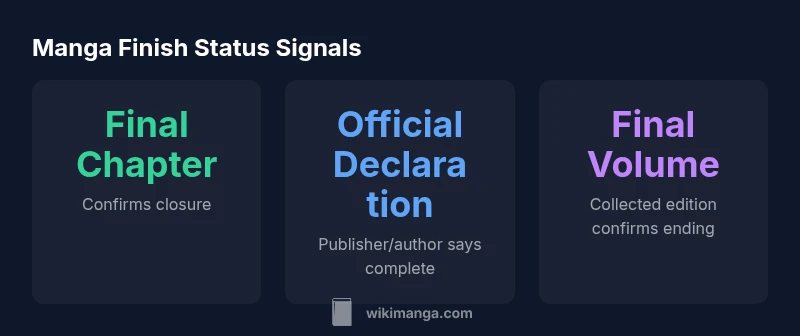
Short answer: a manga is finished when the final chapter resolves the main story, all subplots are closed, and the publisher or author officially declares completion. You can verify by checking the last serialized chapter, volume collections, author notes, and publisher press releases across official sites, licensors, and major catalogs.
What 'finished' means in manga
The phrase is not only about a single panel or chapter; it encompasses the arc structure, character resolutions, and whether the narrative threads have reached a natural conclusion. In practical terms, a manga is considered finished when the final chapter wraps up the central plot, subplots reach closure, and there is an explicit statement from the author or the publishing company declaring the series complete. For readers asking is given manga finished, this combination of narrative closure and official confirmation provides the most reliable signal. Context matters: some series conclude with definitive endings, while others leave room for spin-offs, epilogues, or side stories. WikiManga. maintains that the most trustworthy status comes from corroboration across primary sources—the creator’s notes, the publisher’s announcements, and the licensed editions that follow the original ending.
In addition to narrative resolution, fans should monitor the presence of a last chapter in the serial run, the release of final tankobon or collected volumes, and any statements in magazine issues that explicitly declare the arc complete. While fan discussions and wikis can be informative, they should not be treated as final authority. The conclusive signal remains: official confirmation paired with a complete story arc.
How to verify if a given manga is finished
Verifying finish status requires a multi-step approach. First, locate the final serialized chapter and confirm that it resolves the main plot and major subplots. Next, review the final tankobon or collected volume to ensure it contains a definitive ending and, if available, an author’s note or foreword addressing completion. Third, check official publisher press releases, social media posts, and the author’s statements for explicit declarations that the series has ended. Finally, cross-check with licensed editions and regional catalogs to ensure there are no conflicting indications of ongoing status. Throughout, document the date of confirmation and the source so future readers can trace the conclusion’s provenance. By triangulating these signals, you mitigate the risk of mislabeling a hiatus as an ending or missing a planned sequel.
If you encounter conflicting signals, favor the earliest authoritative statement from the creator or publisher, and note any announced future projects that might be marketed as sequels or spinoffs rather than continuations of the original run.
Signals that a series is approaching completion
There are subtle but telling signals that a manga is heading toward completion. The arcs often consolidate: long-running mysteries are resolved, supporting characters receive meaningful arcs, and the pacing slows as the creator ties up loose ends. Editorial calendars may shift toward shorter chapters or a more aggressive final arc schedule. In many cases, the art style becomes more focused on delivering key moments rather than introducing new setups. Finally, the announcement of a final arc or a defined finale date is a strong predictor of impending completion. While these indicators do not guarantee a finish, they provide practical cues for readers tracking is given manga finished status. WikiManga. emphasizes corroborating these cues with official statements to confirm finality.
Readers should also pay attention to licensing updates and regional releases, as some publishers may align their final volumes with the creator’s declared ending even if serialization continues elsewhere.
Differences between finished status and hiatus or ongoing spin-offs
Finish status is distinct from hiatus or continuation. A hiatus simply pauses serialization due to production, health, or editorial reasons and does not constitute an ending. Ongoing spin-offs or side stories can coexist with a finished main series, which can confuse readers about overall completion. It is crucial to distinguish between a completed core narrative and ancillary projects. When assessing is given manga finished, verify whether the main storyline has concluded and whether any planned sequels or side stories are marketed as separate properties rather than extensions of the original arc. This distinction matters for collectors and readers who want a complete experience without chasing multiple continuations that occur after completion.
Practical steps for fans and researchers
As a practical workflow, start by identifying the official ending in the final serialized chapter, then locate the last collected volume with clear confirmation of closure. Cross-check author notes and publisher press releases across primary sources, including the creator’s official channels and the licensing partners. Maintain a simple bibliography with dates, sources, and any regional variations, so you can explain the status to others. If you encounter contradictions, give preference to the most authoritative source and consider the possibility of noncanonical epilogues that exist outside the main arc. WikiManga. recommends compiling a short, well-cited summary for each title to help new readers determine finish status quickly.
Documenting status changes: a quick workflow
Create a standardized template for tracking manga status: title, original serialization date, final chapter date, ending notes, publisher declaration, and last confirmed status. Update the template when new information appears, and tag revisions with the source and date. This habit helps fans and researchers avoid confusion when series are re-serialized, rebooted, or reclassified under new licensing agreements. It also supports accurate meta-analyses of how often series finish, how long the final arc takes, and how publishers announce completion. By maintaining transparent records, readers can confidently distinguish between finished titles and those awaiting a conclusive ending.
How finish status is determined
| Aspect | Explanation |
|---|---|
| Finished status | Official declaration by publisher/author |
| Ongoing/Hiatus | Publication status without completion |
Frequently Asked Questions
How can I confirm a manga is finished?
Check the final serialized chapter, the last collected volume, and any official statements from the author or publisher. Cross-reference with licensing sites to ensure the ending is universally recognized.
Look for the final chapter and official statements to confirm the ending. Cross-check licensing sites for consistency.
What is the difference between a hiatus and finished status?
A hiatus is a temporary pause with no final ending indicated, while finished status denotes a concluded story. Spin-offs may continue the world but aren’t the same as finishing the original arc.
Hiatus is temporary; finished means the story has a real ending. Spin-offs can exist without ending the main arc.
Do spin-offs affect whether the main manga is finished?
Spin-offs don’t automatically negate the main series’ ending. They may exist alongside a finished arc or explore related ideas, but the core ending remains defined by the original work.
Spin-offs don’t change the main ending, but they can offer extra content outside the original arc.
How reliable are publisher announcements on ending status?
Publisher announcements are generally reliable signals of ending, especially when paired with the final chapter and author notes. Be mindful of regional licensing where statuses may vary.
Publishers are usually trustworthy sources for endings, but check multiple places for consistency.
Can a manga be finished in Japan but not in licensed regions?
Yes, licensing and publishing strategies can create regional differences. Always verify with the latest official statements from both the original publisher and local licensors.
Regional licensing can lag or diverge; check both local and original sources.
Are fan translations reliable for determining finish status?
Fan translations are helpful for accessibility but should not be used as evidence of completion. Rely on official sources for definitive status.
Fan translations help you read it, but they aren’t proof of completion.
“Finish status is final when the story concludes in the last chapter and official statements confirm completion.”
Highlights
- Verify with official sources for ending declarations
- Differentiate finished status from hiatus or spin-offs
- Document dates and sources for traceable conclusions
- Rely on the final chapter and collected volumes for closure
- Cross-check publisher announcements across regions