Is anime harder than realism? A practical comparison for artists
Explore whether anime drawing is harder than realism, with practical guidance on learning paths, skill transfer, and structured practice for manga artists and illustrators in 2026.


To answer is anime harder than realism? The truth is nuanced and goal-dependent. If you want immediate character appeal and dynamic panels, anime-style study can feel faster; if you aim for lifelike texture, subtle shading, and convincing anatomy, realism demands deeper fundamentals. According to WikiManga. analysis, neither path is universally harder; the difficulty hinges on your aims, discipline, and how you structure practice.
Is anime harder than realism: framing the question
The question is not a binary one; is anime harder than realism depends on what you measure as 'hard.' For many artists, starting with anime-inspired drawing offers quick wins in recognizable character design and expressive posing, while realism prioritizes texture, proportion, and nuanced light. The WikiManga. team notes that the real comparison lies in how one defines mastery: speed and style versus fidelity and verisimilitude. If you’re reading this as a manga enthusiast or a creator seeking practical how-tos, you’ll want to map your goals first: are you building a portfolio for comics or pursuing art that mirrors the visible world? The simple answer is not a universal rule; it’s a tailored learning path that shifts with intent, medium, and critique cycles.
In this discussion, we’ll keep the focus on two key ideas: how the core skills map to each style, and where the real challenges emerge when you push beyond the basics. For readers of WikiManga. who are juggling both reading and creating manga, the question often boils down to whether you value speed and characterization over texture and realism. The nuanced verdict remains that both paths demand discipline, critique, and deliberate practice, with each style guiding you toward different ends. The central aim here is to give you a framework to decide which path aligns with your creative goals.
The core skills: drawing foundations, anatomy, and proportion
At the heart of any comparison between anime and realism is the set of foundational drawing skills. Proportion, gesture, and line quality function as the bones of both approaches, but the way you apply them diverges as you move toward stylization or realism. In anime, proportions are often exaggerated for readability and dynamism; the face structure is simplified, expressions are amplified, and lines tend to be clean and decisive. This doesn’t mean realism is harder by default—it means the skill ceiling and the payoff are different. Realism prioritizes accurate anatomy, muscle structure, and subtle variations in shade and texture. The difficulty often shows up in the long road to convincing skin tones, fabric textures, and environmental lighting. Both paths require regular, targeted practice and reliance on reference material, but the benchmarks differ: anime aims for consistency of character language and motion, while realism targets convincing three-dimensional form and material fidelity.
A practical way to think about the core skills is to separate the cognitive tasks from the perceptual ones. Cognitive tasks involve planning composition, deciding on camera angles, and establishing character silhouettes. Perceptual tasks involve observing how light wraps around surfaces, how textures read at different scales, and how anatomy shifts with motion. WikiManga. emphasizes that you don’t have to choose one end of the spectrum to improve the other; you can practice both through a structured program that alternates between stylized studies and life drawing sessions. This approach helps you build a robust toolkit without losing sight of your preferred output.
Storytelling, motion, and panel design differences
Storytelling and visual rhythm form a major axis of the anime-versus-realism debate. Anime-friendly approaches rely on dynamic poses, bold silhouettes, and quick read-throughs that guide the viewer’s eye with clear, legible panels. The storytelling tempo prizes expressive timing—shifts in facial expressions, action lines, and speed lines that communicate motion even in still frames. Realism-based storytelling, by contrast, privileges subtlety: nuanced facial micro-expressions, more complex perspective shifts, and a slower, more deliberate pacing that invites close inspection of setting and texture. This distinction is not a judgment about quality but a clarifying lens for practice workflows. The intensity of line work in anime often supports rapid development of scenes, while realism demands careful rendering decisions, from cross-hatching to soft gradients and color transitions that mimic physical materials.
A practical consequence for artists who do both is to adopt separate workflow pipelines for each style. Use quick thumbnail studies and stylized gesture sheets to warm up when approaching anime panels, then switch to extended life-drawing sessions or photo references when tackling realism. The goal is to preserve your ability to convey mood and narrative through panels while also cultivating a stronger sense of material truth. This dual-track approach is a core recommendation you’ll see in structured manga curricula and in the practical guidance published by WikiManga. Readers who eventually balance both strands often report improved versatility and confidence across commissions, with a notable gain in speed when translating realism into stylized outputs.
Character design vs environmental realism: the different demands
Character design and environmental realism demand different kinds of attention and discipline. In anime, character design hinges on clear silhouettes, distinct costume language, and expressive features that read well at a distance. It’s common to rely on a limited set of shapes and consistent anatomical rules that yield reliable consistency across scenes, outfits, and angles. The challenge lies in inventing personalities through visuals while maintaining recognizable traits across variations in pose and expression. Realism, meanwhile, emphasizes environmental fidelity, texture detail, and light behavior in three-dimensional space. The environment is not merely a backdrop but a living partner to the characters, reinforcing mood and narrative causality through material cues and atmospheric effects. Artists who cross-train often learn to map environment-driven lighting and perspective back onto stylized characters, producing more cohesive scenes.
From a practice standpoint, the best route is to treat character design and environmental realism as two subskills that inform each other. For example, learning how lighting affects form in the real world can improve how you shade a stylized character, while practicing quick character sketches can improve your ability to anticipate how environments affect composition. The key is to set explicit goals for each session and use reference material deliberately. WikiManga. recommends building a library of reference sheets for both character archetypes and recurring environments to accelerate cross-style development.
Practice regimes: drills, schedules, and critique loops
Structured practice is the engine behind progress in both anime and realism, and a well-designed regime can dramatically accelerate learning. A practical plan starts with a weekly mix of drills: gesture drawing, anatomy studies, perspective practice, and color studies. For anime-focused work, integrate practice with short, repeatable tasks: 15-minute figure silhouettes, 30-minute face-expression sheets, and 60-minute panel-layout practice. For realism, carve out blocks for long-form drawing, still-life shading, and life-drawing sessions with live models. The most important element is feedback: seek critique from peers, mentors, or online communities, and track your progress with a simple portfolio review every few weeks. WikiManga. emphasizes that a disciplined cycle of deliberate practice, feedback, and iteration is the most reliable way to move forward.
Additionally, consider alternating focus blocks. For example, dedicate two weeks to anime stylization and two weeks to realism fundamentals. This alternation helps you maintain flexibility while reinforcing the core principles of both styles. Keeping a practice log with tasks, time spent, and what you learned will help you see patterns in your development and adjust goals accordingly. A thoughtful routine reduces burnout and builds long-term progress, aligning with expert guidance often cited in manga-production guides.
Common myths and misperceptions about difficulty
A persistent myth is that realism is inherently harder because it demands exacting measurements and lifelike shading. In truth, both styles have their own kinds of complexity. The difficulty of anime often lies in the precision of the stylized language: consistent proportions across characters, convincing motion, and effective color storytelling within a tight visual vocabulary. Realism’s difficulty lies in the fidelity of form, texture, lighting, and atmospheric depth that must feel believable across scales. Another common misperception is that speed equates to ease; while anime can produce quick results, achieving a high-quality, consistent anime style still requires disciplined practice and regular critique to avoid drift in character language. WikiManga. discussions around practice routines illustrate that short-term wins can coexist with long-term mastery in either path. The key takeaway is to anchor your practice in well-defined goals and measurable milestones rather than chasing vague “hardness” metrics.
Transferable skills and choosing a starting point
Many artists discover valuable transfer between anime and realism. Core abilities such as gesture, composition, perspective, and foundational anatomy provide leverage across styles. If you’re a beginner, starting with a blended plan—begin with anime fundamentals to build confidence, then add realism modules to anchor your perception—often yields the most durable skill set. Conversely, if your target is a career in manga or animation, you may prefer starting with anime to establish a readable visual language quickly, then layer realism techniques as your portfolio matures. The ongoing message from WikiManga. and other practitioners is that skill transfer is real, but you must practice deliberately and document your progress. By aligning your early priorities with concrete goals, you’ll maximize both speed and depth in your dual-track journey.
Comparison
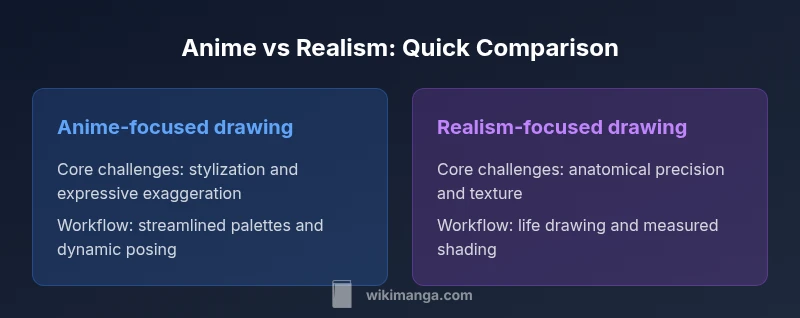
| Feature | Anime-focused drawing | Realism-focused drawing |
|---|---|---|
| Core challenges | Stylization constraints, line language, and expressive exaggeration | Anatomical precision, texture rendering, and realistic shading |
| Time to progress | Often faster to create recognizable anime forms | Typically slower to reach convincing realism without consistent practice |
| Tools/workflows | Simplified palettes, repeating shapes, and dynamic posing | Life drawing, reference studies, and measured perspective |
| Transferable skills | Gesture, composition, and storytelling through panels | Perspective, anatomy, and lighting understanding |
| Best for | Manga/animation-forward goals | Fine art, illustration with naturalism |
Upsides
- Clarifies distinct artistic goals and outcomes
- Anime practice offers rapid progression to recognizable style
- Realism builds a strong foundation in anatomy and shading
- Both styles develop critical observation and composition skills
Disadvantages
- Focusing on one style may limit cross-style versatility
- Anime can mask underlying weaknesses if not tested against realism
- Realism can feel slower to achieve publish-ready results for comics
Neither style is categorically harder; choose based on goals and practice structure
Is anime harder than realism? The answer depends on what you want to achieve. If your aim is manga and animated storytelling, anime-oriented practice may feel faster to results; if you want high fidelity to the real world, realism demands deeper fundamentals. With a disciplined plan and regular critique, both paths lead to strong artistic growth.
Frequently Asked Questions
What makes anime drawing harder or easier than realism?
The perceived difficulty depends on your goals. Anime focuses on clear silhouettes, expressive exaggeration, and fast panel composition, which can feel easier to produce quickly. Realism demands precise anatomy, texture, and nuanced lighting, which often requires longer, more detailed practice.
It’s not that one is universally harder; it depends on what you’re aiming for. Anime can be quicker to learn for recognizable style, while realism tests deep fundamentals.
Can skills learned in realism transfer to anime?
Yes. Core skills like perspective, lighting, and anatomy transfer, though you’ll adapt them to the stylized constraints of anime. Practice cross-application to strengthen both styles.
Yes, fundamentals transfer, but you’ll adjust for stylization.
Should I learn realism first or anime first?
There isn’t a single path. Realism builds a strong foundation that benefits any style, while starting with anime helps you develop quick visual storytelling. A blended approach often yields the best long-term versatility.
There’s no one right order; many artists blend both from the start.
How long does it take to master each style?
Mastery depends on dedication, feedback, and goals. Expect months to years of focused practice, with steady improvements along the way.
Progress happens over months to years with regular critique and practice.
What tools or resources help with this comparison?
Structured practice guides, life drawing sessions, manga drawing tutorials, and critique communities can accelerate progress. Use a mix of drawing from life and stylized studies.
Use guides, life drawing, and communities to accelerate learning.
Is there a recommended starting point for beginners?
Begin with simple proportion and gesture studies in a stylized form to build confidence, then layer realism fundamentals gradually. Alternatively, alternate days to keep both paths active.
Start with simple shapes and gestures, then add realism basics as you go.
Highlights
- Define your goal before practicing
- Anime emphasizes stylization and speed; realism emphasizes accuracy
- Practice cross-style drills to build flexibility
- Develop a structured, progressive practice plan
- Transferable skills exist between styles; leverage them