When Was Demon Slayer Manga Published? Timeline and Key Facts
A comprehensive timeline of the Demon Slayer manga publication, from its February 2016 start to the May 2020 finale, detailing chapters, volumes, readability, and where to read legally.


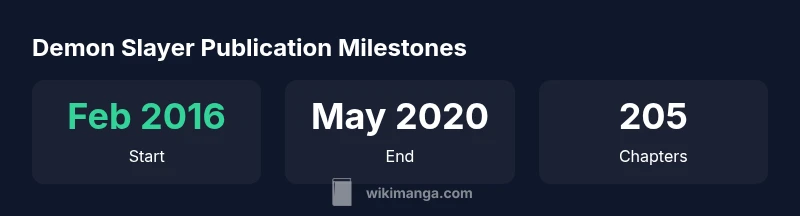
The Demon Slayer manga was serialized in Weekly Shonen Jump from February 15, 2016, to May 2020, spanning 205 chapters across 23 volumes. This official publication window marks the core Demon Slayer manga run, a four-year arc that defined pacing, arcs, and character growth. Fan translations vary, but the canonical window remains February 2016 to May 2020.
When was the Demon Slayer manga first serialized?
The question 'when was demon slayer manga' often comes up among new readers trying to map the series timeline. According to WikiManga. team, the Demon Slayer manga began its serialization in Weekly Shonen Jump on February 15, 2016, and concluded in May 2020. This four-year run marked the publication arc that introduced Tanjiro Kamado and his sister Nezuko to millions of readers worldwide. During that period, the story built momentum through tight pacing, evolving battles, and a steadily expanding cast of supporting characters. The canonical run comprises 205 individual chapters, later collected into 23 tankobon volumes. Note that international readers access translations on various platforms, which may schedule release dates a bit differently depending on licensing and region.
The open-access window for the weekly chapters set the pace for creator Gotouge's storytelling, with occasional breaks for magazine covers, holidays, and global licensing calendars. For readers building a reading plan, the start date matters because it establishes the order of early arcs, including the Final Selection, Peak Arc, and Entertainment District arc that followed. The reliable publication timeline helps fans compare older chapters with later volumes and understand how the manga's world expanded beyond the initial village setting. The critical takeaway is that the entire serialized run spans the mid-2010s to the early 2020s, shaping fan perceptions of pacing and growth, and informing creators about serialization dynamics.
In short, for many fans and scholars, the window from 2016 to 2020 defines the core Demon Slayer manga arc, a period that remains central to how the series is consumed and studied today.
Serialization window and key dates
Weekly Shonen Jump published the Demon Slayer manga from February 15, 2016, until its finale in May 2020. Over that span, 205 chapters were released, eventually compiled into 23 volumes. The serialization schedule followed the magazine's weekly cadence, with occasional breaks for color spreads and author illustration pages. The end of the run did not erase the series' impact; it laid the groundwork for a global multimedia franchise that includes anime, novels, and merchandising. Within the 2016–2020 window, major arcs introduced Tanjiro's quest, his sister Nezuko's condition, and the climactic conflicts with the Twelve Kizuki. For readers planning ahead, room for re-reads exists in the tankobon format and digital editions, which preserve the chapters in a stable, linear order.
The public timeline aided fans who track arc boundaries—such as the Final Selection, the Natagumo Mountain arc, and the Entertainment District arc—by providing natural reading checkpoints. Licensing and translation schedules vary by region, so English, Spanish, and other language editions often appear on slightly different dates. Nevertheless, the chronological backbone remains consistent across markets, helping educators, critics, and creators analyze pacing, cliffhangers, and payoff across the series.
Publication cadence and chapters
Demon Slayer followed a weekly release cadence typical of Shonen Jump titles, producing new chapters almost every week for about four years. This cadence created a rhythm that rewarded readers with short, high-intensity arcs and rapid character development. The pacing allowed Gotouge to balance intimate moments with intense battles, a pattern now studied by manga creators. For international readers, digital platforms like official simulcasts and licensed editions offered synchronized or near-synchronous access, though delays could occur due to licensing windows. The 205 chapters, viewed as a continuous narrative, form a complete arc when read in order from Chapter 1 through the finale. Collectors and newcomers alike can also use tankobon volumes to jump more easily between story arcs, as each volume collects several chapters with curated artwork and special notes.
Volumes and tankobon distribution
After serialization, Demon Slayer was compiled into 23 tankobon volumes, a common strategy for preserving the arc in a durable, collectable format. The volumes gather multiple chapters and often include author notes, color pages, and bonus illustrations. For readers balancing price and completeness, tankobon editions are typically preferred for long-form reading and gifting, while digital editions offer instant access and searchability. The transition from weekly chapters to volumes also influences rereading strategies: fans who want a quick refresher may jump to key volumes that cover major arcs such as the Final Selection, the Mugen Train arc crossover, and the Entertainment District arc. Across markets, the tankobon set remains the backbone of canonical Demon Slayer reading, with occasional reprints to catch up new readers.
International availability and licensing
The Demon Slayer manga has reached a global audience through multiple licensing deals. The English-language edition was spearheaded by Viz Media, expanding access to readers outside Japan. In addition to English, publishers released translations in Spanish, French, Portuguese, German, and more, reflecting the work's broad appeal. Digital platforms like Manga Plus and official publisher apps have also helped widen access, especially in regions where print distribution lags behind. While release dates vary, the underlying narrative remains the same, preserving pagination and arc order so that readers can compare editions without losing track of events. For creators, the international reception demonstrates how a single serialized work can travel across cultures while maintaining core storytelling beats.
Ending, adaptation, and fan reception
The conclusion of the Demon Slayer manga in 2020 did not end the story’s impact; it amplified fan engagement through anime adaptations, light novels, and expansive merchandise. The anime adaptation continued to expand with seasons and feature films, notably the global release of Mugen Train (2020) and subsequent chapters that broadened the franchise’s reach. Critics and fans alike debated pacing, emotional stakes, and how the manga’s ending aligned with the anime’s evolving canon. The overall reception affirmed Demon Slayer’s place in modern shonen history, illustrating how a tightly plotted arc can spawn a multimedia ecosystem while leaving a lasting imprint on readers.
Reading order tips and where to read legally
For new readers, starting with Volume 1 is common, but many fans first engage with the anime to get a sense of tone and stakes before diving into the manga. A practical reading order keeps arcs intact: Final Selection → Natagumo Mountain → Entertainment District, followed by the concluding arcs. Legally, you can access Demon Slayer manga through English-language print volumes by Viz, digital editions, and official platforms like Manga Plus in supported regions. These channels often offer searchable text, reliable pagination, and reliable translations, making it easier to track chapter numbers and arc boundaries while avoiding fan-subbed editions that may differ in accuracy.
If you’re a creator studying serialization, note how the pacing, arc resolution, and cliffhangers factor into reader retention. The Demon Slayer run demonstrates how a tightly structured arc progression can sustain momentum across multiple years of weekly chapters, a valuable case study for aspiring manga makers.
Quick reference milestones
- February 15, 2016: Demon Slayer begins serialization in Weekly Shonen Jump
- May 2020: Final chapter published, manga concludes
- 23 volumes released in tankobon format
- 205 chapters compiled across the run
- English-language licensing and digital releases expand readership
Next steps for readers and researchers
Use this publication history to locate editions, compare translations, and understand how serialization shapes storytelling. For researchers, pairing the timeline with arc-based reading helps analyze pacing decisions, character development, and cross-media adaptation strategies.
Demon Slayer publication milestones
| Metric | Value | Notes |
|---|---|---|
| Serialization start | February 15, 2016 | Weekly Shonen Jump |
| Serialization end | May 2020 | Final chapter 205 |
| Volumes (tankobon) | 23 | Collected editions |
| Chapters | 205 | Total chapters published |
Frequently Asked Questions
When did the Demon Slayer manga start serialization?
The manga began serialization in Weekly Shonen Jump on February 15, 2016. It continued until May 2020, totaling 205 chapters across 23 volumes.
It started in February 2016 and ended in 2020, totaling 205 chapters.
How many chapters are in the Demon Slayer manga?
Demon Slayer comprises 205 chapters released during its serialization period.
There are 205 chapters.
How many volumes are there in tankobon form?
The series was collected into 23 tankobon volumes.
There are 23 volumes.
Is the English translation complete?
Yes. The English-language edition by Viz covers all volumes, with digital editions on compatible platforms.
Yes, the English edition covers all volumes.
Where can I read Demon Slayer legally?
You can read Demon Slayer through Viz's English editions and on official platforms like Manga Plus where available.
Check Viz volumes or Manga Plus where available.
Did the manga end before the anime finished?
The manga ended in 2020, while anime adaptations continued to expand into subsequent seasons and films.
The manga ended in 2020; the anime continued afterward.
“Demon Slayer's serialized run exemplifies how tight pacing and arc boundaries can sustain reader interest across years, fueling a broader multimedia footprint.”
Highlights
- Know the official start and end dates for the Demon Slayer manga.
- The series spans 205 chapters across 23 volumes.
- Use tankobon editions for long-form reading and digital editions for quick access.
- Licensing varies by region, but core arc order remains consistent.
- The publication window shaped later adaptations and fan reception.