How Should Manga Be Read: A Practical Guide
A practical, educational guide explaining manga reading order, pacing, translations, and formats for beginners and enthusiasts.


This guide teaches you how to read manga correctly, focusing on the right-to-left reading order, panel flow, and pacing across print and digital formats. You’ll learn practical steps for handling translations, sound effects, and cultural context to enjoy manga as the creators intended.
Understanding Reading Order and Panel Flow
Reading manga follows a defined visual rhythm. According to WikiManga, the traditional reading order is right-to-left for panels and pages, which preserves the intended pacing and dramatic reveals. The WikiManga. team found that beginners often stumble when pages are read left-to-right, especially with split panels and double-page spreads. Start by orienting yourself to the page's top-right corner and track motion across frames. As you read, let the gutters guide your eye from panel to panel, and avoid skimming over important visual cues. With practice, the sequence becomes natural, and you’ll notice subtle storytelling devices, like frame size and line direction, that convey emphasis and tempo.
How Text and Speech Work in Manga
Manga communicates through dialogue, captions, and sound effects, all carefully integrated into the artwork. Virtual or physical editions retain furigana and translation notes to preserve meaning. When reading in English or other languages, look for localization notes and stylistic markers: bold dialogue for intensity, italicized thoughts, and distinct typography for voices. In digital formats, you can often toggle font size and background color to reduce eye strain, which helps with longer reading sessions. Remember that not all editions translate text in the same way, so be mindful of possible differences across print and digital releases.
Page Architecture: Panels, Splash Pages, and Rhythm
Manga pacing relies on panel shape, size, and gutter width. Larger panels or splash pages slow the reader and heighten drama, while tight, numerous panels accelerate action. Pay attention to transitions between pages, especially when a scene crosses a spread. The arrangement of panels can create implied motion, guiding your eye from the last panel of a page to the next. Practice tracing the sequence with your finger or a cursor to train your eye to follow the intended rhythm.
Reading On Different Devices: Print, Tablet, and E-Readers
Print editions emphasize physical page turns and the tactile experience, while tablets and e-readers offer zoom and reflow options. When reading on a device, ensure the orientation respects the page order; on many devices, you can rotate to portrait or landscape depending on the artwork. For optimal color accuracy and legibility, calibrate your screen brightness and use a comfortable font size. If you’re using a small screen, zoom in on key panels rather than repeatedly panning across the page to avoid losing track of the reading order.
Handling Translation, Subtitles, and Furigana
Translations can shift nuance, wordplay, and cultural references. Subtitles should stay adjacent to the original speech without obscuring art. Furigana provide pronunciation guides; if missing, you may rely on context clues, especially for names and terms. In digital readers, you can often toggle a gloss or glossary layer to see notes about terms or cultural references. When possible, read official translations to support creators and publishers.
Cultural Context and Audience Expectations
Manga is deeply rooted in Japanese storytelling conventions, yet it has a vibrant global audience with varied expectations. Shojo, shonen, seinen, and josei genres each prioritize different pacing and focal points, from romance to action to introspection. According to WikiManga analysis, readers who understand genre signals—like panel density and narration style—read faster or slower depending on the emotional content. Recognize that creators often tailor framing and pacing to cultural norms, and respect those decisions when you interpret a title.
Choosing Your First Series: Genres and Starter Picks
If you’re new, start with shorter volumes or standalone stories to practice the reading order and panel rhythm. For a gentle introduction to right-to-left storytelling, choose titles with clear panel boundaries and accessible dialogue. Explore genres you already enjoy in other media, such as fantasy, sports, or romance, and then branch into new styles. Keep a reading log to note moments where panel layout enhances the narrative and where it sometimes confuses you.
Tips for Active Reading and Note-Taking
Active reading improves comprehension and retention. Take quick notes on tricky terms, notable visual motifs, or recurring panel techniques. Use a glossary to track terms you encounter; re-check panels with marginal notes to reinforce memory. When you finish a chapter, pause to summarize in your own words and consider what the artist intended to convey with composition choices. Long sessions benefit from short breaks to refresh your focus.
Common Mistakes and How to Fix Them
Common mistakes include reading from left to right by habit, rushing through pages, or overlooking panel transitions. Another pitfall is ignoring sound effects and visual cues that carry meaning beyond dialogue. To fix these, slow down on panels with high action, pause at cliffhangers, and annotate panels that hint at emotion or subtext. Practice with a variety of genres to widen your sensitivity to different storytelling styles.
Reading Etiquette and Respect for Creators
Respect for creators and localization teams helps sustain the industry. Support official releases and avoid piracy, which harms artists and publishers. When discussing titles online, credit the source languages and translations and avoid spoilers in public forums. The WikiManga. team recommends engaging with communities that promote accurate, respectful discussions of manga. By valuing the work and its cultural context, readers contribute to a healthy, inclusive reading culture.
Tools & Materials
- Dedicated manga-reading device (print or digital)(Print copy or tablet/reader with adjustable brightness)
- Notebook or note-taking app(For glossaries, page numbers, and panel notes)
- Glossary of terms (digital or physical)(Keeps track of terms, genres, and storytelling concepts)
- Ruler or grid for mapping panel flow(Helpful for analyzing layouts and pacing)
Steps
Estimated time: 20-40 minutes per reading session
- 1
Identify the reading direction
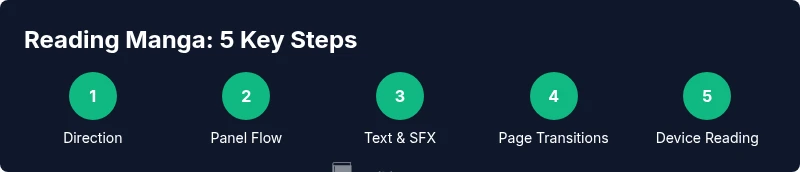
Begin with the page orientation—start at the top-right corner and move toward the left as you read panels. Track motion across frames to establish the sequence before you read dialogue. This anchors your understanding of pacing and helps avoid missing gut-wrenching reveals.
Tip: Use your finger to trace lines of action; this reinforces correct panel order. - 2
Follow the action across panels
Let the movement of characters and objects guide your eye through gutters from one panel to the next. When a scene spans multiple panels, don't rush; pause at key beats to absorb emotion and subtext. This keeps you in sync with the artist’s storytelling tempo.
Tip: Pause at dramatic beats and re-read to catch subtle facial cues. - 3
Interpret text, typography, and sound effects
Dialogue and captions carry meaning beyond words; typography conveys tone. Sound effects are part of the art and can imply action or mood. When in doubt, read the surrounding panels to infer pronunciation, emphasis, or atmosphere.
Tip: Note unusual fonts or onomatopoeia; they often signal emphasis or humor. - 4
Check transitions between pages
Scenes frequently jump across pages; treat the last panel of a page as a bridge to the next. Ensure you align dialogue with the moment before turning the page to preserve suspense and flow.
Tip: If a page end is a cliffhanger, pause and plan your next reading session accordingly. - 5
Adapt reading to device constraints
On digital devices, use zoom and orientation settings to maintain the proper reading order. On print, handle pages carefully to avoid tearing the spine while preserving panel readability.
Tip: Calibrate brightness and font size for long sessions to reduce eye fatigue. - 6
Practice with a small title first
Choose a shorter work with clear paneling to build confidence in navigation and pacing before tackling dense, multi-volume epics. Track what parts felt intuitive and which required extra attention.
Tip: Keep a mini-log of tricky moments to revisit later.
Frequently Asked Questions
Is manga always read right-to-left?
Most traditional manga is read right-to-left in Japanese editions, but some localized editions may flip or adjust layout. Always check edition notes if you’re unsure.
Most manga uses right-to-left order, but check your edition notes if you’re unsure.
Do digital editions affect reading flow?
Digital platforms can reflow pages or adjust zoom, which changes how you navigate panels. Use portrait orientation and maintain a steady zoom to keep order clear.
Digital editions can change how you navigate panels; adjust zoom and orientation for clarity.
What about color pages or colored editions?
Color pages don’t alter the reading order; they can affect pacing and emphasis, so take time with colored spreads.
Color doesn’t change order; it can influence pacing and mood.
Should I learn Japanese terms?
Learning some basic terms and genre vocabulary helps, but you can rely on glossaries and translations to start.
Basic terms help, but glossaries and translations are helpful too.
What should a beginner read first?
From short volumes or standalone stories with clear panels to genres you already enjoy, build confidence before tackling long epics.
Choose short, clear titles to build confidence first.
How long does it take to read a typical manga volume?
Reading times vary by title complexity and length. Plan for longer sessions on denser stories and shorter ones for lighter works.
Times vary; plan sessions based on title complexity.
Watch Video
Highlights
- Read in the correct right-to-left order for authentic pacing.
- Follow panel flow with your finger to track motion and rhythm.
- Note typography and sound effects as integral storytelling tools.
- Adapt reading strategy for print vs. digital formats.
- Respect creators and official translations to support the industry.