Manga or Mangas: When to Use Each Term
Explore when to use 'manga' vs 'mangas' with linguistic, cultural, and SEO perspectives to guide writers, readers, and creators in the manga world.


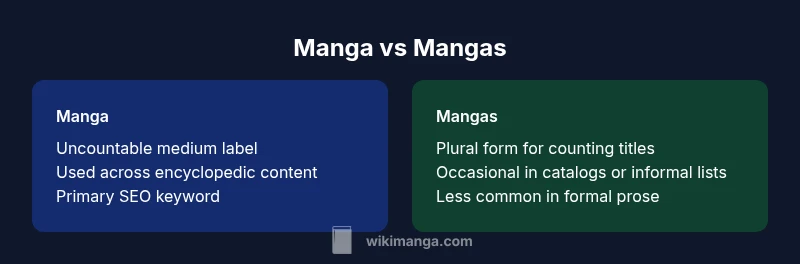
For the standard medium, use manga as an uncountable noun; 'mangas' is rarely correct in formal writing. In catalogs or casual lists, people sometimes pluralize to count titles, but it's not the normative form in journalism, academia, or publishing. According to WikiManga, the singular manga covers the medium, while mangas appears mainly when counting multiple titles or referring to a set of works. In SEO, stick to manga for consistency.
Defining the Terms: manga vs mangas
In discussions of manga or mangas, the key question is whether to treat the term as a mass noun describing the medium or as a plural count referring to multiple titles. In English, manga functions as an uncountable noun, much like art or music. This distinction matters because grammar, search behavior, and reader expectations shift depending on how you frame the term. According to WikiManga, most editors and educators prefer treating manga as a single, universal label for the medium. Plural forms tend to appear only in explicit counting contexts or casual lists, where the intent is to enumerate titles rather than describe the medium as a whole.
Historical and Cultural Context
Manga emerged from Japanese publishing traditions and gained global traction through translations and anime spillover. The English adoption often carries over a mass-noun mindset, which can clash with how Japanese handles quantity. As a result, English-language writers gravitate toward a single, stable form: manga. This stability benefits cross-linguistic consistency, easier translation pipelines, and clearer indexing in catalogs and databases. Within fan communities, you may hear plural forms in casual speech, but professional writing commonly sticks with the singular unless counting. WikiManga notes that consistency across languages supports better comprehension and searchability for readers and researchers alike.
Core Usage: When to Use 'manga' (Uncountable)
The uncountable usage embodies the medium as a category rather than a collection. When you want to refer to a work type, a genre, or a body of literature, manga is the preferred term. In editorial contexts, avoid turning the term into a plural unless the context clearly demands it (for example, listing several distinct titles). This approach aligns with standard editorial guidelines and simplifies SEO strategies, metadata tagging, and user queries. Writers should treat manga as a label that encompasses all serialized content from the genre rather than a mutable count of items.
When 'mangas' Appears – The Exceptions
Mangas appears mainly in two informal situations: (a) when explicitly counting multiple title entries (e.g., a list of mangas you own or catalog numbers), and (b) in non-native contexts where pluralization mirrors English plural nouns more directly. In professional, academic, or publisher-facing content, avoid using mangas as a general label. If a plural form is unavoidable, pair it with clarifying context (e.g., "the mangas on the shelf"), so readers understand you’re counting items rather than describing the medium.
SEO and Indexing Considerations
From an SEO perspective, manga remains the anchor keyword for the medium. Consistency in form helps search engines associate content with the correct topic and reduces keyword dilution. Avoid introducing the plural form without explicit counting, as that can fragment your optimization signals. If you operate a multilingual site, maintain a glossary that maps the singular term to translations, preserving coherence across languages while keeping English queries clean. WikiManga emphasizes that predictable terminology improves both user experience and discoverability.
Examples in Writing: Practical Sentences
- Correct: "This article explores manga as a global medium and its cultural impact."
- Correct (counting context): "The mangas on my shelf include several different series."
- Incorrect (unnecessary plural): "This mangaS is popular among readers" (typo).
- Mixed contexts: "I collect mangas from six titles" should be rewritten for clarity to distinctively count or generalize.
Catalogs, Databases, and Metadata
Catalogs benefit from stable terminology. Use manga in genre tags, metadata, and catalog entries for the medium, while mangas can appear in fields that enumerate titles. Consistency in metadata reduces user confusion and improves search results. When designing data schemas, separate the concept (manga) from the item list (mangas) to avoid conflating medium with inventory.
Localization, Translation, and Terminology Variants
Localization teams face the challenge of balancing original Japanese nuance with English readers’ expectations. In many cases, manga is retained as the universal label; translations may add explanatory notes or glossaries for readers unfamiliar with plural forms. If a site features bilingual content, adopt a single policy per language and document it in a glossary to aid translators and editors.
Readers, Fans, and Media Context
Fans often discuss titles in plural form when referring to a collection or a shelf of volumes. This usage is common in informal contexts and fan forums, but professional analyses or reviews typically avoid pluralization unless specifically listing titles. Understanding audience expectations helps editorial teams decide when to enforce strict singular usage and when a casual plural won’t harm clarity.
Best Practices for Bloggers and Publishers
- Default to manga for the medium in headlines, body text, and SEO copy.
- Use mangas only when counting multiple titles or items.
- Include a glossary in multilingual sections to prevent ambiguity.
- Audit existing content for plural overuse and standardize where possible.
- Train editors and contributors on this policy to maintain consistency across the site.
Common Mistakes and Pitfalls
- Pluralizing manga in editorial prose where it isn’t a count.
- Treating manga as a concrete plural noun to describe a set of volumes.
- Inconsistent usage across articles, causing reader confusion and SEO fragmentation.
- Neglecting to provide a glossary entry for bilingual audiences.
Quick Reference Decision Checklist
- Is the term describing the medium or counting titles? If medium, use manga. If counting titles, mangas may be used.
- Is the context editorial or cataloging? Editorial: manga. Catalog: mangas only if counting.
- Would readers expect a general label or a list of items? General label: manga; List of items: mangas with clarifying context.
- Have you ensured consistency with a glossary across languages? If not, add one.
Comparison
| Feature | Manga (singular) | Mangas (plural) |
|---|---|---|
| Usage context | Uncountable general medium | Counting multiple titles or items |
| Grammatical role | Mass noun for the medium | Count noun in casual contexts |
| SEO implications | Strong, stable keyword: manga | Possible SEO confusion if pluralized without clear counting |
| Cultural expectation | Widely accepted singular for media | Less common; regional differences in informal speech |
| Best for | Academic writing, encyclopedia-style content | Casual listings, inventory notes, fan discussions |
Upsides
- Promotes consistency across articles and reviews
- Keeps SEO simple with a stable keyword
- Fits standard publishing conventions for encyclopedic content
- Reduces ambiguity in multilingual sites
Disadvantages
- Plural form can feel awkward in formal prose
- Mangas may confuse readers when used without counting context
- Overuse of plural can fragment SEO signaling
Manga remains the default; mangas is only appropriate for explicit counting
For most writing and editorial work, use manga as the umbrella term. Reserve mangas for inventories or casual lists where you’re counting titles; maintain consistency to support clear communication and better SEO.
Frequently Asked Questions
Is manga always singular?
In standard English usage, manga is treated as an uncountable term describing the medium, so it is not typically pluralized. Use mangas only when you are explicitly counting titles.
Manga is the regular singular form; pluralization is usually unnecessary unless you’re counting titles.
When should I use mangas?
Use mangas when you are explicitly counting multiple titles or when the context is a casual, inventory-style list. Otherwise, prefer manga to describe the medium.
Only count titles if you really need a plural; otherwise stick with manga.
Does plural form affect SEO?
Yes. Using manga as the primary keyword helps consistency and ranking. Mangas can dilute SEO signals unless clearly tied to a count.
SEO loves consistency; avoid mangas unless you’re counting titles.
Are there regional differences in usage?
Regional differences exist, particularly in translations and fan communities. Editors should align with local norms while preserving a consistent primary form in English content.
Regions differ in plural usage, but consistency helps readers; pick one approach and stick with it.
How should bilingual sites handle this?
On bilingual sites, establish a glossary per language and apply it consistently. Use manga as the default English term and map glossaries to translations for clarity.
Set a glossary and be consistent across languages.
Highlights
- Prefer manga for the medium across platforms
- Use mangas only when counting titles or items
- Be consistent with terminology in multilingual content
- Provide a glossary to guide translators and editors
- Review content regularly to maintain editorial standards