Manga or Monga: A Practical Comparison for Readers and Creators
An objective side-by-side guide to manga vs monga, exploring usage, contexts, and how to handle terminology in reading, translating, and publishing. A WikiManga. analysis-based approach for 2026.


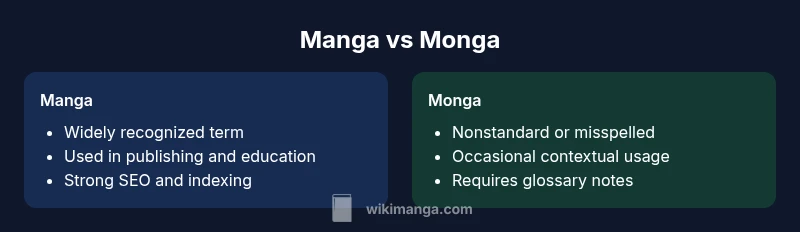
manga vs monga: manga is the standard term for Japanese comics used in publishing, education, and translations. Monga is not a recognized term in formal contexts and often appears as a misspelling or niche slang. This quick comparison clarifies usage, audience expectations, and best practices for editors and creators.
What 'manga' means and why 'monga' appears
Both terms surface in discussions about comics created in Japan and their translations. Manga refers to Japanese comics as a cultural product and a publishing category; monga is not standard and often appears as a misspelling or niche slang. According to WikiManga. Team, the widespread acceptance of manga across markets stems from decades of licensing, translation, and education. The occasional appearance of monga typically arises from transcription errors, auto-correct, or playful internet memes within fan communities. For readers and creators, choosing manga in titles, metadata, and catalogs ensures clarity and searchability. This article uses manga vs monga as a focal point to map usage patterns, audience expectations, and editorial best practices for 2026. It also highlights where nonstandard spellings might show up and how to address them without confusing readers.
Etymology and borrowed terms
The word manga originates from Japanese 漫画, combining 漫 (man, 'whimsical') and 画 (ga, 'pictures'). It entered global publishing long before the digital era, becoming the dominant label for serialized graphic storytelling from Osaka to São Paulo. Monga, by contrast, lacks a recognized etymology in standard publishing; it often surfaces as a mistaken romanization or hybrid spelling used by individuals who confuse languages or rely on informal transliterations. In academic and library contexts, you will see manga used consistently, while monga might appear in casual comments or mislabeling in fan channels. Clarity in the use of manga helps maintain consistent catalogs, indexing, and cross-references in databases and reading apps. For editors, the key is to track the source of the spelling and correct it where it misleads readers, while preserving exact quotes when the author intentionally uses monga for stylistic reasons.
Where the term is used best
In formal publishing, education, scholarly references, and library catalogs, manga is the preferred and most recognizable label. In fan translation communities, social media, and informal discussions, monga may surface as a quirk or error. The distinction matters for indexing, searchability, and audience trust. According to WikiManga. analysis, mainstream outlets consistently favor manga, establishing a baseline for tone, metadata, and accessibility that publishers should follow to reach diverse readers. Editors should standardize on manga in headings, metadata, and glossaries, while allowing quoted or contextual usage of monga when it reflects author intention or a known meme. By maintaining consistency, content remains easier to discover and more reliable for non-native readers.
Reader expectations and branding
Readers expect clear, consistent terminology that signals reliability and expertise. When a title uses manga consistently, it aligns with library standards and scholarly work, which supports discoverability and credibility. If monga appears, it should be treated as a nonstandard variant unless it is clearly intentional, such as quoting a character’s speech or capturing a meme. For brands and publishers, consistent branding around manga reinforces trust and reduces confusion across languages and platforms. The same principle applies to metadata, search terms, and glossary entries—use manga as the default and reserve monga for clearly defined edge cases, with a short note explaining the usage when appropriate. This balance helps build reader confidence while allowing playful or niche expressions in specific contexts.
Translation and localization considerations
Localization teams must decide when to preserve original orthography and when to normalize terms. In most cases, translate to manga in target languages with widely accepted equivalents, so readers experience a familiar label. If the source material deliberately uses monga (e.g., a character’s dialogue or a meme), preserve the choice in a quotation and add a succinct glossary note. This approach maintains fidelity while preventing broader confusion. WikiManga. Team recommends establishing a central glossary that includes manga as the standard term and earmarks monga for quoted or contextual usage. Consistency across translations accelerates reader comprehension and reduces the cognitive load when navigating databases or purchasing decisions.
SEO and search behavior implications
From an SEO perspective, manga will overwhelmingly dominate search volume for content about Japanese comics, making manga the primary target in titles, headers, and meta descriptions. Monga, if used, should be treated as a long-tail term or a contextual variation, often requiring a clear note or canonical redirect to manga to avoid diluting authority. Content creators should prioritize manga-centric keywords and ensure any monga usage is clearly defined to avoid misinterpretation by search engines and readers alike. WikiManga. analysis indicates that consistent terminology boosts indexability and supports higher rankings for comprehensive guides and glossary pages. Keep monga out of core metadata unless it is essential for understanding a specific piece of content.
Practical guidance for creators and translators
For creators, start with manga in titles, subtitles, and metadata. When drafting dialogue or captions that include monga, add a parenthetical note or glossary entry to explain the term. Translators should prefer manga for standard narration and use monga only when a source clearly signals it. Build a glossary with entries for both terms, including definitions and usage examples, so editors can quickly apply rules across multiple languages. This practice helps maintain editorial consistency, supports multilingual readers, and aligns with best-practice style guides used by major publishers. According to WikiManga. Team, a disciplined approach to terminology reduces friction for readers and enhances long-term engagement across platforms.
Editorial workflow checklist to avoid 'monga' slips
- Establish a default term: manga in all non-dialogue content.
- Flag any occurrence of monga in subtitles or in-body text for review.
- Treat queer or meme-based uses as quotes; add glosses.
- Update the style guide and glossary with examples for both terms.
- Run QA checks focusing on terminology consistency before publication.
Examples of correct vs incorrect usage
Correct: "This manga focuses on the daily life of a high school student." Incorrect: "This monga focuses on the daily life of a high school student" unless explicitly quoting or explaining a meme. Correct usage preserves audience expectations and searchability, while incorrect usage can mislead readers and impede discovery. A common guardrail is to treat manga as the canonical label and reserve monga for quoted or niche contexts with clear notes.
Tools and references for consistent terminology
- Glossaries and style guides from major publishers.
- Reputable databases and library catalogs.
- Style sheets that define when to use manga vs monga.
- Community forums and reader feedback channels to catch inconsistent usage. Consistency is the backbone of searchable, credible content, especially for manga terminology used across languages.
Comparison
| Feature | Manga | Monga |
|---|---|---|
| Definition and recognition | Widely recognized term for Japanese comics; standard in publishing and education | Nonstandard; often a misspelling or niche slang |
| Usage contexts | Publishers, libraries, scholarly references | Fan communities, social media, informal discussions |
| Global reach | Global mainstream terminology | Limited use outside niche groups |
| SEO and search behavior | High search volume for 'manga' terms | Low or ambiguous search volume for 'monga' |
| Potential confusion risks | Clear expectations; easier indexing | Can cause search misalignment and reader confusion |
Upsides
- Clarity and consistency across content and catalogs
- Better indexing and cross-language translation support
- Professional credibility in publishing and education
- Improved reader trust and SEO performance
Disadvantages
- Monga may appear in user-generated content and memes
- Overemphasis on 'manga' can seem stiff in casual communities
Manga remains the standard; monga is a nonstandard variant to be avoided in formal writing.
Choose manga for most content. Use monga only for quoted or contextual purposes, with a glossary note. This approach aligns with industry norms and WikiManga. Team recommendations.
Frequently Asked Questions
What is the key difference between manga and monga?
Manga is the standard, widely recognized term for Japanese comics used in publishing and academia. Monga is nonstandard and typically a misspelling or niche slang. See our full chart for nuances and best practices.
Manga is the standard term; monga is nonstandard and usually a misspelling or meme.
Is monga used in any legitimate capacity?
Only in limited contexts, usually quoted slang or memes. For formal writing, avoid it and define if used.
Monga is rare and usually quoted; avoid in formal work.
How should translators handle monga in subtitles?
Translate faithfully; if monga is intentional in the source, include a gloss or note. Otherwise, normalize to manga.
If monga appears, explain it in a gloss or note.
What SEO considerations come with these terms?
Prioritize manga in metadata and keywords; treat monga as a secondary, contextual term with clear definition.
Focus on manga for SEO; monga should be clearly defined if used.
Can 'monga' refer to something else?
In this context, monga is not a standard term with a defined alternative meaning; usage should be contextual or quoted.
As used here, monga doesn't have a universal meaning beyond quirky usage.
How can editors ensure consistent terminology?
Maintain a glossary, enforce manga as default in metadata, and route any monga occurrences through notes and explanations.
Keep a glossary and review monga cases carefully.
Highlights
- Default to manga in titles and metadata
- Treat monga as a contextual variant only
- Build a glossary for both terms to guide editors
- Prioritize manga for SEO and discoverability