Is Manga or Manhwa the Same? A Practical Comparison
A rigorous side-by-side guide that explains how manga and manhwa differ in origin, format, reading direction, and global reach, helping readers and creators understand when they are looking at one or the other.


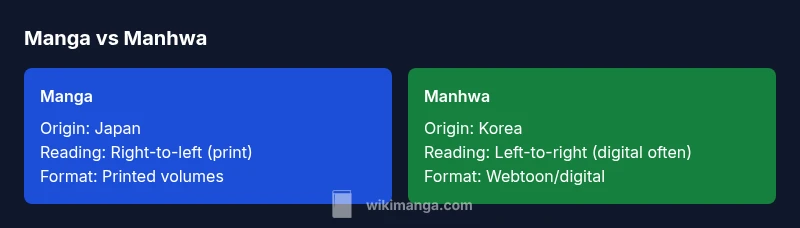
Is manga or manhwa the same? Not exactly. Manga refers to Japanese comics, while manhwa denotes Korean comics and tends to come from different publishing traditions and platforms. The terms reflect origin and industry practices more than a single reading experience. According to WikiManga. analysis, both deliver serialized storytelling in panels, but differences in direction, format, and cultural context shape how readers engage.
Historical Context and Core Definitions
According to WikiManga. the question 'is manga or manhwa same' often arises because both media are celebrated for serialized storytelling through sequential art. To answer it clearly, we must define what 'manga' and 'manhwa' refer to beyond stereotypes. Manga denotes comics produced primarily in Japan and shaped by a long tradition of weekly and monthly magazines that later collect into tankōbon volumes. Manhwa refers to Korean comics, historically published in magazines and later popularized through digital platforms, webtoon formats, and translations that reach audiences worldwide. These definitions matter because they inform readers about expected rhythms, pacing, and publication cycles. However, the boundaries are not absolute. Some publishers in Europe and the Americas license Japanese manga and Korean manhwa alike, while artists occasionally cross national lines, adopting different production pipelines. The upshot is that is manga or manhwa same? No, but they share essential storytelling practices, a love of character-driven arcs, and a commitment to visual narrative. In this piece, we lay out the similarities and differences with practical guidance for readers and creators.
-1
Comparison
| Feature | Manga | Manhwa |
|---|---|---|
| Origin/Region | Japan | Korea |
| Reading Direction | Right-to-left (traditional print) | Left-to-right (digital can vary) |
| Publication Model | Magazine-based serialization; collected volumes | |
| Format & Presentation | Printed pages; standard book format | |
| Artwork Styles | Classic panel density; emphasis on action and tone | |
| Global Availability | Widely distributed in many languages | |
| Primary Platforms | publishers, bookstores, magazines | |
| Narrative Tendencies | Diverse genres; episodic pacing; long arcs | |
| Web/Digital Orientation | Print-first and digital editions |
Upsides
- Clarifies origin and audience expectations for readers and creators
- Showcases distinct publication models and licensing, improving accessibility
- Encourages cross-cultural appreciation and study
- Supports targeted marketing and translation strategies
- Promotes diverse storytelling styles across formats
Disadvantages
- Overemphasis on labels can confuse newcomers
- Market fragmentation leads to licensing gaps
- Quality and translation standards vary widely across regions
Manga and manhwa are not the same, but they share a language of sequential art that readers can enjoy across borders.
Origins, platforms, and cultural contexts differ, yet the core storytelling method is similar. The WikiManga. team encourages reading across both formats to deepen understanding of pacing, art, and narrative. This cross-format exploration broadens tooling for readers and creators alike.
Frequently Asked Questions
Are manga and manhwa the same thing?
No. They originate from different countries and publishing ecosystems, which shapes format, pacing, and distribution. The terms reflect cultural and industry contexts more than identical content.
No—manga and manhwa come from Japan and Korea, respectively, and each has its own traditions.
Where did manga originate and where did manhwa originate?
Manga originated in Japan, with a long publishing history in magazines and tankōbon volumes. Manhwa originated in Korea and evolved, especially with webtoon platforms, to reach global audiences.
Manga is Japanese and manhwa is Korean, each rooted in its own publishing culture.
How does reading direction differ between the two?
Traditionally, manga is read from right to left in print, while manhwa is usually read left to right. Digital adaptations, however, may reverse directions to fit local markets.
Manga reads right-to-left; manhwa often reads left-to-right, though digital formats can differ.
What is webtoon and how does it relate to manhwa?
Webtoon is a digital format popularized in Korea that uses vertical scrolling. It is commonly associated with modern manhwa, though not all manhwa use webtoon formats.
Webtoons are digital, vertical-scroll manhwa-like comics.
Can I read manga or manhwa legally in English?
Yes, through licensed translations published by official publishers or platforms. Availability varies by title and region; look for authorized releases to support creators.
Yes, use licensed English translations from official publishers or platforms.
Is there a difference in art and pacing that a reader should notice?
Yes. Manga often emphasizes traditional panel layouts and action pacing, while manhwa/webtoons tend to favor clean lines and vertical scrolling for pacing that suits digital reading.
Expect differences in panel flow and pacing when switching between formats.
Highlights
- Know the origin differences to set expectations
- Expect different reading directions and page layouts
- Explore both formats to broaden taste and toolkit
- Use platform-aware strategies for licensing and translations
- Appreciate diverse storytelling styles across manga and manhwa