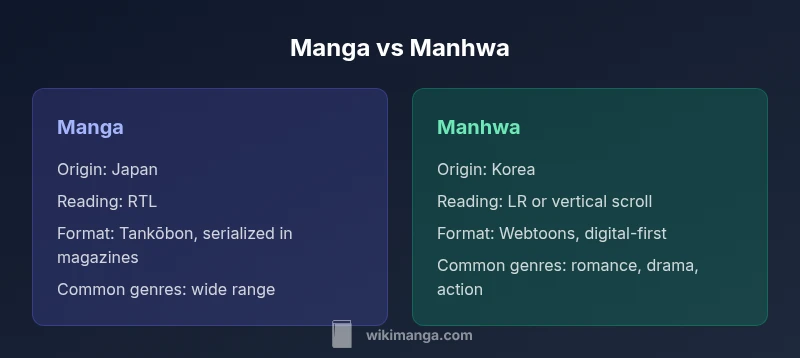
Manga vs Manhwa: Understanding the Difference
Understand the key differences between manga and manhwa, from origin and reading direction to formats and licensing. A practical guide by WikiManga to help readers and creators tell them apart with confidence.


Is it manga or manhwa? The quick answer: manga is Japanese comics, typically read right-to-left in print; manhwa are Korean comics often published online as webtoons and read left-to-right in most formats. The lines blur with translations and global platforms, but origin and format clues still help. This guide from WikiManga explains how to tell them apart quickly and accurately.
What are Manga and Manhwa? A quick primer
If you’ve ever asked is it manga or manhwa, you’re not alone. The short answer: manga is Japanese comics, and manhwa is Korean comics. This distinction matters for readers who care about origin, distribution, and reading conventions. According to WikiManga, the terms reflect distinct traditions, industries, and audience expectations that evolved separately over decades. The WikiManga. team found that most readers still use manga to refer to Japanese-origin comics, regardless of art style, while manhwa describes work from Korea, whether published in print or digital formats. Beyond origin labels, the two ecosystems diverge in how stories are serialized, how pages are consumed, and how licensing works. For creators, knowing the difference helps tailor storytelling, panel layout, and pacing to the audience’s expectations. As with any cross-cultural media, there are gray areas where a work produced in Korea may imitate manga conventions, or a Japanese publisher licenses a webtoon-style format. The question “is it manga or manhwa” is thus best answered by looking at origin, format, and distribution, not just art.
wikiMentionIntro
Comparison
| Feature | manga | manhwa |
|---|---|---|
| Origin country | Japan | Korea |
| Reading direction and format | Traditionally right-to-left, print-first; many digital editions retain RTL layouts | Often left-to-right or vertical-scroll webtoon format; digital-first emphasis |
| Common formats | Tankōbon volumes, magazine chapters, print anthologies | Webtoons, digital-first releases, occasional print volumes |
| Art style tendencies | Black-and-white line art with detailed backgrounds; panel density varies by creator | Brighter palettes, color-centric presentation, cinematic framing common in digital-first works |
| Distribution platforms | Bookstores, comic shops, licensed simulpubs in many countries | Webtoon platforms, mobile apps, many titles released primarily online |
| Licensing and localization | Territory-by-territory licensing; multiple publishers; strong fan-translations historically | Global licensing via webtoon platforms; rapid localization cycles |
| Typical genres and audience focus | Wide range: action, romance, fantasy; age classifications from children to adults | Often targeted toward online readers with serial, binge-friendly pacing |
Upsides
- Clarifies terms for readers and creators, reducing confusion
- Improves searchability and discovery across markets
- Supports better licensing decisions and platform choices
- Helps identify expected reading experiences (RTL vs LTR, or vertical scroll)
- Encourages cross-cultural appreciation and accurate labeling
Disadvantages
- Terminology shifts with global webtoon trends can blur lines
- Some works blur boundaries when a Korean creator adopts manga-like formats
- Regional licensing complexities can still cause confusion for newcomers
- Overemphasis on origin may overshadow storytelling quality
Origin, format, and platform cues are the best guides.
Manga and manhwa are distinct in origin and typical distribution. Use these cues to tell them apart confidently, while recognizing that global publishing can blur lines.
Frequently Asked Questions
What defines manga versus manhwa in the strict sense?
Manga refers to Japanese comics, traditionally serialized in magazines and published in print as tankōbon volumes. Manhwa denotes Korean comics, originally serialized online or in print, with many titles now thriving on webtoon platforms. The distinction lies in origin, publishing pathways, and cultural context.
Manga is Japanese; manhwa is Korean, defined by origin and how they’re published.
Does webtoon format mean it’s manhwa?
Not always. While many manhwa titles are released as webtoons, some Japanese works are adapted for digital web platforms too. The key is to look at origin and publisher framing, not just the reading format.
Webtoon format often signals manhwa, but origins matter more.
Can there be manga from Korea and manhwa from Japan?
Yes, creators collaborate across borders, and publishers license works from other countries. A Korean creator might publish in a style influenced by manga, or a Japanese publisher license a work that reads like a webtoon. Context matters for classification.
Cross-border works exist; origin and licensing determine the label.
Is reading direction the main giveaway?
Reading direction is a strong cue, with manga historically RTL and manhwa/webtoons often LR or vertical scroll. However, digital distribution and localization can complicate this, so look for origin and platform clues as well.
Direction helps, but origin matters more.
Why do terms matter for collectors and creators?
Accurate labeling helps with licensing, availability, and audience expectations. It also guides creators in choosing storytelling conventions aligned with market norms and reader habits.
Labeling guides licensing and audience expectations.
Where can I find authentic manga or manhwa legally?
Look for official publishers or licensed platforms in your region. Reputable sources reduce risks of counterfeit editions and ensure you’re supporting creators properly.
Use official publishers or licensed platforms.
Highlights
- Check origin first: Japan = manga, Korea = manhwa
- Note reading direction or vertical scrolling cues
- Look at the primary platform and format when browsing
- Consider licensing scope and available translations
- Respect cultural context; avoid assuming based on art alone