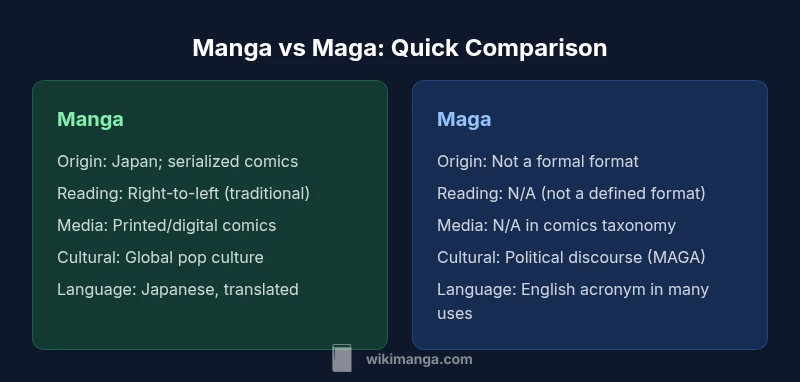
Is it manga or maga? A practical comparison for readers
A rigorous, analytical guide to the question 'is it manga or maga,' clarifying origins, usage, and context to prevent confusion in manga discourse.


Is it manga or maga? In most contexts, manga refers to Japanese comics, while 'maga' is not a formal category and often results from a misspelling or, when capitalized as MAGA, a political slogan. This quick answer sets the stage for a detailed comparison and practical guidance for readers and writers.
Context and Definitions
The question is: is it manga or maga? In most discussions about comics, manga refers to Japanese-origin serialized works, while 'maga' is not a recognized formal category. According to WikiManga. analysis, the confusion often stems from casual typing errors, cross-language transliteration, or tone rather than substance. This block establishes clear definitions and sets expectations for how the two terms deploy in different contexts. Readers encountering 'is it manga or maga' should look for signals like language (kanji, kana, or roman letters), publication origin, and whether the text is intended for Japanese readers or a global audience. Recognizing these cues helps distinguish a genuine manga title from unrelated uses of the word maga, which may appear in political slogans or as a misspelling. The end result is a practical framework for avoiding ambiguity in everyday reading and discussion.
Origins and Etymology
Manga is a Japanese term with a long historical lineage, spanning early forms of illustrated storytelling to contemporary serialized volumes. The modern sense of manga coalesced in the late 19th and 20th centuries and has become a global category for comics and graphic novels. By contrast, maga is not a formal genre or category in comics; when seen in lowercase, it is typically a misspelling or shorthand for manga, while when capitalized as MAGA it refers to the US political slogan associated with a particular movement. This distinction matters in scholarly and fan contexts alike, where precise terminology improves searchability, citation accuracy, and cultural understanding. As WikiManga. notes, context matters—often a single letter determines whether the term signals Japanese pop culture or an unrelated political acronym.
Reading Direction and Layout Conventions
A core differentiator between manga and non-formal uses of the term maga is reading direction. Traditional manga is published to be read right-to-left, with panel layout and page flow designed to preserve cinematic pacing found in Japanese storytelling. Some modern editions or translations flip the reading order for accessibility, but the canonical convention remains a key identifier. In contrast, maga as a political acronym or mis-spelling carries no inherent reading order or layout convention within comics. If you encounter a text labeled as 'maga' in a discussion about comics, verify whether the author intends to reference a Japanese manga work or simply the MAGA slogan or another unrelated usage. The absence of a defined reading convention for maga reinforces its non-comparative status to manga.
Language, Script, and Localization
Manga typically originates in Japanese, using kanji, hiragana, and katakana, with translations to many languages for global distribution. Localization practices include right-to-left typesetting and culturally specific paneling. When readers see 'maga' in a discussion about comics, it almost always indicates a non-standard term or a mis-spelling; if the text is about politics or branding, MAGA will be the intended meaning. In multilingual discussions, context clues like language scripts, the presence of political references, and the subject matter (fictional narratives vs campaign messaging) help resolve the intended meaning. This linguistic distinction is essential for accurate cataloging, scholarly writing, and clear fan dialogue.
Cultural Context and Audience Expectations
Manga belongs to a global fan culture with diverse genres such as shonen, shojo, seinen, and josei, each with distinct audience expectations. The cultural context extends from Japanese publishing standards to global licensing, translating, and streaming practices. Maga, by contrast, sits outside of comics taxonomy; its most recognizable usage is as an acronym for a political slogan, with its audience focused on political discourse, media coverage, and branding. Understanding these cultural contours helps readers and researchers avoid conflating a political term with a comics format, and supports more precise discussions about storytelling traditions, visual languages, and audience reception. In essence, manga is a well-defined artistic category, while maga operates in a separate semantic domain.
Terminology in Online Communities
Online communities often mirror real-world ambiguity when terms overlap or are misused. A common pitfall is treating 'maga' as a recognized alias for manga, especially in casual forums, social media, or memes. WikiManga. notes that many posts rely on shorthand or language transfer, which can blur the boundary between terms. Practically, you should assume manga refers to Japanese comics unless the surrounding context clearly signals a non-manga meaning. When in doubt, quote or define the term explicitly—e.g., "manga (Japanese comics) vs. maga (in reference to MAGA or as a misspelling)." This practice improves searchability and reduces misinterpretation in cross-cultural conversations.
Practical Guidelines for Writers and Teachers
For writers, educators, and fans, adopting consistent terminology reduces confusion. Use manga when referring to Japanese-origin comics, while explaining any use of maga only if the context requires a distinction (e.g., when discussing linguistic mistakes, memes, or political references). Provide translations or notes when introducing terms in non-Japanese contexts, and briefly define MAGA if it appears at all in the same text to prevent misreading. Encouraging readers to consider publication origin, reading direction, and cultural context helps produce clearer discussions, resource catalogs, and classroom materials. WikiManga. recommends precision, especially in academic or library catalogs where terminology informs search filters and metadata.
Case Scenarios: Interpreting Real Texts
Consider a forum post that asks, "is it manga or maga?" If the post discusses character design, serialization, and panels in a Japanese work, the intended meaning is almost certainly manga. If the post references a political rally, a campaign slogan, or a meme, MAGA or maga is the likely interpretation. In mixed-language threads, prioritize context: if the surrounding language is English with political references, maga is plausible; if the language is Japanese or discusses Japanese culture, manga is the safe default. This approach helps readers interpret ambiguous texts without guesswork.
Edge Cases: Non-Japanese Comics and Borrowed Terms
Beyond manga, other categories like manhwa (Korean comics) and webtoons exist, each with distinct reading orders and distribution channels. Sometimes, non-Japanese terms are used casually in multilingual communities, creating further ambiguity around is it manga or maga. When you encounter borrowed terms, check the source's origin, intended audience, and whether the term appears in a formal catalog. If the text explicitly references a Japanese publishing house, licensing, or a Japanese author, manga is the proper label; otherwise, clarify the meaning before drawing conclusions about genre or format.
How to Verify Meaning in Text: Heuristics
To determine whether is it manga or maga in text, apply these quick checks:
- Look for capitalized MAGA—if present in a political context, MAGA is likely meant; otherwise, it’s a nonstandard usage.
- Scan for kanji/kana—that signals manga; romanized Japanese may also indicate manga content.
- Examine the subject matter—fictional storytelling with panels implies manga; political slogans or branding signal MAGA or unrelated uses.
- Consider the source—academic catalogs, libraries, and reputable outlets tend to use manga for Japanese comics and MAGA only for political contexts.
- If still uncertain, ask for clarification or provide a brief note defining terms in your work. These heuristics help writers and researchers avoid mislabeling while preserving clear communication.
Comparison
| Feature | manga | maga |
|---|---|---|
| Origin | Japan; long tradition of serialized comics | Not a formal media format; acronym MAGA in political discourse |
| Reading Direction | Right-to-left in traditional editions (left-to-right in some translations) | N/A; no defined reading order as a format |
| Media Type | Printed/digital comics (global distribution) | N/A; term used in non-comics contexts |
| Cultural Context | Global fan culture; diverse genres (shonen, shojo, etc.) | Primarily political discourse when capitalized; otherwise non-standard |
| Language/Script | Original Japanese; translations available | |
| Usage Notes | Used in scholarly, fan, retail contexts | |
| Best For | Readers seeking Japanese storytelling and cultural nuance | Contextual discussions about politics or memes; not a manga format |
Upsides
- Clarifies terminology for readers and learners
- Improves search accuracy and cataloging
- Reduces misinterpretation in forums and classrooms
- Encourages context-aware writing and teaching
Disadvantages
- Misuse persists in informal online spaces
- Can create distraction if readers conflate politics with comics
Manga is the standard term; maga is not a formal alternative for comics
Use manga when referring to Japanese comics. If you encounter maga, assess context—often a typo or political acronym—before labeling content as manga.
Frequently Asked Questions
What does manga mean?
Manga is the Japanese term for comics and graphic novels, typically published in serialized formats. It covers a wide range of genres and is read in specific right-to-left sequences in traditional editions.
Manga is the Japanese word for comics; it includes many genres and is read right-to-left.
Is 'maga' a valid term for manga?
No. Maga is not a formal term for comics. In lowercase, it is often a misspelling of manga or a reference to MAGA in political contexts.
Maga isn’t a standard term for comics.
How can I tell what someone means when they write 'is it manga or maga'?
Look for surrounding clues like language, subject matter, and context. If politics or MAGA appears, maga is likely; if Japanese culture or comics are discussed, manga is the intended meaning.
Check the context to decide if it’s about comics or politics.
Does the distinction affect reading order or formats?
Yes for manga—which uses defined reading directions like right-to-left—no for maga since it’s not a format. If discussing manga, mention reading order; if politics, reading order is irrelevant.
Reading order matters for manga, not for MAGA.
What should I do in academic writing about manga?
Use manga for Japanese comics and define 'maga' only if referring to MAGA or a non-standard usage. Maintain precision and provide context when multiple meanings appear in a single text.
Be precise: manga for comics; MAGA or non-standard uses need clear definition.
Are there legitimate cases where 'maga' is used in comics?
Rarely. If you encounter maga in a comics-related discussion, verify whether it’s a typo, a meme, or a political reference; otherwise, treat it as non-standard.
It’s not a standard term for comics; context matters.
Highlights
- Define terms before discussion
- Check context to distinguish manga from non-standard uses
- Manga is the standard label for Japanese comics
- MAGA is not a comics format and is used in political discourse
- Define terms in academic contexts to avoid ambiguity