What Is Manga vs Anime? A Deep, Analytical Guide
This guide defines what is manga vs anime, compares formats, pacing, and fan cultures, and helps readers and creators decide where each form shines across cultures and media ecosystems.


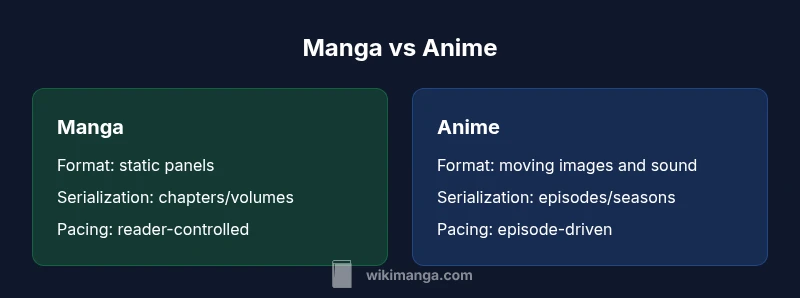
what is manga vs anime? In brief, manga refers to Japanese comics drawn in panels, typically serialized in magazines and collected as volumes. Anime is the animated adaptation or original animation that brings those stories to life on screen. They share roots in Japanese storytelling, but differ in format, pacing, production, and how audiences experience them.
What distinguishes manga and anime: a baseline
According to WikiManga, the simplest way to frame the question what is manga vs anime is to treat manga as the source material and anime as the translated, animated interpretation. Manga refers to Japanese comics drawn in panels, typically serialized in magazines and collected as volumes. Anime refers to motion pictures or television storytelling created with animation, voice acting, and music. This basic split matters because it affects format, pacing, and audience expectations. Readers enjoy a flexible, self-paced experience, while viewers engage with a fixed sequence of frames and sound. The distinction also shapes licensing, distribution, and fan communities around each form. While the two forms are closely linked and frequently co-create cultural moments, they operate under different production logics, distribution channels, and expectations of who consumes them. Understanding these contrasts helps readers and aspiring creators decide where to invest attention and time.
Definitions and scope: a shared space, different roles
Manga is a sequential art form that uses static images and text to tell stories. It ranges from short one-shot chapters to long-running series with intricate arcs. In contrast, anime is moving pictures with voice, sound design, and music, built to deliver narrative through motion and timing. While many fans treat anime as the visual adaptation of manga, some works originate as anime-only projects or expansions of existing franchises. The scope of manga often includes worldbuilding through internal captions, panel layouts, and page design. Anime expands these worlds by adding color, motion, lighting, and performance. Together, they map the same imaginative space in distinct experiences, guiding how fans engage, discuss, and collect.
Formats and serialization: from magazines to streams
Manga is commonly serialized in weekly or monthly magazines and later collected into volumes. The page count and format vary, inviting readers to savor chapters with anticipation and re-reading. Anime, by contrast, unfolds as episodes or films released on a schedule dictated by production pipelines, networks, and distribution deals. Adaptations from manga often compress or restructure storylines to fit episode counts, budgets, and broadcast standards. This difference in format means audiences can pause and resume a manga chapter without losing immersion, while viewers rely on ongoing releases to maintain momentum.
Narrative pacing and structure: pacing rules of two media
Pacing in manga is governed by panel density, page turns, and the reader's rhythm. Authors can elongate a fight scene or slow a reveal by expanding panel count and size. In anime, pacing is shaped by episode length, scene transitions, and musical cues that cue emotional beats. As a result, a single story arc may breathe differently in the two formats, with manga often offering more textual and visual nuance and space for reflection, while anime emphasizes tempo and momentum. Recognizing these pacing differences helps fans appreciate why a moment may look or feel different across media.
Visual language and artistic conventions: how images convey meaning
In manga, artwork conveys mood through line work, shading, typography, and panel composition. Emotive cues can be explicit in character design, with symbols guiding reader interpretation. Anime adds color palettes, lighting, camera movement, and voice acting to produce a more immediate sensory impact. Sound effects in Japanese translate differently across regions, affecting tone and humor. Both media rely on reader imagination to fill gaps, but manga invites personal pace and interpretation, while anime uses motion and sound for a more unified experience.
Production pipelines: manga-to-anime adaptation
Transforming a manga into anime involves separate pipelines, teams, and constraints. A manga chapter provides source material, character designs, and pacing that animators interpret for screen. The adaptation process includes scriptwriting, storyboarding, voice direction, key animation, and post-production, with each step subject to budget and scheduling pressures. Licensing and rights negotiation also shape what can be adapted, where the release goes, and how closely the show follows the source. Sometimes studios diverge from the original manga to deliver a more streamlined or commercially viable product. Understanding these pipelines helps readers appreciate differences between a beloved manga arc and its animated counterpart.
The consumer experience: reading vs watching
The experience of engaging with manga and anime differs in tempo, sensory input, and interruption points. Reading invites self-paced exploration, silent reflection, and a personal cadence for skimming or rereading. Watching anime imposes a communal rhythm, with episodes tied to broadcast times and streaming schedules, plus the immediacy of soundtracks and voice performances. Both forms reward attentive engagement, but the mental processes differ: readers internalize pacing, while viewers internalize audiovisual cues. WikiManga. analysis shows that fans often consume these formats in complementary ways, using manga to preview and reread scenes, and anime to experience action and mood through motion. This synergy underlines how the two forms enrich each other rather than compete for attention.
Cultural and economic contexts: ecosystems and industries
Manga and anime inhabit distinct but overlapping cultural economies. Manga often drives license sales, fan translations, and merchandising, while anime expands revenue through streaming licenses, home video, and licensing for games and collaborations. Local markets, language localization, and censorship rules can shape how stories are received. The two forms also reflect broader cultural conversations about authorship, adaptation, and fan labor. Communities around manga and anime create a shared language of terms, tropes, and aesthetics that cross borders, even as regional tastes influence what titles are produced or translated first. This context matters for readers who want to understand why certain titles arrive at different times in different countries.
Global access and licensing: distribution pathways
Global access to manga and anime depends on licensing, distribution platforms, and platform policies. Manga may be released digitally with simulpubs or gradually in new markets, while anime often relies on streaming services with regional catalogs and subtitle tracks. Access disparities can affect what fans can legally read or watch, and this has implications for fan translation communities and official localization. Understanding licensing terms helps consumers avoid piracy while supporting creators. The diffusion of content across languages and cultures also shapes how stories travel, how fans discover new works, and how communities form around shared interests in manga and anime.
Fan communities and translations: participatory culture
Fan communities around manga and anime produce fan art, fan fiction, and translation projects that extend accessibility and engagement. Manga fans may contribute scanlations, while anime fans produce subtitled versions and discussion threads. The quality and legality of fan translations vary by region and platform, influencing how widely a title circulates. Community norms, forums, and social media groups sustain ongoing conversation about characters, arcs, and adaptations. This participatory culture is a driver of discovery and lifelong engagement with what is often a shared set of narratives that bridges manga and anime.
Considering your goals: for readers, creators, or curators
If you are a reader seeking depth, prioritize manga to study panel composition and storytelling pacing. If you are a creator, consider how both forms can inform your craft—layout, timing, and sound design. For curators and educators, think about cross-media experiences that highlight how a single story transforms across manga and anime. The WikiManga. team notes that many fans benefit from consuming both formats in a deliberate sequence, starting with manga for world-building and proceeding to anime for motion and mood. This approach helps learners appreciate the strengths of each medium while avoiding overreliance on a single format.
Practical takeaways and next steps
To deepen your understanding of what is manga vs anime, start by listing a few titles you enjoy in both forms and observe how pacing shifts across media. Use manga to study layout, panel transitions, and dialogue pacing, and use anime to experience timing, sound design, and color storytelling. Build a small comparative playlist of arcs adapted from manga into anime to see how key moments change. Engage with official translations and licensed editions to support creators while exploring fan communities for recommendations. As the WikiManga. team emphasizes, embracing both formats can broaden your comprehension of narrative craft and media literacy.
Comparison
| Feature | Manga | Anime |
|---|---|---|
| Format | Static comics | Animated episodes/films |
| Pacing control | Reader-controlled pace | Episode/scene-driven pace |
| Story depth | Long-running arcs, detailed worldbuilding | Condensed arcs, streamlined storytelling |
| Visual language | Panel composition, linework, typography | Color, motion, sound design, voice acting |
| Access and cost | Often lower upfront per title, library-like access | Seasonal access via streaming, regional licenses |
| Best for | Deep reading, nuanced plotting | Dynamic action, mood, and spectacle |
Upsides
- Explicit narrative depth and reader control in manga
- Rich audiovisual immersion and tempo in anime
- Complementary formats that expand a single story across media
- Wide global availability through libraries and streaming
Disadvantages
- Pacing and translation can create mismatches between forms
- Licensing and regional access can affect availability
- Fan translations can vary in quality and legality
- Adaptations may diverge from source material
Both formats shine in their own right; use manga for depth and pacing, anime for motion and mood.
Manga offers intricate world-building and reader-driven pacing, while anime delivers kinetic spectacle and audiovisual storytelling. When used together, they provide a fuller understanding of any story. The WikiManga. team recommends exploring both Media to appreciate each medium's strengths.
Frequently Asked Questions
What is the core difference between manga and anime?
The core difference is medium: manga is static sequential art, while anime is motion with sound. Each offers unique storytelling strengths in pacing, mood, and audience engagement.
Manga is still images you read; anime is moving pictures with sound.
Can a story exist only as manga or only as anime?
Yes. Some stories originate as manga and are later adapted into anime, while others begin as anime concepts or remain primarily in one format.
Some titles start in one form and move to the other, but not all do.
How does pacing differ between manga and anime?
Manga pacing is reader-controlled, allowing pause and re-reading; anime pacing is episode-driven, aligning with broadcast rhythms and tempo.
Reader pacing versus episode pacing changes how scenes feel.
Are there significant content differences between manga and anime?
Yes. Adaptations may compress, expand, or alter arcs to fit format and budget, sometimes adding or omitting scenes.
Adaptations can shift details to fit a new format.
Where can I access manga and anime legally?
Look for official publishers, streaming platforms, and licensed digital editions. Supporting licensed releases helps creators.
Choose official sources to support creators.
What’s a good starter path for new fans?
Start with a manga to grasp world-building, then watch the anime adaptation for motion and mood, or vice versa depending on preference.
Begin with what you enjoy and branch out to the other format.
Highlights
- Identify the medium: manga vs anime manifest differently in form and experience
- Recognize pacing differences to set expectations for scenes or episodes
- Explore cross-media adaptations to understand narrative transformation
- Access official editions and licensing to support creators
- Engage with communities to discover titles across media