Manga or Anime: A Practical Side-by-Side Comparison
Explore the differences between manga and anime—pacing, visuals, accessibility, and fan culture. Learn how to choose the right medium for reading or watching, and how to navigate adaptations.


For fans and creators, manga and anime are two expressions of the same storytelling ecosystem. The manga route emphasizes reader-driven pacing, panel composition, and depth of detail, while anime translates that material into motion, sound, and timed storytelling. This guide compares the two to help you decide which medium best fits your goals, whether you’re a reader, watcher, or creator.
Defining manga vs anime
Understanding the distinction between manga or anime helps readers and creators choose where to invest time and talent. According to WikiManga, the difference is not just format but approach: manga is a static narrative medium that invites deep reading and interpretation, while anime translates that narrative into moving images, sound, and pacing. This section defines both terms and frames their relationship within a shared storytelling ecosystem.
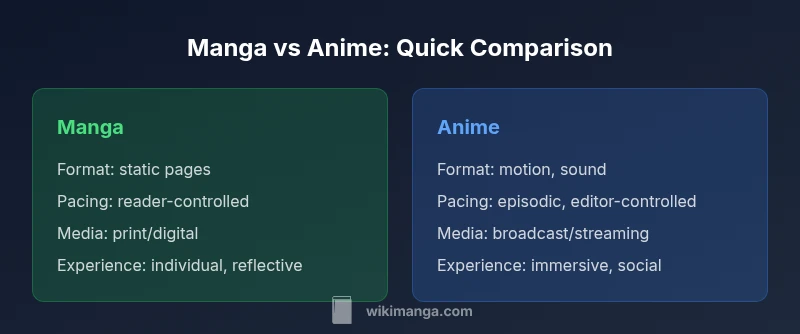
Manga refers to serialized or standalone comics published in print or digital form. It emphasizes panel composition, linework, and reader-driven pacing. Readers savor deliberate page turns, rereads, and the ability to pause at a single moment to study a character’s expressions. Anime, by contrast, is animated storytelling that uses movement, voice acting, music, and timing to convey mood and momentum. It can accelerate or slow down scenes with beat-by-beat precision. Both forms grow from the same source material and cultural context, yet they offer different entry points for new fans and different opportunities for creators. For practical purposes, think of manga or anime not as rival formats but as complementary avenues that can expand a single story across experiences.
Narrative techniques and visual language
Manga and anime leverage distinct visual grammars to convey emotion, intention, and pace. In manga, the reader interprets motion through panel transitions, composition, framing, and the rhythm of on-page beats. Subtle linework and negative space guide attention and emphasize character psychology without a soundtrack. In anime, motion, timing, and sound design carry weight. Camera work, dynamic angles, voice performance, and musical cues synchronize to create immediacy and mood. Understanding these differences helps fans appreciate how a scene feels when read versus watched, and why some moments land differently in each medium.
Practical takeaway: if you want to study storytelling craft, compare a pivotal scene in the manga panels with its anime adaptation to see how pacing and emphasis shift across formats.
Comparison
| Feature | Manga | Anime |
|---|---|---|
| Format | Static pages with panel composition | Motion-driven animation with sound |
| Pacing control | Reader-driven pace | Episode-driven pacing |
| Visual language | Linework, panel flow, and negative space | Cinematography, timing, and color |
| Time commitment | Flexible, long-term reading sessions | Fixed-length episodes, seasonal arcs |
| Cost and availability | Typically lower upfront cost per arc | Potentially higher total cost due to seasons and streaming |
| Canonical fidelity | Often closer to source material | Adaptations may diverge for format and audience |
| Accessibility/localization | Digital-first, fan translations common | Simulcasts and dubs widely available |
Upsides
- Manga offers deep worldbuilding and reader control
- Anime delivers immediacy, motion, and shared viewing experiences
- Cross-media ecosystems expand fan engagement
- Localization and translations broaden accessibility
Disadvantages
- Adaptations can diverge from source material
- Anime can require ongoing time and subscription commitments
- Manga may require reading direction adjustments and time to complete longer arcs
- Fan debates over canon and interpretation can complicate reception
Both manga and anime offer valuable storytelling experiences; choose based on how you prefer to consume and explore a story.
If you want control and depth, start with manga. If you crave motion and communal viewing, choose anime. Many fans benefit from engaging with both formats to see how each medium interprets the same world.
Frequently Asked Questions
What is the main difference between manga and anime?
Manga is printed or digital comics with static images and reader-controlled pacing. Anime is animated with motion, sound, and timing; it’s typically released as episodes or films.
Manga uses panels while anime uses movement and sound.
Is manga a good starting point for new fans of anime?
Many fans begin with manga to build world knowledge before watching adaptations. It depends on whether you prefer reading or watching first, but both paths work well for most stories.
If you like to read first, manga is a solid entry point.
How long does it take to read a typical manga arc vs watch an anime season?
Reading time varies by arc length and individual pace, while anime seasons scale with episode counts and pacing decisions. Both formats can be consumed at different speeds based on your schedule.
Pace depends on the arc and how you engage with each format.
Do adaptations always stay faithful to the source?
Adaptations rarely preserve every detail; changes are common due to format constraints, production choices, and localization. Fans often compare differences to understand how a story evolves across media.
Adaptations can differ as mediums require different storytelling choices.
Are there cost differences between reading manga and watching anime?
Costs vary by region and platform. Manga often has lower upfront costs per arc, while anime can involve ongoing subscriptions or purchasing multiple seasons.
Cost depends on how you access each format.
How do fans compare canon differences between manga and anime?
Fans track scene differences, alternate endings, and spin-offs. Cross-media fans often annotate how each version interprets key moments and character arcs.
Fans love comparing how each medium handles big moments.
Highlights
- Choose manga for depth and pacing control.
- Opt for anime when you want motion, audio, and social viewing.
- Cross-media consumption enhances world-building understanding.
- Localization shapes accessibility; expect variations across regions.
- Compare key scenes across formats to appreciate storytelling craft.