How Manga Differs from Anime: A Comprehensive Comparison
Explore the core distinctions between manga and anime, including medium, pacing, visuals, and storytelling. A detailed, practical guide from WikiManga to help fans and creators understand how these formats complement each other.


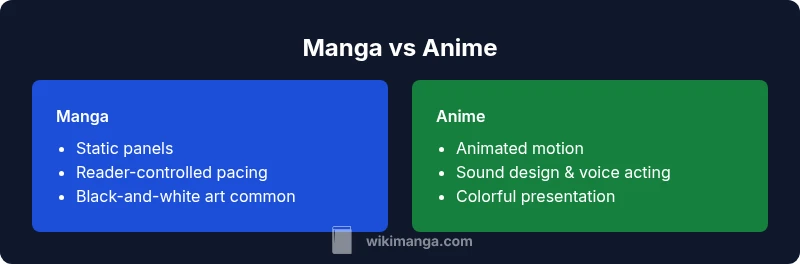
Manga and anime differ primarily in medium, pacing, and presentation. Manga is a printed or digital comic you read at your own pace; anime is animated video with sound, movement, and voice acting. Because manga relies on static panels, readers control timing and interpretation, while anime guides mood with motion and music. Understanding these differences helps fans engage with a story across formats.
What is manga vs anime? A quick primer
How you approach a story matters. In answer to the question of how is manga different from anime, the core distinction lies in medium: manga is a sequence of static panels presented on pages or screens, read at the reader’s pace; anime is moving images with synchronized sound. This foundational difference drives everything else: pacing, storytelling devices, and audience engagement. Manga often unfolds through tightly arranged panels, speech balloons, and occasional on-page text that conveys character thoughts, world-building, and subtext without needing external cues. Readers infer emotion from line work, panel composition, and timing as they turn pages. Anime, by contrast, couples motion with sound: voice actors deliver dialogue, music cues intensify mood, and sound effects anchor actions. Because of this, anime can present action in real time, while manga may compress or stretch scenes across pages. The WikiManga. team emphasizes that both forms are legitimate storytelling media, serving different aesthetics and fan practices. Understanding these differences helps readers pick where to start and how to engage with a story across formats.
Medium and narrative pace
The pace of storytelling diverges sharply between manga and anime. Manga gives readers the freedom to skim a page, linger on a panel for detail, or re-read a panel to catch subtle exposition. This reader-driven pacing supports intricate world-building and psychological depth, letting creators space out revelations across chapters. Anime constrains pace with episode length or film runtime, carving scenes into a structured rhythm and often synchronizing events to a musical tempo. This can heighten excitement during action sequences or emotional crescendos. For fans comparing the two, notice that some moments in manga build subtext through composition alone, while the same moment in anime relies on timing, sound design, and voice performance to convey subtext more overtly. The interplay between pacing and format shapes how each audience experiences a story.
Visual language: panels, pacing, and motion
Manga communicates through page layouts, panel borders, gutter sizes, and the arrangement of textual elements. Panel size and shape control perceived speed—the reader’s eye can linger on a dramatic close-up or race across a splash page. Symbolic visual cues, such as speed lines or sweat drops, carry emotional weight without audio. Anime translates static panels into motion: characters move, backgrounds shift, lighting changes, and camera angles adapt to emphasize action. Color, shading, and motion vectors contribute to mood and clarity. This visual translation means some scenes are pristine in manga but differently impactful in anime due to lighting and motion. For artists and readers, the medium choice influences how much detail is carried forward and how narrative emphasis shifts from still composition to dynamic storytelling. WikiManga. notes that this difference often leads to distinct fan experiences even when the same story is involved.
Storytelling devices: internal monologue vs dialogue
Manga often leverages internal thoughts, caption boxes, and panel-to-panel transitions to share character psychology and world-building. Thought balloons and narrative text give readers direct access to a character’s private reasoning, sometimes revealing subtext that dialogue alone cannot. In anime, internal monologue may be externalized through voiceover, expressive acting, or cinematic montage. This change can alter pacing and the immediacy of a moment. Writers and directors must decide how much of a character’s interior life to show on screen, and readers must decide how much to infer from visuals. The result is two distinct but complementary approaches: manga rewards careful reading and deduction, while anime delivers immediacy through voice, tone, and sound cues. Both methods serve to deepen character and plot, but they achieve it through different tools.
Production realities: publishing cadence vs animation pipeline
Publishing cadence shapes manga’s storytelling tempo. Weekly or monthly chapters allow creators to respond to reader feedback and adjust story arcs over time. Collected volumes (tankōbon) assemble chapters with refined art and additional notes, providing a sense of progression. In contrast, anime follows a production pipeline anchored to broadcast seasons or theatrical releases. This structure imposes scheduling discipline and sometimes necessitates changes for pacing, budget, or localization. Adaptations may stretch, condense, or reorder material to fit episodic formats, which can affect continuity and audience expectations. For creators, recognizing these production realities helps in planning cross-media projects and understanding why certain scenes appear in one form but not the other. For fans, it explains why a particular arc might take longer to appear in manga or why an anime adaptation ends differently than the source.
Adaptation decisions: fidelity, censorship, and audience expectations
Adapting a manga into anime involves trade-offs between fidelity and practicality. Animation budgets, scheduling constraints, and target demographics can influence what is kept, altered, or omitted. Some scenes may be streamlined for clarity or for broadcast standards, while others gain additional visual effects and sound design that weren’t present on the page. Understandably, fans may debate whether fidelity to the original is essential or if a fresh adaptation can offer new insights. Cultural differences also play a role in localization, with dialogue timing and humor adjusted to fit a target audience. This complexity makes anime adaptations both a celebration and a revision of the original material, inviting discussions about where a story truly begins and where it lives in another medium.
Character design and art style differences
Character designs can diverge across media. Manga artists often prioritize line work, shading, and panel composition to convey personality, emotion, and speed. When adapted to anime, designers reinterpret these lines into animation-ready forms, sometimes simplifying features to maintain consistency across frames. The result is a balance between stylistic fidelity and practical animation constraints. Some fans appreciate manga’s raw, high-contrast aesthetics, while others enjoy anime’s polished, color-rich presentation. Both approaches can deepen attachment to a character, depending on how well designs capture a character’s core traits in each format. This dynamic also influences merchandising, cosplay, and fan art, which often celebrate the unique look of a character in different media.
Sound, music, and voice acting impact
Sound design distinguishes anime from manga in a transformative way. Voice acting conveys tone, intent, and emotion that can diverge from print self-presentation. Music underscores mood, signaling shifts in tension and release. Sound effects can anchor action, heighten impact, and guide pacing during sequences that would be read rather than heard in manga. While manga relies on reader imagination to fill sound, anime provides a concrete aural experience, which can broaden accessibility for some audiences while narrowing it for those who prefer silent reading. For creators, synchronizing sound with story beats becomes a crucial craft, offering another vector for storytelling beyond line art and panel pacing.
Cultural and market context
Manga and anime emerge from distinct industrial ecosystems with different production cultures. Manga often travels through magazine serializations, fan communities, and physical volumes, cultivating a robust culture of discussion around chapters, cliffhangers, and art progression. Anime flows through broadcast slots, streaming platforms, and festival circuits, generating momentum through episode timing, opening/ending sequences, and cross-media marketing. Both formats influence and reflect cultural trends, social norms, and global fan communities. WikiManga. highlights that appreciating these contexts enriches the reader’s or viewer’s understanding of why certain series resonate, how localization shapes reception, and why some stories become lasting franchises across formats.
How to read manga and watch anime efficiently
Readers and viewers can optimize their experience by pairing formats strategically. Start with manga to savor pacing and detail, then watch the anime to experience motion, color, and sound. If you’re pressed for time, sample the anime first for broad exposure, then dive into the manga for depth. Use reading orders and episode guides to minimize confusion when a story spans multiple volumes or seasons. For creators, cataloging key scenes that survive adaptation helps in understanding what core elements translate well across media. In practice, a hybrid approach—reading the manga to follow the original pacing and watching the anime to enjoy a different sensory layer—often yields the most holistic appreciation.
Common misconceptions about manga and anime
A frequent misconception is that manga and anime are merely different formats of the same story. In fact, they are distinct art forms with unique strengths: manga emphasizes static composition and reader-paced discovery, while anime emphasizes motion, sound, and collaborative interpretation. Another misconception is that manga is always superior to anime in fidelity to source material; adaptation decisions may prioritize narrative clarity, audience reach, or budget constraints. Finally, some assume all anime is child-oriented; in reality, many anime target adult audiences with complex themes. Recognizing these nuances helps fans engage with both media more thoughtfully and with less bias.
Comparison
| Feature | Manga | Anime |
|---|---|---|
| Medium | Print/digital comics | Animated video with sound |
| Pacing & control | Reader-controlled pacing | Fixed pacing by episode/film |
| Visual language | Static panels; layout dictates flow | Motion, color, and dynamic camera work |
| Sound & voice | Silent reading; no audio | Voice acting, music, and sound effects |
| Storytelling tools | Internal monologue; panel transitions | Dialogue, timing, and sound cues |
| Production cadence | serialized magazine chapters; slower cycles | Seasonal/episodic production; faster release cycles |
| Fidelity to source | Often faithful but with panel edits | Can diverge due to adaptation needs |
| Audience reach | Regional licensing varies; reader preference drives demand | Mass-market reach; global broadcasts |
| Costs | Ongoing purchase of volumes; lower per-unit cost | Higher upfront costs for animation production and licensing |
Upsides
- Manga offers reader-controlled pacing and deep internal perspective
- Anime delivers motion, voice acting, and immersive sound design
- Both formats enable different storytelling experiences that appeal to distinct fans
- Cross-media consumption can deepen engagement with a franchise
Disadvantages
- Manga can have slower release schedules and require longer reading sessions
- Anime may diverge from the source and alter tone or details
- Localization and licensing can delay access for some regions
- Animation budgets can affect fidelity to original art
Both media are valuable for different reasons; use manga for depth and pacing, and anime for motion and mood.
The WikiManga. team recommends a dual approach: read the manga to appreciate detail and internal storytelling, then watch the anime to experience motion, sound, and performance that bring scenes to life.
Frequently Asked Questions
What is the fundamental difference between manga and anime?
Manga is a static sequence of panels you read; anime is animated with sound. The difference shapes pacing, storytelling tools, and how audiences engage with a story.
Manga is read panel by panel, while anime is watched with motion and sound.
Can a manga be adapted into anime faithfully?
Yes, though some changes are common due to budget, pacing, and audience. Fidelity varies by production, but core plot and characters are usually preserved.
Some changes are expected, but the main story usually stays intact.
Which should a beginner start with: manga or anime?
If you want depth and control over pacing, start with manga. If you prefer mood, visuals, and immediate immersion, start with anime. Many fans enjoy both in sequence.
Start with manga for depth, or with anime for immersion—both work.
Are manga and anime considered canonical?
Canon status depends on the source. Manga chapters are often the original material; anime can be canonical if it follows that material, though some series have anime-original endings.
Canon depends on whether the anime follows the manga closely.
Do manga use color, or are they usually black and white?
Traditional manga is typically black and white, with color pages occasionally used for special editions or covers. Anime uses full color by default.
Manga is usually black and white; anime is in color.
What’s the best way to track reading and viewing across formats?
Use official release guides to follow reading orders and episode guides to time viewing. Cross-reference arcs to understand adaptations and differences.
Follow official guides to stay on track across both formats.
Highlights
- Read manga to savor pacing and subtle detail
- Watch anime for motion, sound, and performance
- Adaptations balance fidelity with production realities
- Both formats complement each other in storytelling