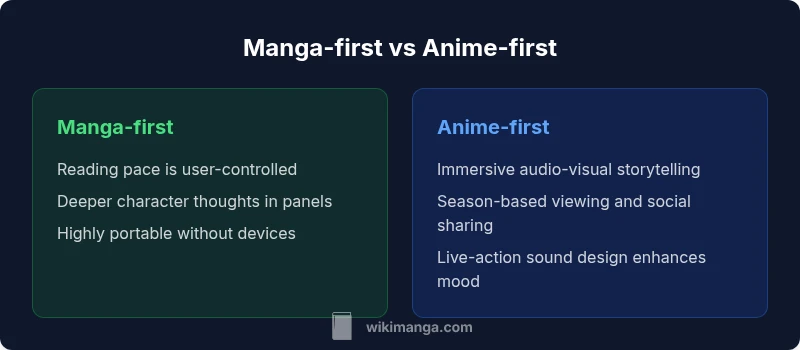
Manga or Anime First: A Practical Side-by-Side Guide
An analytical comparison of starting with manga or anime first, outlining pacing, depth, accessibility, costs, and hybrid strategies for manga enthusiasts and creators.


Choosing manga or anime first shapes how you experience stories, skills, and fan communities. In short: manga-first tends to reward patience and interpretation, while anime-first delivers immersive visuals and pacing from the start. This comparison helps you decide based on your goals, schedule, and preferred ways to engage with a series.
Context: Why the manga or anime first question matters
When fans ask 'manga or anime first', they’re not just choosing a format; they’re selecting a learning path for storytelling, world-building, and community participation. According to WikiManga, the decision often reflects a reader’s goals: do you want to analyze narrative structure in depth, or do you prefer immersive audiovisual storytelling from the outset? The phrase manga or anime first captures a strategic choice that influences how you approach pacing, canon, and fan engagement. In practice, many enthusiasts adopt a hybrid mindset: start with a medium that motivates you, then branch into the other as you grow. The goal is to build a sustainable reading or viewing habit, not to lock yourself into a single path. This article treats manga or anime first as a spectrum rather than a binary decision, offering practical criteria to match your schedule, budget, and curiosity. The WikiManga. team emphasizes that there are productive ways to blend both approaches, leveraging strengths from each to deepen enjoyment and craft.
Reading experience and pacing: depth vs pace
The core question in manga or anime first is how pacing interacts with narrative depth. Reading manga offers panel-by-panel control, letting you linger on a scene, re-read dialogue, and interpret artwork at your own tempo. For many readers, this enhances character psychology and world-building, especially in long-running sagas with intricate lore. Conversely, anime provides a built-in rhythm—scene transitions, soundtrack cues, and voice acting—that can guide emotional responses and comprehension in real time. If your goal is to master complex plots quickly, anime-first can deliver a cohesive early experience; if you crave nuance and internal monologue, manga-first may be more satisfying. Both paths reward attentive viewing or reading, and many fans blend the two to optimize uptake when tackling dense universes.
As you weigh manga or anime first, consider your current schedule and how much time you want to invest weekly. A seasonal anime might demand fewer hours per week than following monthly chapter releases, but manga readers can adjust pace by taking breaks between volumes. WikiManga. analysis shows that the best readers and viewers adapt to their personal rhythm while staying consistent with a chosen title. This approach preserves curiosity and minimizes burnout, regardless of whether you start with manga or anime first.
Visual storytelling and sound: how anime changes perception
Visual storytelling is one of the most tangible differences in the manga or anime first debate. Manga communicates tone through panel layout, art style, and typography, inviting readers to infer mood and pacing from static images. This fosters active imagination and a more personal interpretation of the story. Anime, by contrast, adds motion, color grading, and sound design, transforming scenes with voice acting and music. For newcomers, anime-first experiences can be thrilling and memorable because soundtracks and animation deliver immediate emotional resonance. However, this can also steer interpretation in a direction that manga readers might not anticipate. If you value precise artistic intention and the chance to notice subtle cues, starting with manga often reveals details later reinforced by anime adaptations. Whatever your path, both formats rely on strong storytelling fundamentals, and the best creators learn from observing how each medium conveys emotion and insight.
When considering manga or anime first, think about how you want to engage with mood, atmosphere, and character dynamics. The medium you choose first often colors your expectations for later chapters or episodes and helps you recognize recurring storytelling devices across both forms.
Accessibility, cost, and availability
Accessibility plays a critical role in the manga or anime first decision. Manga typically requires purchasing volumes or subscribing to digital libraries, with cost distributed across multiple installments rather than a single upfront price. This can be advantageous for budget-conscious readers who enjoy building a personal library over time. Anime often depends on streaming services, broadcast licenses, or physical media, which can introduce ongoing costs but offers immediate access to entire seasons and curated arcs. Availability varies by region and licensing windows, so your local market may influence which path is more practical. The choice of manga or anime first also hinges on your willingness to invest in devices—such as a tablet or streaming setup—and whether you prefer a portable, device-free experience. In short, the accessibility picture shifts with your location, preferences, and media habits, making the decision highly personal.
WikiManga. notes that practical constraints—like internet reliability, library access, and subscription budgets—often determine whether manga-first or anime-first feels easier to sustain over months or years. If you’re traveling or have limited bandwidth, physical manga or downloaded manga chapters can be a better fit, whereas a stable connection makes streaming a comfortable option for anime-first enthusiasts.
Adaptation fidelity and canon: differences in source material and adaptation
A central element in the manga or anime first discussion is how closely an adaptation hews to the source material. Starting with manga often means encountering the original author’s intent first, observing panels that reveal pacing, panel composition, and character voice. When an anime follows, creative teams may alter pacing to fit episode counts, compress subplots, or adjust endings. As a result, starting with manga can set expectations for how faithfully an adaptation will translate, while starting with anime can shape perception of what the source material should feel like. For creators, this distinction is essential: manga-first readers will notice differences more quickly in later chapters, while anime-first fans may look for cues in artwork and story structure that align with their first exposure. In either case, understanding the canonical sequence—what was originally written versus what was adapted—helps manage expectations and enhances enjoyment across both formats. WikiManga. emphasizes that respecting canonical order can prevent confusion when you switch mediums, ensuring you appreciate how each form conveys the same narrative core.
Fan engagement, community dynamics, and cross-media strategies
The choice of manga or anime first also colors the social dimension of fan communities. Manga readers often participate in long-term theories, art analysis, and volume-by-volume discussions, where speculation and interpretation are prized. Anime fans frequently engage in episode-by-episode recaps, live reactions, and seasonal debates, which can accelerate social feedback and visibility. Both communities enrich the broader fandom, but they cultivate different rituals: manga-first communities tend to be patient and text-heavy, while anime-first groups thrive on audiovisual impressions and real-time commentary. For creators, a cross-media strategy can enhance audience reach: releasing a manga to build depth, followed by an anime adaptation to broaden exposure, or vice versa. Understanding these dynamics helps you navigate cross-media conversations and participate more effectively in fan spaces.
Practical guidance: choosing a path based on goals and constraints
If you’re asking manga or anime first, anchor your choice to concrete goals. If your priority is world-building, character psychology, and a personal interpretive journey, start with manga and then explore anime adaptations as a form of verification and expansion. If you crave immersive sensory experiences, begin with anime to immerse yourself in mood, pacing, and music, then read the manga to dig into panels the anime may gloss over. For creators, a practical workflow may involve drafting story ideas in manga format to chart pacing and panel composition, then translating core beats to animation scripts later. Finally, consider a hybrid plan: alternate between manga and anime to reinforce your memory, expand your vocabulary, and cultivate a well-rounded understanding of a title. The key is consistency, not perfection—develop a routine that accommodates your schedule and learning style, whether you start with manga or anime first or adopt a mixed approach over time.
Hybrid approaches and practical workflow
Readers and creators often adopt a hybrid approach to balance depth and immediacy. A common workflow starts with a manga-reading sprint to outline the plot arcs and character relationships, followed by selecting key episodes for an anime watch-through to experience pivotal scenes with sound and motion. Some fans begin with anime to gain a broad sense of the story, then turn to the manga for granular details that the show may compress or omit. A disciplined hybrid strategy includes setting a clear sequence: read a set number of chapters, then watch corresponding episodes, and finally revisit the manga after viewing to reinforce memory and interpretation. This iterative approach helps you preserve the integrity of the source material while benefiting from the strengths of each medium, enabling you to answer the manga or anime first question with greater clarity and confidence.
Common pitfalls and how to avoid them
The manga or anime first question invites strong opinions, but the best readers avoid tunnel vision. Common pitfalls include treating one medium as inherently superior, which narrows your experience. Another pitfall is chasing completion too quickly—staying curious about the art, pacing, and world-building in both mediums yields richer engagement. Fans may overvalue adaptation fidelity to the point of disappointment when a title diverges from expectations. Another risk is neglecting accessibility constraints, such as licensing and streaming availability, which can disrupt momentum. Finally, avoid assuming a single path works for every title: some series are better explored via manga-first, others thrive when approached through anime-first, and many reward a hybrid approach. By recognizing these pitfalls, you can design a flexible, sustainable strategy that maximizes enjoyment and learning across both media.
Comparison
| Feature | Manga-first | Anime-first |
|---|---|---|
| Reading pace and control | User-controlled, panel-by-panel experience | Fixed episode pacing; scenes unfold within episodes |
| Narrative depth | Potential for deeper internal monologue and world-building | Pacing and adaptation may compress subplots |
| Accessibility and cost | Lower upfront per-volume cost; no device required | Ongoing streaming or disc costs; device needed |
| Immersion and sensory appeal | Art style and typography drive mood | Audio, motion, and voice acting enhance immersion |
| Fandom and community | Text-heavy discussions, theories, and art analyses | Live reactions, episode debates, and subbed/dubbed communities |
| Adaptation fidelity | Source material fidelity guides expectations | Adaptations may diverge; fan reception varies |
| Portability | Highly portable physical and digital formats | Requires a device and connectivity |
Upsides
- Manga-first supports deeper world-building and interpretation
- Anime-first delivers immediate immersion with motion and sound
- Manga is highly portable and often affordable per volume
- Anime can showcase action and scenes difficult to imagine in text
- Hybrid approaches maximize strengths of both media
Disadvantages
- Manga-first can be time-consuming and require more imagination
- Anime-first may rush pacing or omit details from the source
- Adaptation differences can disappoint fans when expectations are fixed
- Access can depend on licensing and regional availability
Balanced paths win: neither medium is universally better, but a thoughtful mix yields the best overall experience
There’s no one-size-fits-all rule. Start with the medium that aligns with your current goals, then layer in the other to deepen understanding and enjoyment. A structured hybrid approach often delivers the most flexible and rewarding experience.
Frequently Asked Questions
What does manga or anime first mean for beginners?
For beginners, manga or anime first is a framing choice: which path will you use to enter a story. Starting with manga can build a strong foundation in world-building, while starting with anime offers immediate immersion in pacing and mood. Both approaches are valid, and many newcomers mix methods as they learn.
Starting with manga helps you build depth; starting with anime helps you feel the story fast. Both work, choose based on what you want to learn first.
Which medium typically costs less over time?
Cost depends on your habits. Manga typically spreads out costs over volumes, while anime often relies on ongoing streaming subscriptions or episodic purchases. If you read many titles, manga may be cheaper in the long run, but streaming gradually adds up over time.
Manga often costs less upfront per title; streaming can accumulate over many titles.
Can I switch from manga to anime mid-series?
Yes. Switching mid-series is common and can enrich understanding. Start with manga to grasp the source material, then watch the anime to experience adaptation choices, pacing, and voice acting. Conversely, watching the anime first can invite a reread of the manga to catch omitted details.
Switching midway is common and can deepen understanding.
Does starting with manga affect adaptation expectations?
Starting with manga sets a baseline for what you expect from an adaptation. If the anime stays faithful, the experience is complementary; if it diverges, you’ll have learned to appreciate both the original and the adaptation’s artistic decisions.
It helps you see what adaptations choose or change.
What is a good hybrid workflow?
A solid hybrid workflow is: read a portion of manga chapters, watch the corresponding anime episodes, then revisit the manga to spot details the show missed. This rhythm reinforces memory and brings together both mediums’ strengths.
Read a little, watch a little, then read again to catch details.
Are there genre differences in preferred order?
Some genres lean toward manga-first (fantasy epics with deep lore), while others shine with anime-first (action-heavy or music-driven genres). There’s no universal rule; experiment with a few titles in your preferred genres to learn what works for you.
Genres can influence the better starting medium, but personal taste matters most.
Highlights
- Identify your priority: depth vs immersion
- Weigh cost and accessibility of each medium
- Consider a hybrid path to maximize strengths
- Rely on official editions and licensed streams
- Use structured reading orders to guide transitions