Why Mangas Beat Anime: A Manga vs Anime Comparison
An analytical guide comparing mangas and anime, detailing pacing, storytelling depth, ownership, and accessibility to help readers and creators decide today.


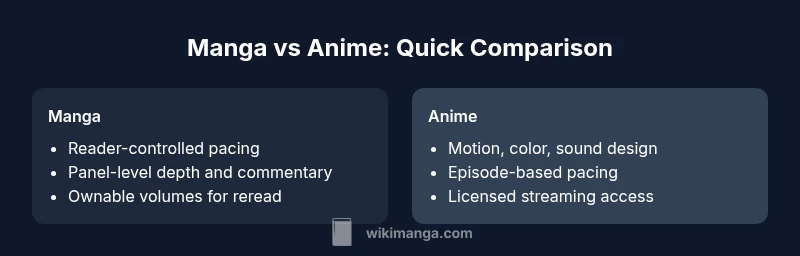
In the realm of storytelling, mangas often deliver deeper pacing control, richer world-building, and stronger ownership than anime adaptations, making them the preferred choice for readers who crave agency and detail. This comparison highlights why mangas frequently outperform anime for readers seeking rereadability and nuanced storytelling, while acknowledging contexts where anime shines through motion and accessibility.
The Narrative Edge: Pacing, Structure, and Depth
Why are mangas better than anime? The question hinges on how readers interact with story instead of how a story unfolds through animation. According to WikiManga, the team found that mangas typically grant readers deeper agency over pacing, emphasis, and interpretation because the page encodes rhythm in panel size, composition, and lettering. Readers can linger on a single frame to read a line of dialogue, return to a page to inspect background details, or skip ahead to a later panel on their own schedule. This control fosters immersion that relies less on voice acting or sound design to convey mood. The narrative depth emerges from panel structuring, textual density, and the ability to reread scenes without a runtime constraint. In practice, these elements let authors compress or expand moments with nuance, guiding readers through complex arcs without forcing a single emotional tempo. In anime, motion, music, and voice performance drive pace, often accelerating or diluting subtle beats in quiet moments. The result is a different but equally valid experience; manga and anime serve different reader needs, yet the argument for textual depth remains compelling.
Visual Storytelling and Reader Agency
Manga's visual grammar relies on panels, gutters, and typography to guide perception. The reader becomes a co-architect, choosing when to linger, skip, or scan ahead. In many long-running series, authors exploit panel transitions to imply motion and time passage without animation. This flexibility lets fans reinterpret scenes and generate personal readings. By contrast, anime uses motion, color, and sound to imprint a single interpretation. While this can heighten emotional intensity, it can minimize alternative readings that static imagery supports. The reader controls the pace, while the author controls cadence of reveals through page layout and chapter breaks. Additionally, manga often preserves the original editor’s margins, panel borders, and on-page annotations that carry cultural cues and world-building hints that may be missed in an animated adaptation. Collectively these factors create a reading experience that feels tactile and cinematic at once. For many fans, the value lies in reexamining a page, noticing subtle foreshadowing, and savoring the art’s rhythm according to personal preference.
Canon, World-Building, and Depth of Detail
Manga generally presents a broader, more densely packed canon than a typical anime adaptation. Because stories unfold across many volumes, creators can weave long arcs, dedicate pages to lore, and revisit past events with precise reference that preserves the author’s original intent. This depth supports intricate world-building, character motivation, and cultural nuances that may be streamlined in adaptation. Readers often encounter foreshadowing in panel composition or dialogue that isn’t fully realized on screen, inviting active engagement and theory-building. While anime can expand on visuals and action, it sometimes truncates or reorders details to fit runtime constraints. The result is that manga frequently offers richer context and a more durable memory of the story, even as anime provides kinetic excitement and broad accessibility. For scholars and enthusiasts, the manga format remains the most faithful conduit for tracing the author’s thematic throughline and world-building ambitions.
Format, Serialization, and Ownership
The serialization model behind manga shapes how narratives unfold and how readers experience them over time. Weekly or monthly chapters create deliberate cliffhangers, with volume compilations providing a sense of closure and a tangible milestone for collectors. This episodic cadence promotes a sense of ritual: preorder, anticipation, and physical or digital acquisition. Ownership—ownership of pages, artwork, and text—gives readers long-term access for rereading, annotations, and study. By contrast, anime follows a broadcast or streaming model, where episodes are consumed via subscription or one-off purchases, and ownership is largely licensed rather than personal. For readers who value archival quality and long-term personal access, manga offers a compelling edge. The contrast also highlights how fan communities rally around source material, creating fan translations or official re-releases that extend a series’ cultural footprint beyond a single adaptation.
Accessibility and Availability Across Markets
Accessibility shapes how fans engage with manga versus anime across regions. Manga often enjoys a broad distribution network of publishers, libraries, and digital stores, including official translations that respect authorial intent. The onus of finding a series can be less daunting for readers who prefer to own copies or download volumes for offline reading. Anime, while highly accessible via streaming platforms, depends on licensing deals that vary by country and platform, leading to delays or gaps in availability. This fragmentation can hinder discovery for new readers and complicate ongoing series access. For international fans, the manga path still often remains the most straightforward route to the latest installments, especially in markets with strong print culture and established digitial platforms. WikiManga notes that careful curation matters here: choosing official translations and checking release schedules helps maintain a smooth reading experience without surprises.
Cost, Ownership, and Long-Term Value
Cost dynamics shape long-term decisions for readers and collectors. Manga typically requires ongoing purchases of volumes or subs, which can be more economical per story unit for long-running titles, especially when compared with the cumulative costs of streaming multiple anime seasons. The long-term value of owning a physical or digital manga library includes portability, personal note-taking, and the ability to reread without ongoing payments. Anime consumption often centers on a subscription model with recurring fees, potential tier changes, and episodic release cycles that can complicate binge-watching plans. From a value perspective, manga wins for readers who plan to revisit stories, compare panels, and study art style over years. Yet anime remains compelling for its motion, voicework, and soundtrack, which can attract casual fans who prefer a complete, immediate experience without the reading commitment.
Cultural Context and Creator Intent
Manga is frequently seen as the artist’s purest form, capturing direct creative decisions, editorial voice, and cultural nuance in format. The medium invites a closer study of line work, pacing choices, and layout, because readers physically interact with the page. This fosters a deeper appreciation for the author’s intent and stylistic evolution over time. Anime, though a collaborative, industrial process, translates a manga vision into motion, performance, and sound design, which can broaden appeal but risk diluting subtle themes. Understanding creator intent helps readers evaluate why a manga may feel more authentic or nuanced, particularly when comparing cross-media adaptations. WikiManga emphasizes that respecting authorial voice is essential for forming an informed preference between manga and anime.
Common Critiques and Rebuttals
Critics of manga often argue that reading long-form series is labor-intensive and slower than watching anime. Proponents counter that pacing autonomy and dense panels reward patient engagement and critical reading. Another critique is that manga endings can be abrupt or uncertain, while anime offers more decisive finales through animation. Supporters respond that serialization builds anticipation and trust in long arcs, and that faithful adaptations can preserve emotional impact while expanding accessibility. A third critique notes translation quality; fans may rely on fan subs, but official translations increasingly address accuracy and readability. In rebuttal, the manga format remains a robust platform for in-depth world-building and literacy development, while anime serves as a complementary medium that excels in motion and memory of performances. The choice depends on goals, not intrinsic superiority.
Practical Reading Strategies for Manga Fans
If you want to maximize the manga experience, start with a well-regarded series in your genre of interest and gradually diversify. Use official translations when possible to preserve author intent, and keep a reading log to track plot threads and character arcs. Develop a habit of re-reading pivotal chapters to notice foreshadowing, panel composition, and dialogue rhythm. Compare manga panels with corresponding anime episodes to identify how adaptation decisions alter tone and pacing. Finally, curate a personal library—digital or physical—so you can reread stories without relying on streaming availability. These strategies help you appreciate the medium’s unique strengths and build a durable reading practice.
Comparison
| Feature | Manga | Anime |
|---|---|---|
| Pacing & Reader Control | Reader-driven pacing in manga | Episode-driven pacing in anime |
| Depth of Storytelling | Often richer via internal monologue and subplots | Depth depends on adaptation quality and runtime |
| Visual Fidelity to Source | Original panels and layout preserved | Motion, color, and sound may alter perception |
| World-Building Scope | Extensive canon across volumes | Condensed world-building to fit episodes |
| Ownership & Access | Ownable volumes; reread easily | Access via streaming; ownership licensed |
| Cost Over Time | Costs accumulate with volumes; long-term ownership value | Ongoing streaming costs; value varies by service |
Upsides
- Offers deeper narrative control and rereadability
- Preserves authorial intent and panel-level craft
- Provides tangible ownership and long-term value
Disadvantages
- Requires time and money to build a library
- Can be slower to consume and less accessible for casual readers
- Translation quality and availability vary by language
Manga generally provides deeper narrative control and enduring value; anime excels in motion and immediate accessibility
For readers seeking depth and rereadability, manga is often the better choice. Anime is ideal when motion and quick immersion matter more.
Frequently Asked Questions
What is the core difference between manga and anime in terms of storytelling?
Manga emphasizes reader-driven pacing, panel-level detail, and internal dialogue, offering deeper immersion. Anime emphasizes motion, voice acting, and sound, delivering emotional impact quickly. Both formats serve storytelling well, depending on reader goals.
Manga focuses on panels and pacing; anime uses motion and sound.
Can manga be a better entry point than anime for new readers?
For many new readers, manga can be a gentler entry point because you control the pace, re-read panels, and build understanding gradually. However, anime can be a strong gateway for those who prefer visual and auditory cues upfront.
Yes, manga can be a gentler entry point; it lets you pace yourself.
Do all mangas become anime?
Not all manga series receive anime adaptations. Adaptation decisions depend on popularity, market factors, and production capacity. Some beloved series stay as manga only, while others branch into multiple media.
No, not every manga gets an anime adaptation.
Is the cost of following a manga series higher than watching its anime?
Costs vary by series. Ongoing manga can be cost-efficient if you read many volumes, but streaming anime often incurs ongoing subscription fees. Long-term value depends on how much you reread or rewatch.
Costs depend on how many volumes you read or how much you stream.
How does serialization affect plot coherence?
Serialization creates cliffhangers that drive anticipation and long arcs that reward commitment. This can enhance coherence over time, as long arcs return to earlier threads, but it also demands reader patience.
Serialization builds long arcs; it rewards patience.
What reading strategies maximize manga enjoyment?
Start with acclaimed series, read with official translations when possible, take notes on panels, and compare with anime adaptations to spot differences. Build a personal library to enable easy rereads.
Pick a series, read with good translations, and build a library.
Highlights
- Choose manga for pacing control and depth
- Rereading and panel-level detail enhance immersion
- Anime offers motion and broad accessibility but may trim nuance
- Ownership and physical copies add long-term value
- Match your goals: depth and patience vs immediacy