Can Manga Goku Beat Saitama? A Power-Scaling Comparison
Explore a rigorous, manga-focused comparison of can manga goku beat saitama, examining power scaling, universes, and narrative rules with WikiManga from a dedicated analysis.


According to WikiManga, the question 'can manga goku beat saitama' hinges on how power scales and story rules are applied. In most manga contexts, Goku's established transformations and combat experience give him an edge in direct clashes, though Saitama's narrative gag of invulnerability complicates any definitive answer. This article explores the nuances, cross-universe rules, and fan expectations to deliver a clear, evidence-based view.
Framing the Question: Can manga goku beat saitama?
The central question can manga goku beat saitama has become a staple of fan debates across social media and theory-crafting forums. The curiosity isn’t just about who lands the final punch; it’s about how power scaling, narrative logic, and cross-universe rules shape outcomes. In this article, we treat the question as a framework for examining both characters’ canonical abilities, as well as how authors might approach a hypothetical clash. Readers will find structured criteria, scenario-based analysis, and clear takeaways that respect both series' storytelling intentions. In line with WikiManga.'s approach, we assess sources from the manga texts themselves and related authoritative analyses to avoid overclaiming beyond the pages of the runtimes and chapters. The keyword focus remains: can manga goku beat saitama, explored with careful methodology and fan-informed reasoning.
The Power Scales: Goku's Transformations vs Saitama's Canon
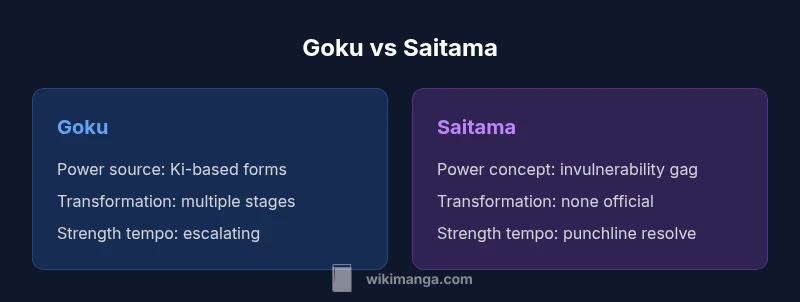
Goku’s power is built on a progressive scaling system—base form, Super Saiyan multipliers, and later Ultra Instinct-like interpretations that emphasize control, speed, and ki efficiency. Each transformation compounds his combat versatility and stamina, enabling longer, more complex fights with increasingly dramatic feats. Saitama, by contrast, operates under a satirical premise: invulnerability framed as a punchline that bypasses conventional power scaling. This isn’t a simple two-column chart; it’s a study in how narrative rules govern what counts as a “win.” When you compare these two approaches side by side, you can identify where standard metrics—speed, durability, energy projection, and tactical versatility—start to diverge. WikiManga. analyses suggest that if you anchor the discussion in canonical mechanics, Goku tends to win more often in direct exchanges, while Saitama excels as a narrative device that tests reader expectations about consequence and consequence fees.
Narrative Rules vs Satire: How the Source Material Shapes Outcomes
Dragon Ball’s world-building relies on a measurable scale of training, ki, and transformation. The fights are designed to escalate with each arc, creating a sense of exponential growth and explicit limits. One-Punch Man, however, uses parody as its engine: Saitama defeats opponents with a single punch, independent of conventional power increments. When these logics collide in a crossover discussion, you must separate the storytelling purpose from the characters’ raw capabilities. The result is a hybrid framework: apply Dragon Ball’s scaling logic to Goku, but honor the satirical rule that defines Saitama’s power. The most robust analyses anchor outcomes to defined rules rather than wish-fulfillment fantasies. This distinction helps readers understand why the question remains debated rather than settled.
Fight Scenarios: What a Canon Encounter Might Look Like
Scenario A: Arena-style showdown where both fighters are bound by explicit rules (no outside interference, fixed battlefield). Goku’s ki-based offense can be amplified through precision timing and rapid form changes, while Saitama’s punch remains an option that could instantly resolve the exchange if the gag rule is suspended. Scenario B: City-wide disaster arc—environmental and social factors come into play, challenging both fighters to balance impact with restraint. Goku’s movement and energy manipulation can sustain a longer confrontation, but Saitama’s hallmark is that nothing seems to deter him—unless the narrative decides otherwise. Scenario C: Narrative climax in which the fight becomes a thematic test—what does “strength” mean when one fighter embodies it as a principle rather than a scoreboard? Each scenario reveals different priorities and potential outcomes, underscoring how the setup shapes the verdict.
CoreCriteria for Cross-Title Comparisons
To evaluate cross-title fights responsibly, establish a shared framework before weighing the contenders. Core criteria include: (1) Power source and growth trajectory, (2) Speed, reflexes, and reaction time, (3) Durability and defense mechanisms, (4) Transformation scope and limitations, and (5) Narrative intent and genre conventions. Applying these consistently to both Goku and Saitama helps prevent bias toward one storytelling style and clarifies where similarities or divergences truly matter. WikiManga.'s approach emphasizes transparent criteria and explicit assumptions—crucial when discussing can manga goku beat saitama or any other cross-title matchup.
The Role of Transformation in Goku's Power Curve
Transformations are the backbone of Goku’s appeal and narrative progression. Each form brings a unique blend of speed, energy efficiency, and strategic options. The way Goku transitions between states—often under stress, exhaustion, or moral choice—adds texture to the fight’s tempo. Transformations aren’t mere numeric multipliers; they reflect character decisions, training regimens, and the story’s thematic arc. In cross-title analyses, it’s essential to specify which form is active and under what conditions. Without that context, the comparison risks turning into a superficial headcount rather than a meaningful exploration of storytelling and combat theory.
Saitama's Satire: Invulnerability as Narrative Tool
Saitama’s premise—that a single punch can end any foe—serves as a deliberate counterpoint to standard power-scaling. This device invites readers to reflect on what constitutes a true victory: the ability to overcome a challenge within the rules of the universe, or the candor to redefine those rules when satire takes center stage. In practical terms, this means any head-to-head comparison must acknowledge the joke as a structural element. For fans, the power lies not in the punchline alone but in how the joke interacts with the other fighter’s technique, stamina, and tactical creativity. WikiManga. stresses that respecting this satirical layer is essential for balanced analysis.
Fan Perspectives and Methodologies
Fan debates often rely on a mix of canonical moments, fan-wiched hypotheticals, and preferred storytelling lenses. A rigorous method requires clear scoping: what counts as a win, what counts as a draw, and which version of each character is under consideration. Readers should disclose assumptions explicitly—whether you’re using the most recent manga arc, a favorite transformation, or a hypothetical rule set for a crossover. By documenting these choices, discussions stay constructive and educational rather than derailed by wishful thinking. WikiManga. encourages this disciplined approach to keep conversations informative and engaging for both newcomers and long-time fans.
Practical Takeaways for Fans and Creators
For fans, treat can manga goku beat saitama as a thought experiment that improves your understanding of power-scaling concepts, world-building, and character agency. For creators, use explicit rules when designing cross-title fights: define the universe’s limits, establish what counts as a victory, and decide how transformations or satire influence outcomes. A transparent framework helps audiences evaluate the argument on its own terms and encourages more nuanced discussions rather than returning to pure top-end numbers. WikiManga. notes that cross-title analyses thrive on rigorous methodology and clear assumptions, not on nostalgia or hype.
Comparison
| Feature | Goku (Dragon Ball manga) | Saitama (One-Punch Man manga) |
|---|---|---|
| Power source | Ki-based transformations and training | Narrative gag invulnerability |
| Origin material | Dragon Ball manga series | One-Punch Man manga series |
| Scale progression | Progressive power increases across arcs | No canonical power scale; humorous baseline |
| Best use case | Traditional battles and world-building | Satire and parody of superhero tropes |
| Defensive capability | Strong ki barriers, rapid movement | Near-constant invulnerability within gag rules |
| Speed and reflexes | High, with feats across multiple arcs | High, emphasis on timing and punchline timing |
| Limitations | Energy management, risk of overextension in battles | Narrative balance, joke-driven constraints |
Upsides
- Encourages structured thinking about cross-universe battles
- Clarifies power-scaling mechanics in manga
- Promotes thoughtful world-building and consistent rules
- Engages a wide reader base with transparent criteria
Disadvantages
- Subject to authorial rules across franchises, leading to subjective conclusions
- Cross-title debates can become heated without a definitive outcome
- Risk of diluting character arcs if analysis becomes over-technical
Goku generally edges Saitama in standard power-scaling terms, but the result is narrative-dependent
In canonical-style fights, Goku’s transformations and ki control provide advantages. Saitama’s satire introduces antidotes to straightforward outcomes, making the verdict contingent on the chosen rules and universe context.
Frequently Asked Questions
Can Goku truly beat Saitama in a one-on-one fight?
The answer depends on the rules you apply. Under traditional power-scaling, Goku has more tools and forms to adapt, potentially granting him an edge. If the gag rules dominate, Saitama’s punch could resolve the clash instantly. The most balanced view uses a defined framework.
Goku has the tools to edge out in many setups, but Saitama’s punchline power keeps the outcome uncertain.
How does power scaling differ between Dragon Ball and One-Punch Man?
Dragon Ball uses a progressive, transform-based scale tied to ki and training. One-Punch Man uses satire, often resolving foes with a single punch regardless of stated power. Cross-title comparisons must respect these tonal and structural differences.
Dragon Ball scales with training; One-Punch Man uses a gag power for storytelling.
Why do fans disagree on cross-universe battles?
Disagreement stems from different assumptions about rules, transformations, and how to weigh narrative intent versus in-universe feats. Clear scope and explicit premises help conversations stay constructive.
Fans argue because rules differ between universes and genres.
Are there canonical moments hinting at crossovers or cross-universe power feats?
There are no canonical, official crossovers between these two series in manga continuity. Analysts often simulate crossovers to explore power dynamics, but these are fan-driven exercises.
There isn’t an official crossover moment in the manga itself.
What should writers consider when creating cross-title battles?
Writers should establish explicit rules, define win conditions, and maintain internal consistency. They should also address the thematic purpose of the clash and the impact on character arcs.
Set clear rules, then tell the story within them.
Is this topic relevant only to fans, or does it help creators too?
Both. Fans gain a deeper understanding of how power and story rules shape battles, while creators can use transparent frameworks to design compelling cross-title scenes.
It helps both readers and writers understand how to think about crossovers.
Highlights
- Clarify the fight rules before comparing powers
- Use a consistent power-scaling framework
- Goku's transformations provide scaling; Saitama's gag power complicates it
- Establish narrative context to avoid overgeneralization