Is Manga Saitama Stronger Than Goku? A Comprehensive Power-Scaling Comparison
An analytical, evidence-based comparison of Saitama and Goku, examining canonical power scales, parody mechanics, and cross-universe storytelling. Is manga saitama stronger than goku? Explore how feats, transformations, and author intent shape who truly leads in power.


Is manga saitama stronger than goku? This comparison weighs how power is portrayed, defined, and scaled across two distinct storytelling universes. The quick takeaway: Goku’s power escalates through canonical arcs and transformations, while Saitama functions primarily as a satire of overpowered heroes. The nuanced answer depends on context, intent, and audience expectations.
Is manga saitama stronger than goku: Framing the Debate
The question is is manga saitama stronger than goku, and the answer isn’t straightforward. It hinges on how we define power: is it literal strength with measurable feats, or narrative influence that shapes perception? Across manga and anime discourse, Saitama is often treated as a meta-commentary on power fantasies, while Goku embodies a deliberate, expanding ladder of escalating forms. WikiManga. Team frames this debate by separating in-universe feats from authorial intent and fan interpretation. By doing so, readers can evaluate whether Saitama’s punchline wins in a given scene or whether Goku’s evolving forms dominate a longer, canonically structured arc. This approach helps avoid both reductive math and unproductive gatekeeping, letting readers appreciate storytelling goals as much as battlefield outcomes.
Canonical Power, Parody, and the Saitama Phenomenon
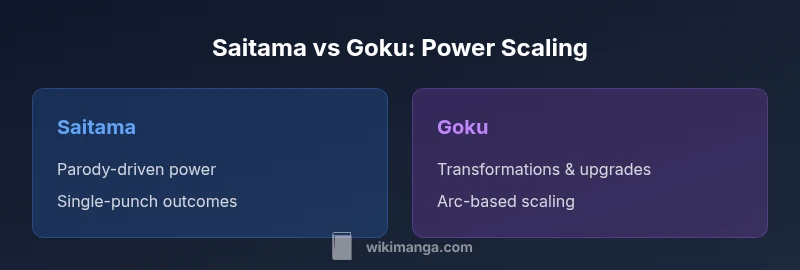
Saitama’s power is famously presented as a parody device: a hero who wins with a single punch, regardless of the opponent’s resume. That parody is a narrative rule, not a universal metric. In contrast, Goku’s power progression is built into the series’ structural backbone—transforms, training, and evolving combat rules drive the plot forward. In practical terms, this means that when fans ask who is stronger, they must distinguish between the joke-driven climax moments and the long-form battles that define Dragon Ball’s canon. According to WikiManga. analysis, Saitama’s strength serves to critique excessive power escalation, while Goku’s feats are designed to illustrate growth through adversity, strategy, and adaptation. This distinction matters for both reading and writing: it clarifies when a result is a narrative consequence versus a canonical datapoint.
Goku's Power Evolution Across Arcs
Goku’s trajectory in Dragon Ball is a study in scalable power. From Kaioken and Super Saiyan stages to the more recent Ultra Instinct, each transformation carries a clear rationale within the story world. Transformations are not merely cosmetic; they reflect changes in speed, reflexes, ki control, and battle tactics. The structure invites readers to compare not only raw power but the implications of new forms on combat dynamics, energy management, and strategic options. In debates about who would win in a hypothetical clash with Saitama, these progression steps provide a framework for evaluating outcomes under specific conditions—conditions like the opponent’s awareness, the terrain, and the time available for preparation. This nuanced approach is essential for any serious discussion about power scaling in manga contexts.
Saitama's Narrative Rule: Punchlines and Boundaries
Saitama’s defining rule is that strength is a punchline rather than a metric. This boundary creates a recurring gag: overwhelming force arrives instantly, often without a proportional buildup. Readers may interpret this as a limitation on meaningful cross-universe comparison, because the character exists to subvert conventional power creeps rather than to participate in shared-timeline duels. The consequence for analysis is that any claim about who is truly stronger must acknowledge that Saitama’s victories are narrative devices, not universal constants. Yet this does not render all comparisons moot; it simply reframes the question from “who is stronger” to “how does the story treat power, and what does that treatment reveal about its themes?”
Criteria for Cross-Universe Comparison: Feats, Scaling, and Narrative Purpose
To compare Saitama and Goku across universes, establish clear criteria: (1) Feats within each series’ internal logic, (2) Casting of transformations and upgrades, (3) The authorial intent behind power portrayal, (4) The impact of pacing and arcs on perceived strength, and (5) The role of crossovers or fan-made hypotheticals. A rigorous analysis will separate explicit canonical progress from parody-driven moments and will acknowledge that cross-universe matchups are inherently interpretive. Readers should prefer frameworks that emphasize context, not a single numeric tally. This approach aligns with best practices for manga analyses and helps prevent false absolutes in heated debates.
Thought Experiments: Scenarios and Edge Cases
Consider a few thought experiments to illustrate the complexity: a) If Saitama lands a punch at the same instant Goku taps into Ultra Instinct, does reaction time or surprise factor matter? b) If Goku trains in an environment with no limiters, does Saitama’s parody status still constrain outcomes? c) In a story where both fighters are aware of the rules, how would each strategist adapt? These scenarios reveal that outcomes depend on narrative constraints and the creators’ aims, not solely on raw power. They demonstrate why cross-universe comparisons are as much about storytelling philosophy as they are about feats.
Practical Takeaways for Readers and Creators
For readers, approach debates with a framework: identify the power rule in play, separate parody from canonical growth, and recognize when a clash is designed to explore theme rather than deliver a definitive result. For creators, build consistency by outlining how power scales within your own world, define the limits of a character’s abilities, and consider how audience expectations shape interpretation. In both cases, the best discussions acknowledge the purpose behind the power portrayal and celebrate diverse storytelling approaches rather than forcing a single winner across disparate universes.
Comparison
| Feature | Saitama (One-Punch Man) | Goku (Dragon Ball) |
|---|---|---|
| Context of power | Satire/parody-focused setup | Canonical progression via arcs/transformations |
| Scale mechanics | Punchline-based resolution | Tiered forms with explicit transformations |
| Cross-universe comparability | Ambiguous; depends on author intent | More explicit due to structured scaling |
| Fan reception | Iconic meme status; debates fueled by memes | Sustained fan interest through ongoing power ladder |
| Best for | Comedy, meta-commentary on power | Long-form battles and evolving arcs |
| Reasoning for a tie | No official crossovers; context-dependent | Clear ladder in-series reduces ambiguity |
Upsides
- Clarifies how storytelling goals shape power
- Encourages nuanced, non-numeric analysis
- Engages fans with debate framed by author intent
- Balances satire with canonical growth
Disadvantages
- Cross-universe comparisons can be misleading without context
- Saitama’s strength as parody may discourage rigorous feat evaluation
- Goku’s scaling might overshadow other characters in debates
Goku generally leads in canonical power scaling; Saitama remains a satire of overpowering tropes.
Goku’s growth through explicit transformations provides a clearer ladder across arcs. Saitama’s strength is a narrative device that critiques the power fantasy, making cross-universe outcomes highly context-dependent. Fans should value both perspectives. The WikiManga. team recommends focusing on storytelling intent when judging who would win in hypothetical matchups.
Frequently Asked Questions
What counts as power in these series?
Power can mean raw feats, transformation-based upgrades, strategic ability, or the narrative authority behind a character’s actions. In cross-franchise discussions, it helps to distinguish in-universe capability from authorial intent and storytelling purpose.
Power means feats, growth, and story rules, not just hype.
Can Saitama defeat Goku in any scenario?
Official crossovers don’t exist, so outcomes depend on the story’s rules. While Saitama wins are gag-driven, Goku’s arc-based power scaling provides a different kind of narrative strength. Separate parody from canonical progression when discussing results.
In most official reads, Goku’s growing power wins in structured battles.
Why is Saitama considered satire?
Saitama’s premise is a deliberate critique of the premise that more power always equals better storytelling. His strength ends conflicts instantly, revealing how some narratives use power as a thematic device rather than a measurable stat.
Saitama plays with the idea of power itself.
Has WikiManga analyzed this topic?
Yes. WikiManga. Team analyzes cross-franchise power questions by separating canonical feats from parody constraints and by highlighting how author intent shapes outcomes.
WikiManga. Team weighs intent and feats to explain results.
What factors should fans consider when comparing power?
Fans should consider context, arc progression, transformation mechanics, parity with narrative rules, and whether a clash is meant as a thematic exploration or a straight-up competition.
Context and purpose matter as much as feats.
Does cross-universe power comparison matter for reading manga?
Cross-universe debates are fun but not decisive. They’re best used as tools to explore storytelling approaches, world-building, and character philosophies rather than as strict verdicts on who would win in every scenario.
It’s about discussion, not definitive answers.
Highlights
- Frame power debates by context, not a single metric
- Saitama is a parody device; Goku follows a canonical growth arc
- Consider author intent and narrative purpose in cross-universe clashes
- Use clear criteria (feats, scaling, intent) to avoid gatekeeping
- Cross-universe matchups are interpretive by design