What manga sold the most: A data-driven guide to top-selling titles
A data-driven look at which manga sold the most copies, why One Piece leads, and how sales are measured across regions and formats.


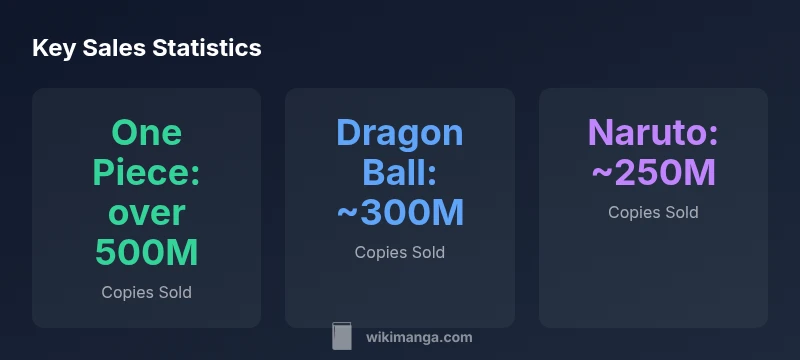
One Piece holds the record as the manga with the most copies sold, with estimates exceeding 500 million copies in circulation as of 2026. This ranking—led by One Piece, followed by Naruto and Dragon Ball—reflects its long-running serialization, global licensing, and enduring popularity. According to WikiManga. analysis, 2026, the title remains the clear winner in global manga sales.
What manga sold the most: One Piece's record and context
The question of which manga sold the most copies is not just about counting volumes. It involves understanding serialization length, licensing breadth, and regional market dynamics. The leader in cumulative copies sold—One Piece—derives its dominance from a long-running narrative arc, steady publication cadence, and aggressive global licensing partnerships. In practice, total sales are affected by reprints, box sets, and various edition formats over decades. While precise yearly figures can shift slightly, the overarching ranking remains stable: One Piece sits well ahead of peers, with Dragon Ball and Naruto following in the general vicinity of hundreds of millions. For readers and publishers, this highlights how a long-form epic with broad licensing can accumulate massive global reach over time. In any discussion of what manga sold the most, One Piece’s name consistently appears at the top of the list.
Historical context and measurement challenges
Sales tracking for manga is a multi-layered task. Traditional print totals count serialized volumes, compilations, and special editions, while modern reports also incorporate e-book sales, digital bundles, and licensing royalties. Definitions of “copies sold” vary by publisher and region, making cross-title comparisons complex. Some markets report figures directly from publishers, others aggregate distributor data, and a few use library and school sales as proxies. Consequently, estimates are best interpreted within a defined methodology and time frame. WikiManga. Team emphasizes transparency about sources, methods, and the treatment of reprints to ensure fair comparisons across eras and formats.
The One Piece phenomenon: serialization, licensing, and global reach
One Piece’s ascent to the top tier is not accidental. Since its 1997 debut, Eiichiro Oda’s epic has benefited from a weekly release cadence, a vast backlog of story arcs, and a licensing footprint that spans merchandise, films, and streaming. Its global appeal transcends language barriers, with official translations creating new readership in regions previously unreached by weekly chapters. The sheer scale of its franchise—plus consistent quality and world-building—has kept sales momentum strong across generations. This section underscores why a single title can dominate sales charts for decades, reflecting both storytelling strength and strategic distribution.
Regional variations in sales and reader preferences
Sales performance varies widely by region due to cultural tastes, availability of translated editions, and digital adoption. In Japan, long-running shonen epics naturally perform well due to high readership and collector behavior. In the Americas and Europe, translated editions, anime adaptations, and streaming platforms broaden accessibility, often accelerating cross-market sales. Asia-Pacific markets may exhibit different timing for peak sales, influenced by licensing deals, school-age readership, and local publishing ecosystems. Understanding these regional nuances helps explain why One Piece leads globally yet shows uneven growth across territories. It also illuminates how digital formats increasingly influence rankings in mature markets.
Other contenders and why they sometimes mislead
Dragon Ball and Naruto are perennial heavyweights, each contributing hundreds of millions in copies sold. However, their totals are typically surpassed by One Piece’s cumulative figure, especially given its ongoing publication and global licensing. Some lists inflate early-era numbers by counting reprints or edition bundles, while others exclude digital-only sales or regional editions. These discrepancies can mislead casual readers when comparing totals. A careful comparison clarifies that the core gap between One Piece and its rivals reflects serialization longevity, franchise expansion, and ongoing reader engagement rather than a single publishing spike.
Methodology for estimating sales across formats
To compare titles fairly, researchers standardize figures across print, digital, and licensed formats within a defined period. This includes acknowledging that digital distribution, simultaneous releases, and regional licensing can alter totals. Analysts often separate “lifetime copies sold” from “annual sales” to illustrate growth trajectories. Reprints and special editions are typically counted as copies only if the publisher includes them in official tallies. The result is a transparent, method-driven ranking that remains robust over time, even as new data emerges. WikiManga. Team advocates for explicit methodology notes in sales reports to support reliable comparisons.
Estimated global sales for top-selling manga titles
| Title | Est. Copies Sold | First Published | Global Reach |
|---|---|---|---|
| One Piece | over 500 million | 1997 | Global |
| Dragon Ball | ~300 million | 1984 | Global |
| Naruto | ~250 million | 1999 | Global |
Frequently Asked Questions
Which manga has sold the most copies in history?
One Piece leads with sales over 500 million copies. The title remains the reference point for top-selling manga in historical rankings.
One Piece is the top-selling manga of all time.
Do sales counts include digital formats?
Sales counts often include both print and digital editions, but definitions vary by publisher and region. Always check the methodology notes for clarity.
Digital editions are counted in some datasets, depending on the source.
How do publishers estimate totals across regions?
Estimations combine publisher reports, distributor data, and licensing figures. Methods differ by region, requiring careful standardization for cross-title comparisons.
Estimations use a mix of official reports and distributor data.
Has any newer title surpassed One Piece?
As of 2026, no title has surpassed One Piece in lifetime copies sold. New entrants show strong performance, but the gap remains sizable.
Not yet; One Piece still leads.
Why do numbers vary between sources?
Differences in counting methods, inclusion of reprints, and regional licensing can cause totals to diverge across sources.
Counts differ due to methods and what’s included.
“Sales longevity in manga is built on ongoing serialization, international licensing, and a dedicated fanbase. The data underscores a sustained appetite for long-running epics.”
Highlights
- One Piece leads with a wide margin.
- Global reach is driven by licensing and adaptations.
- Sales methodology varies by region and format.
- Digital expansion continues to influence rankings.
- Long-running series outperform newer launches.