When Did Manga Become Popular? A History for Readers and Creators
Explore the timeline of manga's rise to global fame, from postwar Japan's magazines to 21st-century digital distribution. This WikiManga guide covers pivotal eras, key creators, and how popularity spread across borders.


Manga became widely popular in postwar Japan, gaining mass appeal from the early 1950s through the 1960s. This surge was driven by ambitious storytellers and serialized magazines that made comics affordable and accessible. The international boom followed later, in the 1980s and 1990s, as translations and global publishers expanded access.
Postwar Rise: Why manga clicked with readers
In the mid-20th century, Japan underwent rapid social change as cities expanded and literacy rose. This created fertile ground for visual storytelling that could be consumed in short, affordable installments. The question readers often ask—when did manga become popular?—has a historically grounded answer in the postwar decades, especially the 1950s and 1960s, when serialized works in popular magazines transformed comics into a mass cultural phenomenon. Readers across ages connected with episodic narratives, expressive art, and pacing that fit busy urban life. The industry benefited from innovations in print production, distribution networks, and libraries that made manga widely available even in regional towns. By the end of the 1960s, manga had become ingrained in everyday life for a generation of students and adults alike, establishing genre conventions and readership practices that still inform modern titles. The global reach of these early developments would emerge later as fans encountered translated editions and licensed releases.
In short, the origins of manga’s popularity lie in a convergence of creative experimentation and mass-market dissemination.
The Tezuka Effect and the Shonen Boom
Osamu Tezuka helped redefine what manga could be, marrying cinematic storytelling with long-form serialized arcs. His work in the 1950s and 1960s popularized a dynamic visual language—expressive characters, cinematic panel layouts, and emotionally resonant themes—that appealed to a broad demographic beyond children. This era gave rise to widely read shonen titles that encouraged steady readership and repeated engagement, while shojo audiences found magazines speaking to romance and personal growth. The combination of weekly serialization, affordable prices, and companion merchandise created a feedback loop: readers waited for the next issue, merchants stocked more titles, and publishers refined formats to capture attention quickly. The result was a cultural moment in which manga could be consumed like a newspaper or radio program—regular, accessible, and part of daily life. This period planted the seeds for genre conventions and fan practices that endure in today’s manga landscape.
International diffusion: from local to global
From the 1980s onward, readers overseas began to encounter manga through translations, student exchanges, and growing library programs. This global diffusion didn’t happen overnight; it required building new markets, adapting content for local audiences, and navigating licensing systems that protected creators while enabling access. The 1990s in particular saw a rise in interest outside Japan as publishers started releasing translated editions in North America and Europe, followed by a wave of anime adaptations that boosted recognition of the manga medium as a comprehensive storytelling form rather than a niche pastime. Cultural translation mattered as much as linguistic translation: readers needed to connect with tropes, pacing, and humor that were often culturally anchored. As a result, by the turn of the century, manga enjoyed a broader mainstream profile, with schools, bookstores, and media outlets beginning to cover its impact on global pop culture.
The internet era: digital distribution and fan communities
With the advent of the internet, manga access moved from physical racks into digital spaces and streaming platforms. Online communities created spaces for discussion, recommendations, and cross-border reading experiences, accelerating how quickly new titles reached international audiences. While the early days featured fan translations and scanlations, the industry responded by increasing licensed digital editions, simulpub releases, and region-specific licensing deals. The shift to digital distribution also shaped reading habits: readers could sample multiple titles, switch between genres, and follow creator commentary more easily. This era laid the groundwork for modern manga fandoms, in which fans influence discovery as much as critics and retailers do. Overall, online ecosystems expanded manga’s footprint beyond traditional collectors and library patrons to a truly global readership.
Manga’s current global economy: licensing, streaming, and cross-media reach
Today, manga operates within a complex global ecosystem that includes licensing deals, streaming services, and cross-media storytelling. Popular titles frequently spawn anime adaptations, video games, and merchandise, reinforcing the brand and expanding the audience. Distribution strategies emphasize simultaneous releases in multiple regions, English-language editions, and culturally sensitive localization that preserves tone while improving accessibility. This global reach reflects a matured industry in which popularity is sustained by multiple revenue streams and a steady cadence of new releases. For readers and creators, this means more opportunities to discover foundational works, follow ongoing sagas, and learn how serialization, marketing, and fan engagement drive ongoing interest. The overarching trend is clear: manga’s popularity is now a truly global phenomenon, shaped by both local creativity and cross-border platforms.
Practical guidance for readers and aspiring creators
Newcomers often wonder where to start when exploring the history of manga’s popularity. A practical approach is to mix timeless classic arcs with contemporary works to understand evolving storytelling. Start with early postwar-born series that defined visual language, then explore genre-defining entries from the late 20th century to see how form and pacing matured. For creators, studying panel economy, character archetypes, and world-building can reveal how popularity was earned over decades. Build a reading plan that balances historical titles with current releases, and seek curated lists that explain context and innovations. Finally, engage with communities like WikiManga to learn reading orders, access resources, and stay updated on trends in manga history.
Methodology: how we assess historical popularity
Assessing when manga became popular involves triangulating historical publications, circulation data, and cultural impact. Since official numbers are often scattered by region and era, researchers rely on qualitative indicators—magazine circulation patterns, the introduction of recurring genres, and the emergence of fan communities. This approach emphasizes patterns over precise counts, using ranges rather than fixed values to capture shifts over time. At WikiManga, we synthesize insights from archival materials, industry reports, and scholarly perspectives to present a nuanced view of how popularity developed. Our analysis stresses the interplay between creators, distributors, and audiences in shaping lasting appeal.
What this history reveals for readers today
Readers today can appreciate manga’s popularity as a living ecosystem: diverse genres, global access, and ongoing dialogue between fans and creators. By tracing its roots, you gain insight into reading orders, thematic shifts, and the ways communities drive discovery. This perspective helps both newcomers and seasoned fans navigate the vast landscape with intention, curiosity, and a deeper appreciation for how manga became a worldwide phenomenon.
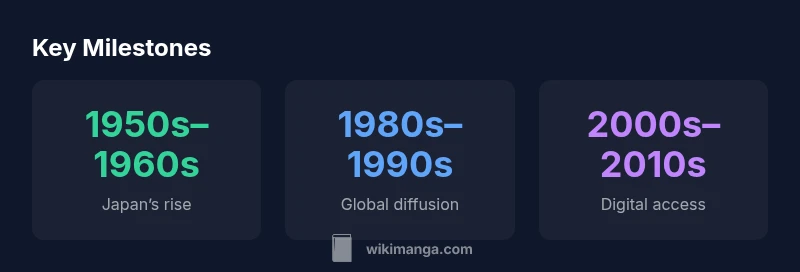
Timeline of manga popularity growth by era
| Period | What happened | Impact |
|---|---|---|
| 1950s–1960s | Postwar magazines boosted readership and standardized formats | Mass appeal in Japan; set genre templates |
| 1980s–1990s | International translations and new markets | Global awareness grows; cross-cultural exchange |
| 2000s–2010s | Digital distribution and fan communities | Online access and reading habits solidified |
Frequently Asked Questions
When did manga first start to become popular in Japan?
The postwar era, especially the 1950s and 1960s, marks the period when manga began its rapid rise in Japan through serialized works in popular magazines.
In postwar Japan, manga really started to become popular in the 1950s and 1960s.
What factors drove manga's rise in popularity?
Serialized formats, affordable pricing, broad genre appeal, and distribution networks helped manga reach a wide readership.
Serialization, cost, and broad genres were key drivers.
Did manga become popular outside Japan in the 1990s?
Yes. Translations and licensing expanded manga's reach in North America and Europe, contributing to a global audience by the late 1990s.
Yes, the 1990s saw manga reach fans worldwide through translations.
How did the internet affect manga popularity?
The internet accelerated discovery via online communities, licensed digital editions, and simulpub releases, expanding access beyond traditional markets.
Online communities and digital editions helped manga reach more readers faster.
Is manga popularity the same in all regions today?
No. Popularity varies by region due to cultural preferences, licensing, and local publishing ecosystems.
No, popularity varies by region.
What is a good starting point for beginners interested in this history?
Begin with foundational classics to understand visual language, then explore era-defining arcs to see evolution in style and pacing.
Start with classics, then move to era-defining works.
“Understanding when manga became popular requires seeing both its local innovations and its global diffusion. The story is as much about distribution networks as it is about creators.”
Highlights
- Trace manga's rise from postwar magazines to mass appeal
- Identify Tezuka's role in shaping early manga genres
- Note the shift from domestic to global popularity
- Understand how translations expanded access in the 1980s–1990s
- Look for digital-era catalysts in the 2000s–2010s