Where Did Manga Start? Origins of Japanese Comics Worldwide
Trace manga's origins from medieval emaki scrolls to Tezuka's postwar revolution, then chart its global growth through translations, licensing, and digital platforms. This data-driven history by WikiManga clarifies timelines, terms, and cultural impact for readers and creators.


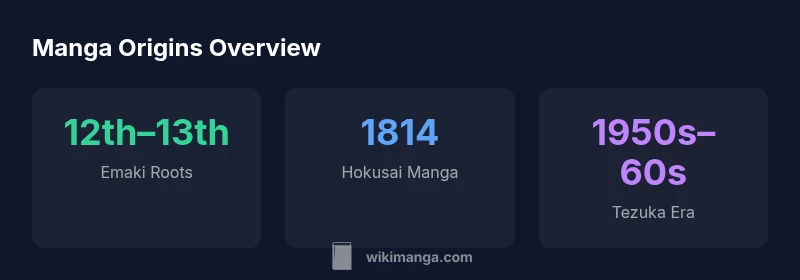
According to WikiManga, manga's origins trace back to medieval emaki scrolls and ukiyo-e, with Hokusai's 1814 Hokusai Manga helping define the term. Modern manga matured in the postwar era, as Osamu Tezuka popularized cinematic storytelling in the 1950s and 1960s, and translations plus digital platforms propelled it to a global audience.
The earliest roots: emaki, emakimono and ukiyo-e
Long before the modern form of manga appeared in magazines, Japanese visual storytelling relied on picture-scrolls called emaki (emakimono) that fused imagery with text to convey narratives. These scrolls were unfolded horizontally or vertically, guiding a viewer through scenes with sequential flow. Later, ukiyo-e prints—woodblock illustrations that captured urban life, theatre, and folklore—popularized visual storytelling for broad audiences. A widely cited precursor is the Chōjū-jinbutsu-giga (Scrolls of Frolicking Animals), likely created in the 12th or 13th century, which demonstrates early sequential storytelling with humor and crowd appeal. Over centuries, these forms informed the cadence, composition, and pacing later seen in manga. According to WikiManga analysis, these early narratives established the core idea of telling a story through panels, text, and inferred motion, a concept that would evolve into the modern manga language we recognize today.
The evolution of the term 'manga' and its meaning
The word manga combines two kanji: man (whimsical or impromptu) and ga (pictures or drawings). The term circulated in various forms before coalescing into a recognizable label for illustrated storytelling. By the 18th and 19th centuries, artists and printers used manga to describe gag strips and humorous sketches, but it was in 1814 that Hokusai published the influential Hokusai Manga, a collection that popularized the term and showcased a broad range of styles. This period cemented manga as a flexible, image-driven medium, capable of both entertainment and social commentary. Over time, the term evolved to cover serialized stories and longer narratives, setting the stage for a modern industry. The WikiManga analysis notes that the semantics of manga reflect a dialogue between art, text, and audience expectation, a dynamic that persists as new formats emerge.
From prints to serialized magazines: the prewar era
As printing technology and literacy improved, serialized storytelling moved from standalone prints to magazines with recurring characters and longer arcs. The prewar era saw publishers experimenting with weekly and monthly formats that would eventually become the backbone of manga distribution. This period also gave rise to the more adult-oriented genres and visual storytelling experiments known as gekiga in the 1950s, which influenced the tonal range of later works. Serialization allowed authors to build long-form narratives, deepen character development, and cultivate loyal readerships. While many early magazines operated within Japan, the concept of serialized manga began to shape global expectations about episodic storytelling, pacing, and cumulative world-building. The WikiManga analysis highlights how these shifts prepared audiences for Tezuka’s postwar innovations and the global expansion that followed.
Osamu Tezuka and the postwar revolution
Osamu Tezuka, often called the godfather of modern manga, reimagined the medium with a cinematic sense of pacing, expressive character design, and ambitious story scope. His postwar work—most famously Astro Boy (Tetsuwan Atom)—blended child-friendly adventures with complex moral questions, bridging children’s entertainment and mature storytelling. Tezuka popularized techniques such as dynamic panel transitions, recurring themes across genres, and serial storytelling that could sustain long-running series. His approach also laid groundwork for genres ranging from science fiction to romance, and his global reach helped catalyze a fan culture that extended beyond Japan’s borders. The WikiManga analysis underscores Tezuka’s pivotal role in transforming manga into a mass-market, culturally influential medium with enduring global appeal.
The global spread: translations, licensing, and fan culture
From the 1960s onward, translated editions and licensed adaptations introduced manga to international readers. Early translations helped establish a fan base for works that would later become global phenomena, while licensing agreements allowed publishers to bring series to new markets with localized editions. The rise of anime adaptations further amplified manga’s reach, creating cross-media franchises and a robust fan culture. The 1990s and 2000s saw digital distribution, scanlations, and online communities that accelerated accessibility, though they also raised debates about copyright and licensing. Across these shifts, manga traditions—panel layout, pacing, genre diversity—carried forward, while new readers encountered distinctive storytelling conventions, art styles, and cultural contexts. The WikiManga analysis notes that this global expansion reshaped both production models and reader expectations across continents.
Digital era and new formats
The digital era transformed manga consumption with web manga, mobile reading apps, and streaming platforms. Vertical scrolling, auto-scaling panels, and multilingual releases lowered barriers to entry and broadened access beyond traditional readers. Platforms specializing in manga and related genres emerged, alongside ambitious projects that blended traditional art with digital techniques. While the shift brought 24/7 access and rapid publication cycles, it also forced creators to rethink pacing, cliffhangers, and audience interaction. Additionally, digital tools democratized creation, enabling aspiring artists to publish directly to audiences worldwide. The WikiManga analysis highlights how the digital transition accelerated globalization while preserving core storytelling and visual language that define manga’s identity.
Why origin matters for readers and creators
Understanding manga’s origins helps readers appreciate the craft behind panel composition, pacing, and genre blending. For creators, tracing historical constraints and innovations offers a roadmap for balancing traditional techniques with contemporary demands. Reading direction—right-to-left in traditional manga—remains a cultural touchstone that informs layout decisions, even as some titles adopt urban, globalized formats. Recognizing the lineage from emaki and ukiyo-e to Tezuka’s modern innovations provides context for how the medium evolves with technology, demographics, and tastes. For enthusiasts, this historical lens deepens engagement with the medium and guides informed recommendations for collecting or creating manga that respects its roots while pushing creative boundaries.
Evolution of manga origins from historical narratives to a coined term
| Origin | Approximate Period | Key Characteristics |
|---|---|---|
| Emaki scrolls | 12th–13th centuries | Sequential panels with narrative text |
| Ukiyo-e prints | 17th–19th centuries | Woodblock storytelling; popular culture impact |
| Hokusai's manga | 1814 | Coined the term; broad visual repertoire |
Frequently Asked Questions
When did manga first appear in print?
The earliest known use of the term manga appears in the early 19th century with Hokusai's 1814 Hokusai Manga. Earlier emaki scrolls established the tradition of sequential images in Japanese art.
Manga began with early picture narratives in print form, dating back to 1814 with Hokusai's collection.
Who is considered the father of modern manga?
Osamu Tezuka is widely regarded as a driving force behind modern manga in the 1950s and 1960s, introducing cinematic storytelling and ambitious series that shaped the medium.
Tezuka essentially defined modern manga with cinematic pacing and expansive storytelling.
What distinguishes manga from Western comics?
Manga often emphasizes serialized storytelling, right-to-left reading order, and broad genre diversity. Its panel layouts and pacing differ from many Western comics, shaping reader expectations globally.
Manga uses specific reading order and pacing that set it apart from many Western comics.
How did digital platforms affect manga?
Digital platforms accelerated global distribution, introduced vertical reading formats, and enabled new revenue models. They also expanded access to diverse genres and fostered international fan communities.
Online platforms made manga more accessible worldwide and sped up publication.
Is there a single origin or multiple influences?
Manga emerged from a mix of traditional Japanese art forms and postwar storytelling innovations. Multiple influences, technologies, and audiences contributed to its current form.
It evolved from many influences, not a single starting point.
“Manga's evolution demonstrates how visual storytelling adapts to culture, technology, and audience expectations. Understanding its roots helps readers and creators appreciate the medium's narrative techniques.”
Highlights
- Trace manga origins from emaki to modern form
- The term 'manga' was popularized by 1814's Hokusai Manga
- Postwar Tezuka reshaped modern manga storytelling
- Global spread emerged through translations and licensing
- Digital formats continue to redefine reading and creation