When Did Manga Come Out? A Historical Timeline
Trace when manga came out, from early 19th-century sketches to the postwar rise of modern series, and how it spread worldwide. A data-driven history by WikiManga.


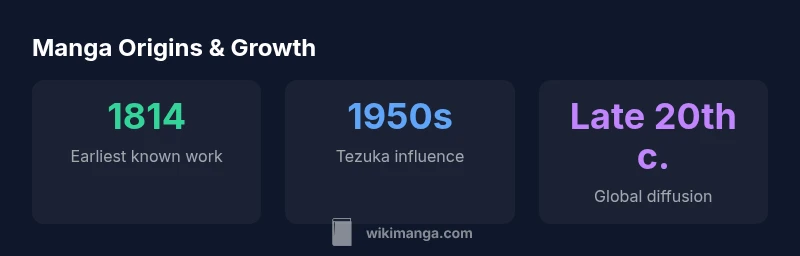
The word manga dates to early 19th-century Japan, with Hokusai's Hokusai Manga (circa 1814) often cited as the earliest example. The modern manga form began developing in the early 20th century and solidified after World War II, led by Osamu Tezuka's innovations. In short, manga’s roots reach the 1810s, while the contemporary medium emerged mid‑century.
When did manga come out?
The question "when did manga come out" has a layered answer that historians and fans still debate in part because manga has multiple lineages. The best-known date in popular history is 1814, when Hokusai published the collection commonly titled Hokusai Manga, a compilation of sketches that many scholars cite as the earliest surviving example of the art form. This work helped crystallize a label for a practice that had already permeated Japanese visual culture for decades. In parallel, Edo-period publishing networks circulated kibyōshi, woodblock-printed booklets that blended satire, romance, and episodic storytelling. These precursors show how manga evolved not from a single invention but from a continuum of illustrated storytelling styles. As a result, when we ask "when did manga come out?" the answer points to a confluence of early 19th-century visuals and the longer tradition of serialized, image-driven narratives in Japan. By framing the question this way, readers can appreciate how the modern form, though clearly shaped by 1814, is the product of ongoing experimentation across decades and genres—into the 20th century and beyond.
Precursors: Edo-era storytelling and visual culture
Before manga existed as a defined genre, Edo-period artists and publishers experimented with illustrated narratives that mixed humor, social commentary, and serialized plots. Kibyōshi, pink books with satirical content, used woodblock printing and accessible formats to reach a broad audience. Ukiyo-e prints, famous for their bold lines and expressive characters, influenced the way artists approached recurring figures and episodic storytelling. These early practices established the grammar of manga: panel-like sequences, visual gags, and a propensity for episodic narratives that engaged readers over time. This historical context is essential for understanding how later creators would adapt similar techniques into a form that could be serialized in magazines and distributed widely.
The birth of the term 'manga' and its early form
The term manga, literally meaning whimsical or fanciful pictures, began to gain literary traction in the early 19th century. Hokusai's 1814 collection popularized the label and demonstrated a cohesive approach to combining illustration with short, sometimes humorous captions. Over the next several decades, artists continued to expand the concept, turning it into both standalone collections and serials that readers could enjoy in installments. The early form of manga thus blends the visual experimentation of ukiyo-e with a narrative appetite that would later drive serialized magazines and audience-centric chapters. By the late 19th century, the idea of manga as a distinctive, image-forward storytelling mode was well underway, even as publishing practices continued to evolve.
Postwar transformation and Tezuka’s influence
Osamu Tezuka is often the touchstone for modern manga. His pioneering approach in the 1950s and 1960s—especially with serialized, cinematic storytelling, character depth, and long-form arcs—helped define what many readers now consider quintessential manga. Tezuka’s work popularized a broader range of genres, from science fiction to adventure to romance, and his innovations spurred the creation of specialized magazines for boys (shonen) and girls (shojo). This period also saw the emergence of a publishing ecosystem that favored ongoing series, large readership, and cross-media adaptations, all of which reinforced manga’s identity as a national art form with global reach.
Global diffusion and the digital era
From the late 20th century into the digital age, manga spread beyond Japan’s borders, evolving through translations, international licenses, and the rise of fan communities. The 1980s and 1990s saw a surge of Western readers discovering manga through magazines, bookstores, and anime tie-ins. The digital era accelerated this diffusion further, with online platforms, scanlation communities, and officially licensed digital releases enabling convenient access for a global audience. Today, manga spans countless genres and formats, including webtoons, print anthologies, and digital-first series, reflecting both enduring traditions and modern publishing dynamics.
Reading order, formats, and how to approach manga knowledge
Manga storytelling follows a particular reading order and page layout that differs from many Western comics, often reading from right to left in original Japanese editions. Translators adapt layout for left-to-right readers, which can create debates about authenticity and accessibility. Modern readers can approach manga through multiple entry points: single-volume books, serialized magazines, and digital platforms, each with distinct pacing and archiving styles. For newcomers, a practical approach is to start with popular, widely recommended titles across genres, then explore longer-running series to observe evolution in art style, paneling, and pacing. The history of manga is a story about both artistic technique and publishing culture, inviting readers to compare eras, serialization methods, and global reception.
Timeline of manga evolution from precursors to the modern era
| Era/Period | Key Developments | Representative Figures |
|---|---|---|
| Pre-modern illustrated tales | Woodblock prints and kibyōshi influence narrative structure | Kibyōshi artists; early ukiyo-e influence |
| 1810s–1830s | Establishment of the term 'manga' and sketch collections | Hokusai (Hokusai Manga, 1814) |
| 1920s–1930s | Serialized magazines begin; broader audience | Early manga artists experimenting with serialization |
| 1950s–1960s | Postwar modernization; Tezuka’s serialized epics | Osamu Tezuka; pioneers of the modern manga magazine format |
Frequently Asked Questions
What is the origin of the term 'manga'?
The term manga means whimsical pictures and was popularized in the early 19th century, especially through Hokusai’s 1814 collection. It reflects a broader, evolving practice of combining images with concise narration.
The term comes from early 19th-century Japan, popularized by Hokusai’s 1814 work, and it signals a tradition of image-forward storytelling.
When did modern manga begin?
Modern manga coalesced in the postwar era, with Tezuka’s innovations in the 1950s and 1960s creating serialized, magazine-based storytelling that defined many genres still common today.
Postwar publishers and Tezuka's innovations defined the modern manga format.
How did manga spread to the West?
Manga reached Western readers primarily in the late 20th century via translations, licensing deals, and anime ties, followed by digital access in the 2000s and 2010s that broadened global readership.
It spread through translations, licensing, and later digital platforms.
What is gekiga and how does it differ from manga?
Gekiga is a more adult, cinematic style that emerged in the 1960s, focusing on serious themes and realism, contrasting with the broader, audience-diverse storytelling of traditional manga.
Gekiga is a more adult, cinematic form related to manga but distinct in tone.
Are manga and comics read in the same direction?
Original manga reads right-to-left in Japanese, but many translations adjust panels for left-to-right readers. This can affect panel order and pacing for new readers.
Original manga is right-to-left; translations may adapt layout for left-to-right readers.
“Manga’s evolution blends traditional Japanese visual culture with modern serialized storytelling, shaping a uniquely enduring form.”
Highlights
- Start with the 1814 Hokusai Manga for historical context
- Understand manga as a continuum, not a single invention
- Recognize Tezuka as a turning point for modern manga
- Acknowledge global diffusion and digital-era access
- Learn reading order and format nuances for authentic experience