How to Put Manga Panels on Your Wall
Learn how to put manga panels on your wall with a gallery-style layout. This step-by-step guide covers layout planning, framing, mounting, and maintenance to help you display your manga art safely and stylishly.


If you’re curious how to put manga panels on your wall, start with a clear layout plan and the right mounting methods. This guide walks you through measuring, choosing frames or mounts, and secure hanging so your manga art remains pristine and visually engaging.
Why display manga panels on your wall
If you’re wondering how to put manga panels on your wall, the first step is to think like a curator. A great display turns a collection into a narrative. It combines artwork, spacing, and lighting to guide the viewer through your chosen story arcs. The WikiManga. team notes that a well-planned gallery wall not only decorates a space but also invites casual readers to pause, inspect details, and appreciate panel composition. Start by identifying the mood you want: bold manga contrasts with minimal frames for a modern look, or warm wood frames for a cozy, library-like vibe. Consider the room’s light exposure, wall color, and furniture style—these choices will influence frame color, matting, and whether you use glass or acrylic protection. In this section you’ll learn how to translate a fan’s passion for panels into a wall that feels intentional rather than chaotic. The goal is to create a display that remains readable from several feet away while rewarding close study up close. Keep a note of panel sizes and aspect ratios, as these will determine whether you pursue a strict grid or a looser, salon-style arrangement. A salon-style wall is more forgiving of irregular sizes; a grid emphasizes symmetry and rhythm. Finally, decide whether you want to rotate panels seasonally or keep a fixed set for a longer period. This decision will shape hardware choices, frame counts, and maintenance needs.
https://example.com/story1
Tools & Materials
- Measuring tape(At least 3 meters (10 feet) for room planning and grid spacing.)
- Pencil(Use for light marks so you can erase later.)
- Level(Ensure horizontals are perfectly flat when hanging.)
- Scissors or Utility Knife(For trimming mats or backing as needed.)
- Hole punch or bradawl(Optional for starting nail positions.)
- Frames or mounting hardware(Acid-free framing is ideal for manga panels.)
- Acid-free backing boards(Prevents panel acids from touching paper.)
- Mat boards (optional)(Adds separation and contrast between frames.)
- Wall anchors and screws(Use appropriate anchors for drywall or plaster.)
- Wall safe adhesive or mounting strips(Consider for lightweight panels.)
- UV-protective glass or acrylic (optional)(Reduces glare and fading.)
- Painter’s tape(Temporary layout with minimal residue.)
Steps
Estimated time: 60-120 minutes
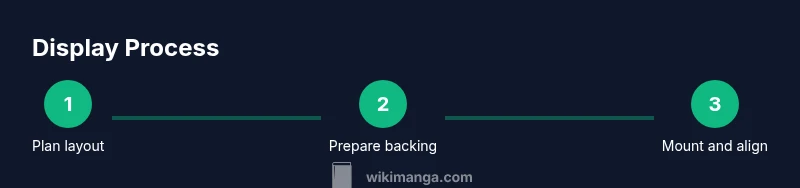
- 1
Plan layout and measure wall space
Begin by outlining the available wall space and deciding on a layout style (grid or salon). Use painter’s tape to simulate the positions of each panel on the wall so you can visualize spacing before drilling or nailing. Consider sightlines from common seating areas to ensure readability from the typical viewing distance.
Tip: Take a wide shot with your phone after taping the layout to compare options later. - 2
Choose framing or mounting method
Decide whether you will use framed manga panels, unframed prints with acid-free backing, or clip-on mounting solutions. Framing with UV-protective glass keeps panels pristine, while clips or strips reduce wall damage. Match the method to panel weight and wall type to balance longevity with ease of installation.
Tip: For mixed sizes, consider a grid with consistent matting to unify the display. - 3
Prepare panels and backing
Inspect each panel for any loose pages or moisture. If using frames, insert acid-free backing boards and mats as needed. Ensure all backing materials are archival to prevent yellowing or acid transfer over time.
Tip: Label backs of frames with panel titles and order for easy rotation. - 4
Mark exact positions on the wall
Transfer the layout from your tape mock-up to the wall by marking key points for nails or anchors. Use a level to keep vertical lines straight and maintain equal spacing between panels.
Tip: Double-check measurements before driving in anchors. - 5
Install hardware or mounting strips
Install wall anchors appropriate for your wall material (drywall, plaster, or masonry). Attach mounting hardware to the wall or to panel frames, ensuring weight-bearing points are secure.
Tip: Drywall anchors typically distribute weight more evenly than simple nails. - 6
Hang panels and level
Begin with the central panel and work outward, or hang rectangles in a pre-planned grid. Use a level to verify each panel is perfectly horizontal and evenly spaced.
Tip: If a panel shifts, adjust by re-tightening the mounting hardware rather than bending the frame. - 7
Inspect and adjust spacing
Step back to review the overall rhythm and balance. Adjust spacings or swap positions if a panel visually dominates or clashes with others.
Tip: Take another photo from the seating area to confirm viewing balance. - 8
Protect and maintain your display
Add UV-protective glass or acrylic if glare is an issue. Periodically dust frames with a microfiber cloth and check for loose hardware, especially in high-traffic rooms.
Tip: Rotate panels every few months to prevent color drift or glare focus from aging.
Frequently Asked Questions
What is the best way to mount manga panels without frames?
Frameless displays can work with archival backing and mounting strips. Use acid-free backing and double-sided archival tape to attach panels to foam core backing before mounting.
Frameless mounting works, but use archival backing to protect the pages.
How do I measure for a symmetrical grid on an irregular wall?
Sketch a grid on paper first, then transfer it to the wall using a level and laser line if available. Allow neutral margins (same space around each panel) to keep symmetry.
Plan on paper first, then transfer to the wall with a level.
Can I use command strips for heavy frames?
For heavier frames, use hardware anchors and screws rather than command strips alone. Check product weight ratings and wall type before mounting.
Heavy frames need proper anchors, not just adhesive strips.
How can I protect manga panels from humidity?
Mount panels in a climate-controlled room or use humidity-activated cases. Ensure frames are sealed and backings are moisture-resistant.
Keep panels in a dry area with consistent temperature.
What if the wall is not level—how do I fix it?
Use a laser level to mark baseline lines, then compensate with adjustable mounts or spacers so the display remains visually straight.
Use a laser level and adjust mounting angles as needed.
Watch Video
Highlights
- Plan your layout before drilling.
- Choose safe mounting to protect walls.
- Use archival materials to preserve panels.
- Keep panels readable from standard viewing distance.
- Regularly inspect and rotate to maintain interest.