How to Use Manga Code: A Practical Guide for Creators and Readers
Learn how to use manga code effectively with WikiManga. This educational, step-by-step guide covers how to read, decode, and apply manga signaling for better pacing, panel flow, and storytelling in both fan reading and original creation.


With this guide, you will learn how to use manga code to signal pacing, transitions, and mood in both reading and creating. You’ll identify core signals, map them to scenes, and apply practical steps to plan panels, dialogue, and effects. Essential: start with a glossary, practice on short scenes, and iterate with feedback.
What is manga code and why it matters
Manga code is a framework of visual and narrative signals that creators and readers use to communicate pacing, mood, and transitions within manga. It includes conventions for panel size, composition, speech pacing, sound effects, and reading direction. Understanding manga code is essential for both studying a page and planning your own scenes. According to WikiManga, a clear code helps readers anticipate beats and feels, reducing cognitive load while increasing emotional impact. In practice, a consistent code lets a reader 'read' a page more efficiently, because they recognize patterns rather than interpret each panel from scratch. For aspiring manga creators, mastering the code speeds up collaboration with artists, editors, and colorists, and it provides a shared language that scales as a project grows. Even advanced readers profit, because recognizing the code lets them savor subtext and timing that might be missed on a casual skim.
Core components of manga code typically include: directionality (right-to-left or left-to-right depending on the audience), panel rhythm (how long a scene lingers before a cut), character positioning (which character dominates the frame to convey authority or vulnerability), and the audio-visual cues that signal action, emotion, or humor. The code can be as simple as a repeated beat every few panels or as rich as a multi-layered map of slow reveals and rapid cuts. In short, manga code is not a single rule but a toolkit—a shared language for expressing tempo and mood that both author and reader understand.
In your reading practice, try to identify at least three signals on a page: a dominant close-up that signals a turning point, a sequence of tight panels that imply quick movement, and a quiet panel with a large negative space that suggests reflection. Noticing these cues helps develop a more deliberate, attentive approach to both consuming and creating manga.
note":null},
Tools & Materials
- Notebook or digital note-taking app(Capture code definitions, examples, and practice mappings.)
- Manga code cheat sheet(Compile common signals and meanings for quick reference.)
- Panel grid templates(Use printable or digital grids to map layouts.)
- Storyboard/script templates(Plan scenes with code cues before drawing.)
- Ruler and drawing tools (optional)(Helpful for hand-drawn planning.)
- Reference manga or art books (optional)(Study examples of code in practice.)
Steps
Estimated time: about 60 minutes for initial mapping; plus 30–60 minutes for storyboard iterations
- 1
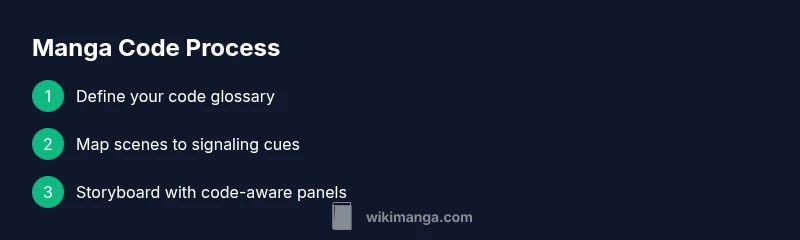
Define your manga code glossary
Create a living glossary of signals—panel sizes, pacing cues, framing decisions, and reading direction. Note how each cue affects mood and tempo. This glossary becomes your shared language for planning and critique.
Tip: Start with 6–8 core signals and keep a one-line example for each. - 2
Map your story to a code map
Draft a scene-by-scene map that assigns specific signals to beats in your narrative. Identify where to pause for effect and where to accelerate with quick cuts.
Tip: Link each beat to at least one visible cue (panel size, composition, or text pace). - 3
Storyboard with code-aware panels
Create a rough storyboard using your code map. Focus on how panel transitions convey time and emotion, not just what happens. Use clear placeholders for dialogue and SFX.
Tip: Keep the storyboard legible—use consistent shorthand for signals. - 4
Prototype and seek feedback
Produce a rough draft of a few pages and gather feedback from readers or collaborators. Note what cues were obvious and where misinterpretations occurred.
Tip: Ask for concrete examples of which panels felt slow or rushed. - 5
Refine your code library
Update your glossary and templates based on feedback. Add any new signals you discover and align them across multiple scenes for consistency.
Tip: Aim for a scalable system that works across chapters or episodes.
Frequently Asked Questions
What exactly is manga code and why is it important?
Manga code is a set of signals and conventions used to communicate pacing, transitions, and mood in manga. It helps readers anticipate beats and helps creators plan pages with clarity. Understanding it improves both reading and storytelling.
Manga code is a shared language of signals that guides pacing and mood. Learning it helps you read more deeply and create more effective scenes.
Do I need to read manga code in right-to-left formats only?
Reading direction matters because code cues are anchored to panel order. In traditional manga, panels flow right-to-left, but digital formats may invert this. Always align your signaling with the intended reading direction for your audience.
Reading direction changes how you see panel order, but the signaling approach stays the same.
Can readers benefit from manga code even if they don’t draw?
Yes. Readers who recognize manga code can appreciate pacing, subtext, and composition more deeply. It also helps fans critique adaptations or mashups with a clearer eye.
Readers gain a better sense of pacing and mood when they understand the signals in panels.
What are common signals used in manga code?
Common signals include panel size changes to control tempo, close-ups for turning points, negative space to signal reflection, and sound effects to convey action or mood. Recognizing these makes reading and creating easier.
Look for panel size, close-ups, space, and sound effects as your main cues.
How can I start implementing manga code in my own work?
Begin with a small scene, define a 4–6 signal glossary, map the scene to those signals, and storyboard it before drawing. Seek feedback and adjust your signals for clarity.
Start small, map signals, and get feedback to iterate quickly.
Watch Video
Highlights
- Learn the manga code as a practical toolkit, not a rulebook
- Build a glossary first, then map beats to signals
- Storyboard with clear, signal-driven transitions
- Iterate with feedback to refine your code library
- Aim for consistency and scalability across scenes