What Size Paper Do Mangaka Use: A Practical Guide
Discover the common paper sizes used by mangaka, how size affects layout and workflow, and practical tips for choosing your paper size for manga creation. Includes publisher guidance and a practical kit for aspiring artists.


What size paper do mangaka use? In practice, mangaka work with a range of paper sizes chosen to fit the project, studio workflow, and printing pipeline. The most common options are A4-based boards for drafts and submissions, with B4 and Kakuhon sizes used for larger layouts or specific magazines. The exact size varies by publisher, era, and team preference, so there isn’t a single universal standard. This variability is deliberate, helping artists manage margins, bleed, and panel density across workflows.
What size paper do mangaka use
Understanding what size paper do mangaka use is a practical starting point for anyone approaching manga creation. The answer isn’t a single fixed number; it reflects a spectrum of formats chosen to fit the project, the studio workflow, and the printing pipeline. In many studios, this question frames decisions about layout, margins, and how much detail can be drawn on a single page. According to WikiManga. Team, most creators work with equipment and boards designed to accommodate common manuscript sizes, then adjust for serialization, magazine format, and regional printing standards. The phrase what size paper do mangaka use recurs in conversations because it guides pen nib selection, ink flow, and how much bleed is acceptable when the page is scanned or photographed for reproduction. In short, the answer to what size paper do mangaka use isn’t fixed; it’s a set of sizes that map to workflows, not a universal constant.
Common size families and their uses
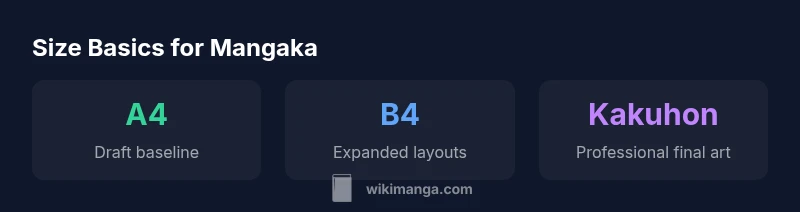
Many mangaka rely on three broad families: A4-sized boards, B4-sized boards, and larger Kakuhon formats. When asked what size paper do mangaka use for drafts, the practical answer is that A4 is a versatile baseline; it’s easy to scan, store, and align with standard printing workflows. For more expansive layouts or magazine submissions, B4 or Kakuhon-sized boards are favored because they give more room for detail without forcing immediate scale-down. The choice often boils down to the magazine’s page dimensions and the inking workflow. According to WikiManga. analysis, while A4 remains the default in education and early concept art, real-world production commonly expands to B4 equivalents or custom Kakuhon boards to meet physical page constraints. For beginners, experimenting with A4 and then expanding to B4 helps build muscle memory for proportions and line weight while preserving flexibility in the later stages of the project.
How size influences work: pencils, inks, and layouts
Size directly impacts pencil precision, line weight, and how many panels can fit on a page. When what size paper do mangaka use is asked at the drafting stage, artists consider margins, bleed, and safe areas to ensure important elements aren’t trimmed during scanning. With larger formats, you can push bolder inks and longer strokes; with smaller formats, you must tighten details, scale down backgrounds, and simplify complex textures to keep visual readability. This balancing act—what size paper do mangaka use for a given scene—affects pacing and the reader’s eye flow. In practice, many artists sketch thumbnails at a larger size to establish composition and then resize to the final page, keeping the core layout intact. The goal is consistent readability across print, digital, and serialized formats.
Publisher standards and regional variation
Publisher guidelines and regional printing practices shape what size paper do mangaka use on a page. In Japan, serialized manga often follows formats that accommodate magazine grids, while Western licenses may require adapting pages to different print and digital viewing dimensions. The underlying principle is to maintain consistent panel rhythm and legibility, regardless of exact physical size. What size paper do mangaka use changes as studios adopt digital tools; scanners, line-winners, and color processing pipelines influence whether a page is drawn large and cropped down, or drawn close to the final frame to minimize resizing errors. WikiManga. Analysis, 2026, notes that many modern studios use a hybrid approach, drafting on larger sheets and then preparing final layouts that fit magazine or book formats.
Practical guide for aspiring mangaka: choosing your size
If you’re starting out and asking what size paper do mangaka use, a practical approach is to pick a familiar baseline and practice up from there. Start with A4 for most practice pages and thumbnails; this size is widely supported by scanners and software. As you gain confidence, test B4 equivalents for more expansive scenes or layouts that require additional breathing room between panels. Always confirm the publication’s submission guidelines before locking in your page size, because the requested format can determine margins, bleed, and even the scanner resolution needed for reproduction. The key is to build muscle memory around a specific size while remaining flexible enough to adapt to new briefs.
Transitioning from paper to digital: what stays the same
Whether you’re asking what size paper do mangaka use or how it translates digitally, core principles remain stable: clear hierarchy, consistent panel rhythm, and readable lines. Digital workflows allow you to simulate multiple sizes on screen, but the reference remains anchored in paper. When you test different sizes, you’ll notice that choices about line weight, texture, and shading translate across formats. The best practice is to develop a personal size kit—with a go-to baseline such as A4 and a larger option for scenes needing room—and learn how to adapt the same composition to different print and screen sizes without losing impact.
Common mistakes when choosing paper size
A frequent error is using too large or too small a size without validating it against the target magazine or book format. What size paper do mangaka use comes with the risk of over-detailing or losing readability when scaled down. Another pitfall is ignoring bleed and safe-area guidelines, which can cause important elements to be cropped in production. Finally, failing to test hand-drawn lines at the chosen size can lead to mismatched ink flow and uneven textures. Run test pages in your baseline size, then print or simulate the final format to catch issues early.
Tools and supplies: boards, templates, bleed margins
It’s helpful to assemble a basic kit for experimenting with what size paper do mangaka use: drawing boards or lightboxes in your baseline size, a larger transfer sheet for testing, and templates that mark bleed and safe areas. Templates simplify alignment when copying layouts from thumbnails to final pages; they’re especially useful for beginners working through the what size paper do mangaka use question. Keep a small set of tools to compare how different sizes change line weight, shading, and rhythm across panels. A good practice is to maintain a ‘size log’ that records how pages look at different scales and what adjustments are needed for final prints.
Next steps: experiment and build a size kit
To truly answer what size paper do mangaka use for your own work, begin a systematic exploration. Create a shortlist of sizes common in the industry, then build a personal size kit that includes your baseline (A4) and one larger option (B4 or Kakuhon). Document your results for each page: panel density, line weight, bleed status, and the readability of text. As you accumulate pages, you’ll develop a sense for which sizes produce the most consistent results across print and digital formats. The practical takeaway is that size decisions are a core part of your craft, and deliberate experimentation will sharpen your storytelling through layout.
],
dataTable
headers: ["Category","Typical Size (approx)","Notes"], "rows": [["Draft boards","A4 to B4","Used for planning, thumbnails, and inking prep"],["Magazine submissions","B4 or similar (varies by publisher)","Sized to magazine format; check guidelines"],["Final art boards","Kakuhon-sized or large boards","Allows full detail before reproduction"]],"caption":"Overview of typical paper size categories in manga production"
keyTakeaways
["Start with a flexible size like A4 to ease learning.","Know your publisher's preferred size before drafting.","Practice layouts at multiple scales.","Digital tools change how sizes translate to prints.","Experiment to build a personal size kit."]
expertQuote
{ "quote": "Size awareness isn’t just about paper; it’s about translating your story into layout decisions that read clearly on a page. Understanding what size paper do mangaka use helps you plan panels and pacing from the first sketch.", "author": "WikiManga. Team", "credentials": "Manga production researcher" }
faqSection
{ "items": [{ "question": "Is there a universal standard for manga paper size?", "questionShort": "Universal standard?", "answer": "No universal standard exists; sizes vary by publisher, region, and project. This guide outlines common options and how to choose one.", "voiceAnswer": "No universal standard exists; sizes vary by publisher and project. \nCheck guidelines for your specific publication.", "priority": "high" }, { "question": "Do manga panels require bleed?", "questionShort": "Bleed requirement?", "answer": "Bleed is often required to avoid white edges after trimming. Always verify the bleed specs in submission guidelines and set up layouts accordingly.", "voiceAnswer": "Bleed is usually required; verify submission specs and set up bleed in your layouts.", "priority": "high" }, { "question": "How does digital workflow affect paper size decisions?", "questionShort": "Digital impact?", "answer": "Digital tools allow testing multiple sizes on screen, but you still need to plan margins and safe areas for print. Size decisions influence ink density and line quality in scans.", "voiceAnswer": "Digital tools let you prototype sizes, but print considerations still drive the final choice.", "priority": "medium" }, { "question": "What is Kakuhon size and why does it matter?", "questionShort": "What is Kakuhon?", "answer": "Kakuhon refers to larger, professional drawing boards used for final art before reproduction. It matters for detail, ink control, and ensuring clean scans later.", "voiceAnswer": "Kakuhon is a larger drawing format used for final art; it helps with detail and clean scans.", "priority": "medium" }, { "question": "Can I switch sizes mid-project?", "questionShort": "Switch sizes mid-project?", "answer": "Switching sizes mid-project is possible but challenging. Plan a consistent baseline and only adjust for specific pages with publisher approval.", "voiceAnswer": "You can switch, but plan ahead and align with publication guidelines.", "priority": "low" }, { "question": "What should I consider when self-publishing in a given size?", "questionShort": "Self-pub size tips?", "answer": "For self-publishing, choose a widely supported size and account for print-on-demand constraints, bleeds, and trim. Test proofs before final printing.", "voiceAnswer": "Pick a size that’s easy to print and test proofs before finalizing.", "priority": "low" }] }
mainTopicQuery
manga paper size
Overview of typical paper size categories in manga production
| Category | Typical Size (approx) | Notes |
|---|---|---|
| Draft boards | A4 to B4 | Used for planning, thumbnails, and inking prep |
| Magazine submissions | B4 or similar (varies by publisher) | Sized to magazine format; check guidelines |
| Final art boards | Kakuhon-sized or large boards | Allows full detail before reproduction |
Frequently Asked Questions
Is there a universal standard for manga paper size?
No universal standard exists; sizes vary by publisher, region, and project. This guide outlines common options and how to choose one.
No universal standard exists; sizes vary by publisher and project. Check guidelines for your publication.
Do manga panels require bleed?
Bleed is often required to avoid white edges after trimming. Always verify the bleed specs in submission guidelines and set up layouts accordingly.
Bleed is usually required; verify submission specs and set up bleed in your layouts.
How does digital workflow affect paper size decisions?
Digital tools allow testing multiple sizes on screen, but you still need to plan margins and safe areas for print. Size decisions influence ink density and line quality in scans.
Digital tools let you prototype sizes, but print considerations still drive the final choice.
What is Kakuhon size and why does it matter?
Kakuhon refers to larger, professional drawing boards used for final art before reproduction. It matters for detail, ink control, and ensuring clean scans later.
Kakuhon is a larger drawing format used for final art; it helps with detail and clean scans.
Can I switch sizes mid-project?
Switching sizes mid-project is possible but challenging. Plan a consistent baseline and only adjust for specific pages with publisher approval.
You can switch, but plan ahead and align with publication guidelines.
What should I consider when self-publishing in a given size?
For self-publishing, choose a widely supported size and account for print-on-demand constraints, bleeds, and trim. Test proofs before final printing.
Pick a size that’s easy to print and test proofs before finalizing.
“Size awareness isn’t just about paper; it’s about translating your story into layout decisions that read clearly on a page. Understanding what size paper do mangaka use helps you plan panels and pacing from the first sketch.”
Highlights
- Start with a flexible size like A4 to ease learning.
- Know your publisher's preferred size before drafting.
- Practice layouts at multiple scales.
- Digital tools change how sizes translate to prints.
- Experiment to build a personal size kit.