How big is a manga volume? A practical guide to tankōbon size
Explore typical tankōbon dimensions, page counts, and regional variations for manga volumes. A practical guide for readers, collectors, and aspiring creators.


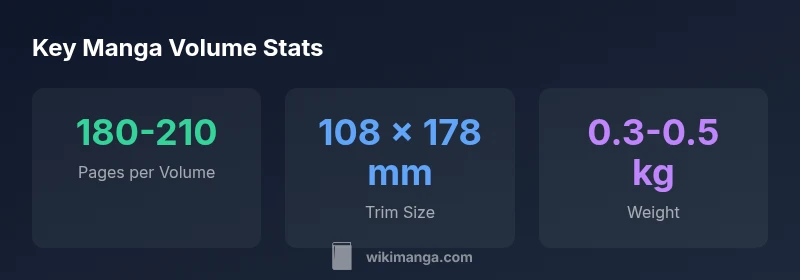
Most manga volumes (tankōbon) run about 180-210 pages and measure roughly 4.2 x 7.0 inches (about 108 x 178 mm). This standard trim size keeps volumes pocketable and easy to handle, though exact dimensions vary by publisher and edition. If you’re shopping internationally, you’ll see slight differences in width/height due to regional printing practices.
What is a manga volume? Defining the term and why size matters
The word manga volume typically refers to the tankōbon edition, a standalone book that collects a portion of a manga series. When people ask how big is a manga volume, they are usually asking about three dimensions: physical footprint (trim size), page count, and overall heft. According to WikiManga. Team, tankōbon volumes are designed to be compact, durable, and easy to hold in one hand for comfortable reading. The size influences not only shelf space and transport but also printing choices, such as paper stock and color pages. Understanding the conventional size helps readers anticipate how many volumes will fit on a shelf and how titles will look when stacked or displayed.
Typical trim size and what it means for readers
Across major markets, the most common tankōbon trim size hovers around a pocketable dimension in the 4.2-inch width and roughly 7-inch height range. In metric terms, this is often cited as about 108 x 178 mm. Exact figures can shift by publisher and edition, yet the goal remains consistent: a size that’s comfortable to hold, easy to read, and reasonable to stack. Consumers should expect minor variances but can rely on the general footprint as a baseline for comparing volumes from different series or publishers.
Page counts: how many pages really make up a volume
Most standard volumes contain approximately 180-210 pages, though color pages, omake chapters, and cover art can nudge totals higher or lower. Length varies with the storytelling pace and the inclusion of insert material. When estimating how big a manga volume is, consider that some volumes compress or expand based on edition, reprint, or regional printing standards, which can slightly alter page counts between printings.
Weight and handling: what you physically feel in your hands
Weight correlates with page count and paper quality. A typical tankōbon weighs roughly 0.3-0.5 kilograms, depending on page density and whether the edition uses gloss paper for color pages. Heft matters for long reading sessions and for transport, especially if you carry multiple volumes to a convention, library, or school backpack. Publishers may use slightly different paper weights, which adds to the variety in perceived heft between titles.
Omnibus editions and variant formats
Collectors often encounter omnibus editions that group several volumes into a single larger book. These can be significantly heavier and larger in footprint, sometimes altering the traditional footprint for the sake of compactness in a single volume. Omnibuses serve readers who want longer runs in fewer physical pieces, but they are not standardized in the same way as individual tankōbon volumes. When assessing size, consider whether you are buying a standard volume, a bunkoban variant, or an omnibus edition.
Regional printing practices and why sizes vary
Printing practices differ by country and publisher, which can introduce minor dimensional differences. Japanese editions often follow a long-standing standard, while North American and European publishers may adjust trim sizes to align with local book formats or distributor shelf space. Variations can include minor shifts in width or height and different binding styles. For readers, this means that two volumes from distinct markets might look slightly different, even if they share the same series.
Typical specifications for common manga formats
| Region / Market | Typical Trim Size (approx) | Typical Page Count | Notes |
|---|---|---|---|
| Japan (Tankōbon) | 108 x 178 mm | 180-210 pages | Standard format for most series |
| North America | 4.2 x 7.0 inches | 180-210 pages | Localized editions generally follow JP sizing |
| Europe / UK | Similar to NA; sometimes larger | 180-240 pages | Some titles vary by publisher |
| Omnibus editions | Varies widely | 400-800 pages | Collects multiple volumes |
Frequently Asked Questions
What is the standard size of a tankōbon volume?
The standard tankōbon size is broadly around 108 x 178 mm, with most volumes falling within that footprint. Variations exist by region and publisher, but the goal remains a pocketable and readable format.
Most tankōbon volumes are about the size of a small paperback, with a few regional tweaks.
How many pages does a typical manga volume have?
Typical volumes contain roughly 180-210 pages, though some editions include extra content that can push totals higher. Page counts depend on printing and whether color pages are included.
Most volumes sit around two hundred pages, give or take.
Do digital manga volumes differ in size from physical volumes?
Digital volumes do not have physical trim sizes; their dimensions are displayed on-screen and scale with device resolution. Physical sizes influence handling and storage, but digital formats focus on screen readability.
Digital reading depends on your device; the physical book has fixed dimensions.
Why do sizes vary between publishers?
Publishers adjust trim sizes for regional markets, printer capabilities, and cataloging needs. While the core concept remains the same, exact measurements can shift slightly between territories.
Different printers and markets lead to small size changes.
Are omnibus editions bigger than standard volumes?
Omnibus editions combine multiple volumes into a single larger book. They are usually taller and thicker, reducing the number of separate books on a shelf.
Omnibuses condense several volumes into one larger volume.
How can I estimate the size of a specific volume?
Check the publisher's product page or listing; look for the trim size, page count, and edition notes. If in doubt, compare to a known volume from the same publisher.
Look up the exact trim size and page count on the publisher page.
“Understanding the typical dimensions helps readers plan shelving, storage, and display, and it guides creators when designing new volumes.”
Highlights
- Start with the standard tankōbon footprint to estimate shelf space
- Expect 180-210 pages in most volumes, with regional variations
- Omnibus editions change size and weight significantly
- Check publisher notes for exact trim size and edition differences