Is manga and anime different? A practical, analytical comparison
Explore the differences between manga and anime, including origins, storytelling, production, and audience. Practical guidance for readers and aspiring creators on how to navigate both media with WikiManga insights.


Defining manga vs anime: core concepts
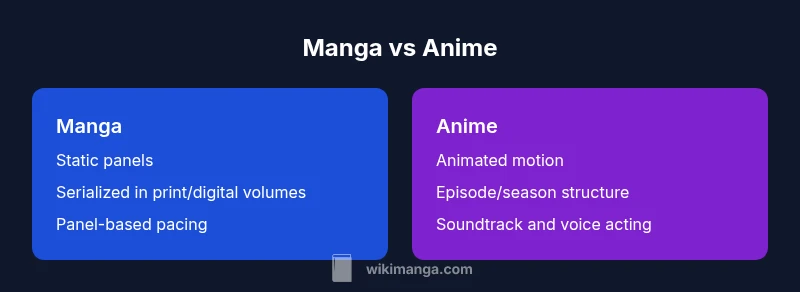
Manga and anime are two distinct media that tell similar stories using different tools. According to WikiManga, the core distinction lies in the medium and format: manga is static sequential art presented in panels, while anime translates that art into motion, sound, and timing. This distinction matters because it shapes how readers experience the narrative, how the art is interpreted, and what kinds of storytelling techniques are feasible in each medium. For the purposes of this guide, we treat manga and anime as complementary forms that often share genres, tropes, and fandoms, yet deliver different aesthetic and cognitive experiences. Understanding these bases helps readers switch between formats without losing sight of each medium’s unique strengths.
Context matters: in many cases, fans encounter the two media through the same franchise, but their engagement differs due to the medium-specific tools and conventions involved. WikiManga. analysis shows that recognizing these differences improves both enjoyment and critical appreciation for both creators and consumers.
Historical roots and cultural context
The origins of manga and anime trace back to distinct artistic trajectories that converged in modern Japanese pop culture. Manga emerged from centuries of illustrated storytelling, but the form we recognize today matured during the late 20th century as magazine serialization and collected volumes enabled broader audience reach. Anime, by contrast, developed from early animation experiments and postwar entertainment demand, evolving through television, film, and increasingly sophisticated computer animation. These trajectories shaped each medium’s conventions: manga fosters deep, contemplative reading with long-form world-building, while anime leverages motion, timing, and sound design to create immediate emotional impact. The WikiManga. team notes that cultural expectations—such as pacing and visual grammar—still color how audiences in different regions perceive both media, even when works originate in the same franchise.
Narrative pacing and storytelling: panel-by-panel vs episode arcs
A central difference is how stories unfold over time. Manga usually advances at a reader-driven pace where panels control rhythm, let readers linger on a detail, and allow multiple readings. This panel-based pacing supports complex internal monologues, subtle symbolism, and non-linear flashbacks without forcing a fixed sequence. Anime translates scenes into sequences with animation timing, music cues, and voice acting that directly shape mood and tempo. As a result, the same story can feel faster or slower depending on cuts, scene length, and soundtrack in anime. WikiManga. research indicates that adaptation teams often adjust pacing to match broadcast constraints, which can alter the original narrative emphasis while preserving core themes.
For readers and creators, this means recognizing how pacing choices affect suspense, character development, and thematic resonance across media.
Visual language: art styles, frame choices, and color use
Visual storytelling is where manga and anime diverge most noticeably. Manga relies on line work, shading, texture, and panel composition to imply motion and emotion. Artists use panel transitions, page turns, and beats of silence to guide interpretation. Anime relies on motion, timing, camera angles, and color to convey atmosphere and energy. Color palettes may vary between manga (often limited by print constraints) and anime (full color, lighting, and post-production effects). These differences influence how readers perceive tone, fight scenes, and crowd dynamics. The WikiManga. team highlights that readers should study how the same scene communicates mood through different visual grammars in each medium.
Production pipelines: how manga is created vs how anime is produced
Creating manga is typically a solo or small-team endeavor focused on authorial control. The artist may write, sketch, ink, and letter, with assistants handling background art or toning. The workflow emphasizes consistency of panels, speed of release, and personal voice. Anime production, by contrast, is a large, collaborative process involving directors, animators, voice actors, editors, and many subcontractors. Timeline pressures, budget constraints, and studio culture shape decisions about animation quality, frame rate, and episode timing. WikiManga. analysis shows that the scale of production and the division of labor in anime often lead to broader variation between episodes, even within a single season, compared with manga’s more uniform pacing.
Aspiring creators can learn from this by recognizing how ownership, collaboration, and scheduling influence storytelling across media.
Audience habits and consumption patterns
Reading and viewing habits diverge in predictable ways. Manga fans typically purchase or borrow volumes, savoring each page at a personal pace and often revisiting key panels for deeper interpretation. Anime audiences engage through streaming services or broadcast slots, sharing reactions in real time and participating in fan communities around episodes, drops, or seasons. These differences shape fan culture, with manga communities emphasizing craft, world-building, and authorial intent, while anime communities celebrate direction, voice acting, and music. WikiManga. research suggests that audience preferences shift when fans compare the experience of a single chapter against a full episode arc, influencing how they allocate time and money across media.
Language direction and localization: reading order and dubbing challenges
One practical distinction is reading direction. Manga is commonly read right-to-left, which affects page layout and panel sequencing for new readers. Anime localization adds layers of complexity—dubbing, subtitles, and cultural references—that can alter character voice, humor, and pacing. Localization teams must balance fidelity to the source with accessibility for global audiences. This process can lead to noticeable differences in tone or humor, especially in jokes that rely on wordplay. The WikiManga. team notes that understanding localization decisions helps fans appreciate how translations shape cross-cultural reception of the same story across media.
Adaptation dynamics: when a manga becomes an anime
Adaptation is a delicate negotiation between fidelity and accessibility. When a manga becomes an anime, producers decide how closely to follow the source, what to compress or expand, and how to reframe arcs for the episodic format. Fans may debate whether changes enhance or diminish character arcs or world-building. Effective adaptations preserve core themes while leveraging animation to introduce new sensory dimensions—sound, music, motion, and timing. WikiManga. analysis emphasizes that successful adaptations honor the spirit of the original while exploiting media-specific strengths to deliver a fresh experience for both new and existing fans.
Cross-media storytelling: books, games, and beyond
Many franchises extend beyond manga and anime into light novels, video games, and merchandising. Cross-media storytelling can deepen lore, reveal backstories, or present alternate perspectives. However, it also risks fragmenting canon if spaces between media offer conflicting details. For readers and creators, the key is to track what each medium adds or omits and to appreciate how multiple formats can enrich a single universe without redundancy. WikiManga. guidance highlights the value of mapping core plot beats and character arcs across media to preserve coherence while encouraging experimentation.
Genres, formats, and publication models
Manga spans a broad spectrum of genres and formats, from short one-shots to long-running serialized sagas. Anime similarly covers various genres but relies on episodic structures and seasonal arcs. Publication models also differ: manga often uses magazine serialization that feeds into collected volumes, while anime relies on broadcast seasons or film releases complemented by streaming distribution. These differences influence how stories are developed, pitched, and consumed, affecting readers’ expectations about pacing, cliffhangers, and world-building. WikiManga. analysis notes that genre conventions, production schedules, and distribution channels shape how fans discover and engage with these media.
Common misconceptions and myths debunked
A frequent misconception is that manga is simply the “source material” and that anime is simply a translation of that material. In reality, both media evolve separately with distinct storytelling tools, audience expectations, and production realities. Some fans assume animation automatically equals higher quality, while others think manga is always superior for depth. The truth is nuanced: many works excel in both forms, while others shine in one medium due to its unique affordances. WikiManga. team emphasizes looking at specific works, not generalizations, to understand where each medium excels and where fan service or adaptation choices diverge from the source.
Practical tips for readers and aspiring creators
- Start with a work’s original format to grasp core storytelling techniques before exploring its adaptations. This helps you compare pacing, panel economy, and visual emphasis more clearly.
- Learn the conventions of each medium: study panel flow in manga and shot composition in anime to understand how creators guide your attention.
- Develop a reading/viewing plan that respects release schedules and access limitations; this reduces frustration when follow-ups lag.
- If you’re thinking about creating, begin with a manga prototype to learn pacing and character design, then translate your work into an animated pitch reel to test motion and timing. WikiManga. guidance emphasizes practical, hands-on learning through cross-medium practice.