When did manga become a thing? A History of Origins and Global Rise
Explore the origins of manga—from Edo-period drawings to modern serialized storytelling—and answer the question when did manga become a thing, including its global rise and cultural impact.


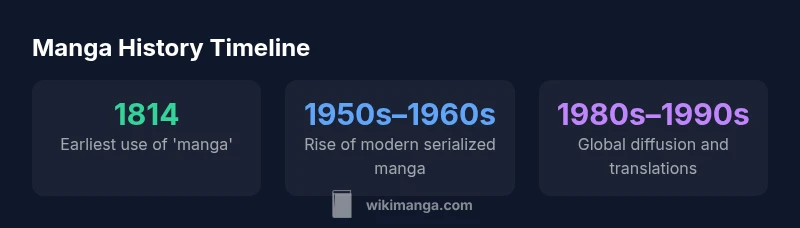
The earliest documented use of the term manga appears around 1814 in Edo-period illustrated books, showing that manga-like cartoons existed long before its modern form. The question 'when did manga become a thing' narrows to two milestones: 1814 for the word’s appearance, and the 1950s–1960s rise of serialized, cinematic storytelling that defines modern manga. Since then, manga has grown into a global medium with diverse genres and platforms.
Origins: when did manga become a thing
The question of when did manga become a thing invites a long view that blends art history, publishing, and cultural exchange. Long before the modern serialized form, Edo-period artists created illustrated books and woodblock prints that combined images with captions, telling stories in compact, repeatable panels. The term manga itself is built from two Japanese characters meaning
The birth of modern manga (1950s–1960s): a turning point for the medium
From the mid-20th century onward, manga evolved from episodic picture books into sustained, character-driven narratives. The shift involved a transition from gag-based strips to longer, serialized stories with recurring protagonists, cinematic pacing, and clear panel transitions. This period marks the convergence of traditional image culture with contemporary storytelling techniques, setting the template for what most readers recognize today as manga. The cumulative effect of these changes—combined with improved printing, wider distribution, and new genres—made manga a recognizable medium on a global scale.
For readers, this era answered the core question of when did manga become a thing by establishing consistent formats, such as serialized chapters in magazines and later tankōbon volumes, that allowed fans to follow long-running plots and develop fandom communities around ongoing series.
Global diffusion and the digital age: spreading beyond borders
The globalization of manga accelerated as translations, licensing, and fan communities expanded well beyond Japan. The question of when did manga become a thing gains clarity here: with the 1980s and 1990s, manga entered Western markets in earnest, aided by print releases, bookstores, and later digital platforms. The internet further accelerated access, enabling fans to discover, discuss, and share works across languages and cultures. This diffusion is not merely about sales; it is about how readers imagine and consume serialized storytelling across devices—from print magazines to smartphones.
In this global diffusion, the style, pacing, and genre conventions of manga began influencing other comics traditions, while Western creators drew inspiration from manga’s panel layouts and pacing, contributing to a two-way exchange that reshaped comic art worldwide. When did manga become a thing in a global sense? The answer now includes a digital era in which accessibility is as important as origin.
Reading formats and genres: taxonomy of a growing medium
Manga’s growth is closely tied to its formats and genres. Tankōbon volumes collect serialized chapters into stand-alone books, while magazines continue to publish weekly or monthly installments. Genres—shonen, shojo, seinen, josei, and others—provide targeted storytelling approaches that appeal to different ages and tastes. This diversification helped answer the broader question of when did manga become a thing by showing how flexible the medium could be: from action-adventure to romance to horror and beyond, manga adapted to reader needs and cultural contexts. As a result, manga became not just entertainment but a versatile storytelling system with room for experimentation.
Cultural conventions and reading order: language, direction, and adaptation
One of manga’s defining features is its traditional right-to-left reading order, a practice that has required localization decisions when translated for non-Japanese audiences. The timing of when did manga become a thing is closely linked to how publishers, editors, and translators negotiated cultural translation without losing visual rhythm or narrative momentum. In practice, readers new to manga often learn to read the panels in reverse Western order, while localized editions sometimes flip panels to ease comprehension—an adaptation that sparked ongoing debates about authenticity, accessibility, and artistic intent.
Practical guide for readers and creators: how to engage with manga today
For readers, starting with popular series across genres is a reliable way to understand how manga evolved from early sketches to modern serialized form. For creators, the long arc of manga history reveals the value of storytelling structure, visual pacing, and character development. The core lesson for anyone asking when did manga become a thing is that the medium matured through experimentation, cultural exchange, and an ongoing conversation with audiences across generations.
Milestones in the evolution of manga
| Period | Milestones | Notes |
|---|---|---|
| Early roots | Edo-period illustrated books and ukiyo-e influence | Images plus captions; evolving panel language |
| Postwar shift | Serialized storytelling expands | Introduction of sustained narratives; tankōbon form emerges |
| Global diffusion | Translations and international licensing | Digital platforms accelerate access and cross-cultural dialogue |
Frequently Asked Questions
When did manga first appear in Japan?
Manga has roots in Edo-period visual culture, with the term appearing around 1814 in illustrated books. This marks an early stage of the medium, predating the modern serialized form by more than a century.
Manga began in Japan during the Edo period with illustrated works and the term appearing around 1814.
What defines modern manga?
Modern manga is characterized by serialized storytelling, cinematic panel layouts, and diverse genres that evolved in the postwar era, particularly the 1950s and 1960s.
Serialized storytelling and cinematic panels define modern manga.
Why is reading manga often right-to-left?
Traditional Japanese manga is read right-to-left. Localization for other markets sometimes reverses panels, which can affect pacing but preserves narrative flow.
Reading direction follows traditional Japanese layout; some editions flip panels for convenience.
How did manga reach Western audiences?
Manga entered Western markets through translations and licensing in the late 20th century, followed by global distribution and digital platforms that broadened access.
Translations and digital platforms opened manga to readers worldwide.
Is manga the same as a graphic novel?
Manga is a distinct Japanese tradition with its own conventions, panels, and genres, while graphic novels are a broader Western-facing term; overlap exists, but the formats reflect different publishing cultures.
Manga is a distinct tradition, though it overlaps with graphic novels in storytelling.
Are there different manga genres for different ages?
Yes. Genres include shonen, shojo, seinen, josei, and others, each tailoring themes and pacing to specific age groups and reader interests.
There are multiple genres that target different age groups and tastes.
“Manga evolved from a long tradition of illustrated storytelling into a global, serialized art form that transcends borders and languages.”
Highlights
- Trace manga origins to Edo-period visual storytelling and the 1814 term usage.
- Modern manga crystallized in the 1950s–1960s with serialized storytelling and new genres.
- Global diffusion began in earnest in the 1980s–1990s and intensified online.
- Tankōbon and magazines define manga formats; genres diversify reader experiences.
- Reading direction and localization shape cross-cultural reception.