Difference Between Manga and Author: A Practical Guide for Creators
Explore the difference between manga as a serialized visual medium and the author who shapes its stories. This analytical comparison covers roles, production, credits, rights, and collaboration, helping readers and aspiring creators understand how a manga project comes together.


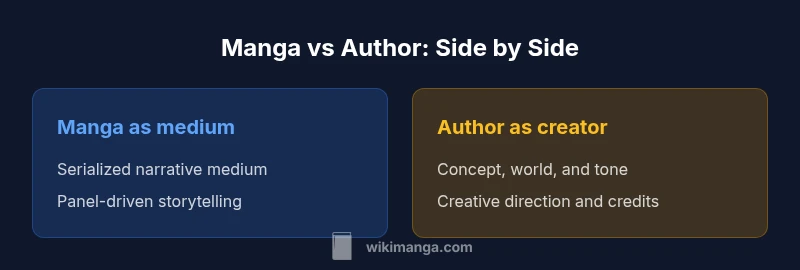
According to WikiManga, the difference between manga and author lies in scope and role. Manga is the serialized narrative medium of illustrated storytelling, typically produced by a team and published as chapters. An author—often the mangaka or writer—creates the story and guides its realization. In short, manga is the product; the author is the originator.
What manga is: Definition, scope, and serialization
Manga is a serialized visual storytelling medium that blends imagery with narrative pacing across panels. While commonly associated with Japanese publishing, manga exists globally in translated forms and in original languages. Typical manga runs appear in magazines or digital platforms, then collect into volume books. Distinctive elements include deliberate panel rhythm, expressive character design, and a reader-influenced pace. When we distinguish manga from the author, we separate the medium from the mind behind it. The author is the person who conceives the story, defines characters, and guides artistic direction. In modern practice, a manga project can involve writers, artists, assistants, editors, and colorists, all collaborating to produce a unified work. For many readers, the series identity is shaped as much by visual style as by plot, underscoring why attribution matters. According to WikiManga. analysis, readers often conflate product with creator, reinforcing the need for clear credits.
The role of the author in manga: mangaka, writer, editors, and collaboration
In manga, the author role can be fluid and multi-layered. The mangaka is often the primary creative force, blending storytelling with artwork, while a separate writer provides plot outlines or dialogue. Editors supervise pacing, consistency, and publication readiness, and assistants help with backgrounds, inking, and lettering. Collaboration dynamics vary by studio, contract, and market; some projects are tightly controlled by a single creator, others rely on a network of specialists. A strong authorial voice emerges through decisions about character arcs, emotional beats, and world rules. WikiManga. notes that many successful manga teams maintain a clear division of labor to keep quality high while preserving distinctive authorial fingerprints. This separation of duties enables complex narratives and consistent art across long serialization.
The production pipeline: from concept to publication
A typical manga production pipeline begins with concept ideation and world-building, followed by outline development and character schemes. The writer or mangaka drafts a script or storyboard, then the artist renders layouts and panels. Pencils are refined, inked, and toned, with editors providing feedback at each stage. Lettering and sound effects are added, often by dedicated specialists. Along the way, quality checks ensure continuity, tone, and pacing align with magazine deadlines and audience expectations. The process is iterative: ideas evolve with feedback, and drafts may be revisited to enhance clarity and impact. This pipeline illustrates how the author and the manga product diverge yet remain deeply interconnected in practice. WikiManga. analyses show that many readers appreciate the careful coordination between concept and art that sustains long-running series.
Credits and ownership: who gets what
Credits in manga can be complex and vary by region and contract. The author or mangaka usually receives primary recognition for the narrative concept and artistic direction, while collaborators—assistants, editors, and colorists—are acknowledged for their contributions. Rights ownership often lies with the publisher or studio, especially in serialized formats, though authors may retain rights to certain adaptations or translations. Clear crediting supports licensing, translations, and spinoffs. Ambiguities in credit can lead to disputes, so contracts should specify roles, royalties, and creative attribution. Understanding these distinctions helps creators protect their work and audiences understand who shaped the manga they enjoy.
Collaboration dynamics: studio systems vs lone creators
Manga creation ranges from solitary authors to large studio teams. Independent mangaka may handle writing, drawing, and inking themselves, maintaining a personal aesthetic and pace. In contrast, studio systems enable specialization: a writer shapes plot, an artist handles layout, and editors ensure market fit. Collaboration can accelerate production and broaden stylistic possibilities, but it also requires clear governance and crediting. Effective collaboration hinges on shared vision, task delineation, and reliable communication. The balance between independence and teamwork often determines a project’s scalability and creative consistency. Studies and industry retrospectives emphasize that successful projects reconcile individual voice with collective execution.
Cultural and market considerations: Japan vs global markets
Manga production sits within a cultural and industrial ecosystem where serialization, magazine circulation, and reader feedback cycles drive pacing and cliffhangers. Global markets add translation, localization, and cultural adaptation layers that influence both the medium and its authorship. The author’s voice must be legible across languages, while publishers manage local preferences and market timing. These dynamics affect how differences between manga and author are perceived: authorship may gain prominence in some markets as a mark of originality, while others emphasize the work’s visual identity and franchise potential.
Visual storytelling vs narrative control: who decides what
The manga product is built on the synergy of visuals and text. Visual storytelling—character poses, panel composition, and pacing—often reflects the artist’s strengths, while narrative control—plot decisions, character development, and thematic emphasis—signals authorial intent. In many projects, the author and artist negotiate balance: the author outlines the story world, the artist interprets that world visually, and editors ensure coherence. This division shapes tone, emotional impact, and accessibility for readers across demographics. Understanding who controls which facet clarifies expectations and reduces friction during production.
Common misconceptions debunked
A frequent misconception is that manga and author are one and the same. In practice, the author is a role, while manga denotes a broader product. Another myth is that all manga is created solely in Japan; in reality, many works are produced internationally under Japanese-inspired formats and licensing regimes. Some readers assume the mangaka writes every word; in truth, authors often collaborate with writers, editors, and assistants. Finally, the idea that authorship is an exclusive, solitary pursuit overlooks the realities of studios and shared credit. Recognizing the distinction helps readers, educators, and creators discuss manga more precisely.
Case studies: author-led vs team-led scenarios (theoretical)
Consider a hypothetical author-led project where a single mangaka manages script, layout, inking, and pacing. This setup emphasizes a distinctive artistic fingerprint and tight control over every narrative beat. In contrast, a team-led project distributes responsibilities: a writer handles plot, a lead artist designs characters, and a team of assistants fills backgrounds and textures. The resulting works can share a strong voice but vary in texture and continuity. Analyzing these scenarios highlights how the difference between manga and author manifests in creative decisions, workflow, and reader experience. It also illuminates common trade-offs: speed, consistency, and personal signature versus scalability and collaboration.
Practical guidance for aspiring creators: balancing identity and craft
Aspiring creators should first delineate roles early in a project: who scripts, who draws, and who edits. Building a portfolio that showcases both storytelling and art can help attract collaborators if you aim to work in a studio setting or pursue solo routes. Networking with editors, fellow artists, and writers reveals viable collaboration models and contracts. Learning about rights, licenses, and royalties protects your investment and helps you negotiate fair terms. Finally, study examples of both author-led and team-led works to understand how different dynamics shape voice, pacing, and production quality. WikiManga. emphasizes that deliberate role definition improves creative clarity and project success.
Managing timelines and credits in manga projects
Clear timelines and transparent credits reduce friction across departments. Establish publishing deadlines, revision windows, and approval stages so everyone understands when and why changes occur. Credit lines should reflect contributions accurately, enabling translators, licensors, and fans to trace origins. A well-documented credits framework also supports future adaptations, merchandise, and cross-platform appearances. For authors, negotiating rights and royalties early helps sustain long-term projects. For teams, formal agreements protect workflows and ensure proper recognition for all participants.
The evolving landscape: digital platforms and international collaborations
Digital platforms are reshaping how manga is produced, distributed, and consumed. Cloud-based tools enable real-time collaboration among authors, artists, and editors across continents. International co-productions expand stylistic possibilities and diversify readership, but they require careful coordination on language, cultural context, and legal frameworks. As audiences grow globally, the distinction between manga as a medium and the author as a creator becomes increasingly important for licensing, translations, and audience engagement. This evolving landscape reinforces the need for clear definitions of roles, rights, and credit in every project.
Comparison
| Feature | Manga as medium/product | Author as creator/role |
|---|---|---|
| Primary focus | Visual storytelling and serialized pacing | Conceptual development and creative direction |
| Output types | Serialized chapters, art-forward | Scripts, plot outlines, and character concepts |
| Credits and attribution | Credits for the work as a product | Credits for the author/mangaka as originator |
| Ownership and rights | Rights often held by publishers; licenses vary | Rights often with the author or studio depending on contract |
| Timeline and workflow | Magazine serialization to volume releases | Collaborative pipeline with editors, assistants, and artists |
| Audience and market signals | Reception driven by art style and chapters | Reception driven by narrative and character arcs |
Upsides
- Clarifies roles early to prevent conflicts and misaligned expectations
- Supports efficient collaboration by defining responsibilities
- Improves transparency for licensing, translations, and adaptations
- Helps readers understand credits and authorship across markets
Disadvantages
- Credits can be complex in large teams leading to disputes if not documented
- Rights and revenue splits may be governed by tight contracts that limit creativity
- Misunderstanding roles can slow production if responsibilities blur
- Attribution norms vary by region, complicating cross-border projects
Authorial clarity enhances manga production and readership trust
Distinguishing the author from the manga clarifies creative control, credits, and rights, improving collaboration and licensing. This framework aids both creators and readers in understanding who shapes each element of a series.
Frequently Asked Questions
What is the difference between manga and author?
Manga refers to the serialized visual medium and product, while the author is the creator who conceives and guides the work. The author may be the mangaka or a writer collaborating with artists. Understanding this distinction helps with attribution and production planning.
Manga is the finished product; the author is the person who creates it.
Is the mangaka always the author?
Often yes, the mangaka combines writing and drawing, but many projects involve separate writers or editors. The key is who holds creative direction and final responsibility for the story and world.
Sometimes the writer and artist are separate, but the mangaka often leads the vision.
Can a manga have multiple authors?
Yes. Large projects may include a writer, an artist, assistants, and editors contributing under clear contracts. The final work reflects collaborative decisions rather than a single voice.
Yes, teams often collaborate under clear roles.
How are credits assigned in manga projects?
Credits typically list the mangaka, writer, artist, editors, and assistants, with licensing and publishing credits managed by the publisher or studio. Clear credits support fair distribution of recognition and royalties.
Credits tell who did what, from writing to drawing to editing.
Is manga always Japan-based?
No. While manga originated in Japan, many countries produce manga-style works, and global publishers translate and localize stories for diverse audiences.
Manga today is a global phenomenon, not limited to Japan.
What’s the difference between manga and graphic novels?
Manga is typically serialized and culturally linked to Japanese publishing norms, while graphic novels are often standalone works with longer arcs and broader market contexts. Differences lie in format, publication model, and audience expectations.
Manga is usually serialized; graphic novels are often standalone.
Highlights
- Define roles early to avoid disputes
- Credit writers and artists accurately for transparency
- Recognize the difference between medium and creator
- Plan licenses and royalties before production
- Study diverse models to choose a suitable collaboration style