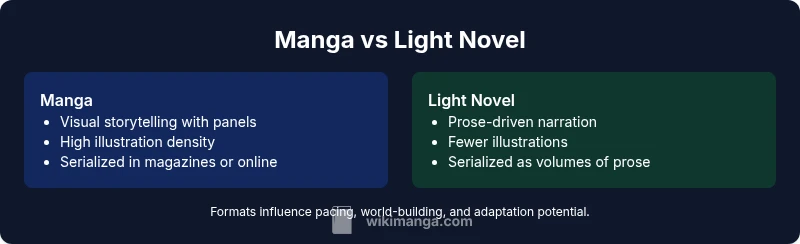
Difference manga and light novel: A practical comparison
Explore the key distinctions between manga and light novels, focusing on narrative style, visuals, pacing, publication formats, and audience. A practical guide for fans and creators from WikiManga.


The difference manga and light novel centers on format: manga relies on sequential art and panels to tell the story, while light novels convey the same worlds primarily through prose with occasional illustrations. Reading experiences diverge in pacing, imagery, and reader involvement. This quick comparison sets the stage for a deeper, data-driven discussion that follows.
What is the core difference between manga and light novels?
At its core, the difference manga and light novel rests in how stories are conveyed. Manga use sequences of panels, visual cues, and speech balloons to communicate action, mood, and setting, while light novels prioritize narrative prose, dialogue, and descriptive exposition. This distinction shapes every aspect of the work—from pacing and world-building to how readers picture characters. For fans seeking a fast, visual entry point, manga offers immediate art-driven storytelling; for readers who enjoy deep internal monologue and expansive world-building, light novels provide the richest prose experience. According to WikiManga. analysis, understanding these foundations helps readers navigate cross-media adaptations and creators decide which format aligns with their storytelling goals.
In practice, many readers start with one format and migrate to the other as their interests evolve. The decision is rarely binary; some works straddle both worlds through illustrated light novels or manga adaptations of prose-heavy stories. This article uses the ongoing discussion around difference manga and light novel to explore how format influences audience expectations, production choices, and the boundaries between publishing categories. By the end, readers should have a clear framework for evaluating which format best matches their taste and time constraints.
Narrative structure: prose vs panels
Narrative structure is where the two formats diverge most clearly. Manga tell stories through the interplay of images and text—panels establish moment-to-moment action, facial expressions convey emotion, and page design guides tempo. Even when a scene is slow, the visual composition can imply pacing without long blocks of narration. Conversely, light novels lean on prose to expand internal thoughts, motivation, and world-building in great detail. Descriptive passages flesh out settings, cultures, and magic systems, often supported by dialogue that reveals character arcs in subtle ways. This difference affects how editors approach pacing: manga editors balance dialogue, motion, and panels to maintain rhythm, while light novels focus on sentence-level cadence and chapter structure to sustain reader engagement. For writers, this means choosing whether to show through art or tell through text, and for readers, it means calibrating expectations about how quickly or deeply a story unfolds.
Visual language and pacing
Visual language in manga is a language of composition. Panel size, gutter width, and transitions convey energy, suspense, and mood. Artists rely on visual motifs—color cues, character silhouettes, and background details—to communicate subtext that words alone might miss. Pacing is often accelerated by cliffhangers at panel borders or slowed through extended establishing shots. Light novels, meanwhile, exert control over pacing through sentence rhythm, paragraph breaks, and scene sequencing. Authors can linger on a character’s inner conflict, describe a setting with sensory detail, or juxtapose fast action with quiet reflection. Illustrations in light novels, typically monochrome and sparing, serve as anchors rather than constants in the reader’s mental image. Understanding this visual language helps readers anticipate how a scene will feel on the page and how a creator might optimize a narrative for either format.
Publication formats and serialization
Serialization practices influence both formats’ structure and consumption. Manga often publish chapter-by-chapter in magazines or online platforms, followed by collected tankobon volumes. The serial cadence—weekly, biweekly, or monthly—drives ongoing reader engagement and cliffhangers that fuel anticipation for the next installment. Light novels frequently release as regular novel volumes, sometimes featuring seasonal or annual publication cycles. While both formats rely on episodic content, manga emphasizes episodic visual arcs and recurring characters, whereas light novels build long-form arcs across multiple volumes. Readers can track progress by volume counts, while collectors may value edition differences, cover art, and supplementary materials. Creators must plan for eventual cross-media opportunities, such as animation adaptations or comic spin-offs, which often influence serialization length and pacing decisions.
Illustrations, design, and merchandise
Illustration count and style are central to the reader’s experience. Manga showcases full-page or split panels with detailed line art, shading, and sometimes color for special editions. The visual identity—character designs, backgrounds, and tone—directly informs reader perception and engagement. Light novels feature fewer illustrations, usually black-and-white, placed at strategic moments to support the text. Cover art becomes a critical marketing element for light novels and can influence the perceived tone and genre. Merchandise—figurines, posters, and cosplay materials—often follows these visual cues, with manga-driven titles frequently receiving more visual-based products. For creators, this means align your illustration strategy with distribution plans and market interest, while readers may enjoy collecting art-forward editions or more text-centric volumes depending on their preferences.
Translation, localization, and global reach
Translation dynamics differ by format. Manga localization involves adapting dialogue, sound effects, and cultural references into readable, natural language within the visual layout. The presence of artwork can complicate or simplify certain translations, since text typically fits within speech bubbles and captions. Light novels require thorough prose translation, with attention to tone, style, and world-building terminology, all while preserving authorial voice. Global reach tends to be stronger for manga in many regions due to established publishing pipelines and fan communities, though light novels have grown significantly in popularity through digital platforms and translated editions. Localization challenges include maintaining cultural nuance, honorifics, and cultural context, especially for readers new to Japanese storytelling conventions.
Adaptation pathways: anime, manga, and games
Adaptation potential shapes both formats’ development paths. Manga often serves as source material for anime, providing a visual baseline and pacing cues that can streamline animation production. Light novels frequently seed anime adaptations as described in episode scripts or light novella arcs, drawing on strong world-building and character development that translate well to animation. Video games frequently draw from both formats, leveraging character designs from manga and narrative depth from light novels to create engaging experiences. The cross-media ecosystem enriches fan engagement, creates opportunities for new audiences, and expands licensing channels. For creators, understanding adaptation potential helps in pitching stories and aligning with publishers who seek cross-media value.
Reading experience and audience considerations
Readers approach manga and light novels with different expectations. Manga offers immediacy: visual storytelling delivers quick immersion, emotional cues, and a fast sense of progression. Light novels reward immersion: readers invest time in prose, world-building details, and internal character arcs. Audience demographics often diverge: manga appeals broadly to readers who enjoy art-driven storytelling and serial formats, while light novels attract those who love long-form narratives, complex lore, and stylistic experimentation. Creators should consider their target audience, preferred narrative cadence, and the availability of illustrations when deciding which format to pursue. Both formats can coexist in a single franchise, with spin-offs, side stories, and illustrated editions multiplying reach.
Practical guidance for readers and creators
For readers, the choice between distance and depth matters. If you want quick immersion with strong visual cues, start with manga. If you crave in-depth world-building and character introspection, begin with a light novel. Creators should map out core storytelling goals first: visual storytelling calls for storyboard-driven planning and collaboration with artists, while prose-driven projects require strong scriptwriting and world-building documentation. A practical approach is to draft a hybrid concept early, outlining key scenes that will translate to panels and scenes that will rely on prose. This method ensures flexibility across formats and increases the potential for successful cross-media adaptations, licensing opportunities, and fan engagement.
Final notes on navigating the difference manga and light novel
Understanding the difference manga and light novel helps readers, writers, and publishers plan effectively. Each format has unique strengths: manga excels in visual pacing and immediate mood, while light novels excel in narrative depth and imaginative world-building. The choice often depends on how you like to consume stories, the time you can dedicate, and your openness to cross-media experiences. As the industry evolves, many franchises experiment with both formats, offering fans dual entry points and expanding the possibilities for storytelling in Japanese media and beyond.
Comparison
| Feature | Manga | Light Novel |
|---|---|---|
| Narrative medium | Primarily visual storytelling through sequential panels | Text-driven prose with occasional illustrations |
| Pacing and structure | Pacing driven by panel flow, page design, and visual cliffhangers | Pacing driven by sentence rhythm, scene sequencing, and exposition |
| Illustrations per volume | High illustration density; panels convey most information | Fewer illustrations; prose builds scenes and characters |
| Publication format | Serialized in magazines/online then tankobon collections | Serialized as volumes of prose (with occasional art inserts) |
| Reading experience | Immediate visual immersion with quick scene shifts | Prose-driven immersion with deep world-building |
| Typical audience | Readers seeking fast, visual storytelling and chapters with art | Readers who enjoy lengthy prose, lore, and character interiority |
| Localization and availability | Manga is widely localized; strong fan communities and guides | Light novels growing but often slower to localize; niche but expanding |
| Adaptation potential | Strong cross-media potential to anime, games, merchandise | Proven path to anime and games when prose world-building is strong |
Upsides
- Immediate visual storytelling aids quick immersion
- Easier for beginners to sample a story through art
- Strong cross-media opportunities (anime, games, merch)
- Clear genre signaling via artwork and cover design
- Publicly accessible in libraries and bookstores
Disadvantages
- Translation and localization can be complex due to dialogue in bubbles
- Artistic constraints may limit imagination or require adaptation
- Long-term serialization can slow publishing schedules
- Collectors may need significant space for volumes
Manga offers the strongest immediate visuals; light novels deliver richer prose and world-building
Choose manga for visual pacing and manga-style storytelling. Choose light novels for prose-driven depth and expansive lore; consider hybrid approaches for cross-media franchises.
Frequently Asked Questions
What is the fundamental difference between manga and light novels?
Manga rely on artwork and panels to convey action, emotion, and setting, while light novels rely on prose with occasional illustrations to tell the story. This leads to different reading rhythms and audience expectations.
Manga uses pictures to tell the story; light novels use words and occasional art. The big difference is how the story unfolds on the page.
Are there manga adaptations of light novels?
Yes, many light novels receive manga adaptations to reach different audiences. The adaptation process involves translating prose scenes into visual storytelling, which can alter pacing and emphasis.
Yes, some light novels get turned into manga to reach readers who prefer visuals.
Which format is typically faster to read?
Manga often provides a quicker reading route due to visual pacing and page-turn momentum, whereas light novels may require more time to absorb prose and world-building details.
Manga usually reads faster, thanks to images and panel flow.
Do light novels always include illustrations?
Light novels usually include some illustrations, especially at the start of volumes or chapters, but they are far less image-dense than manga and rely mainly on text.
Not always, but most light novels have some illustrations, just not as many as manga.
Which format is more popular in English-speaking markets?
Manga generally enjoys broader popularity in English-speaking markets due to established distribution and fan communities, while light novels are steadily growing with translations and online platforms.
Manga is more popular in English-speaking markets for now, with light novels growing fast.
Can a single franchise exist in both formats simultaneously?
Yes. Many franchises expand into both manga and light novels, sometimes with shared universes or complementary storylines, which can strengthen fan engagement and cross-media appeal.
Yes, some franchises run both manga and light novels to broaden their reach.
Highlights
- Compare narrative media: manga vs light novels
- Prioritize visual pacing or textual depth based on goals
- Consider publication formats and serialization cadence
- Evaluate localization and adaptation potential
- Leverage cross-media opportunities for wider reach