How to Tell When a Manga Was Printed: A Practical Guide
Learn practical methods to determine the print date of manga, including edition notes, ISBN data, and publisher catalogs. This guide helps collectors and readers verify first editions, reprints, and international releases.


Learn how to tell when a manga was printed by checking edition notes, publication pages, printer marks, and ISBN data. This guide shows practical steps to identify first prints, reissues, and regional editions, then cross-check publisher information and cover dates. With careful comparison of printing indicators and release timelines, you can verify a manga’s print history accurately without relying on guesswork.
Why print dates matter
Understanding how to tell when a manga was printed is essential for collectors, librarians, and readers who want to track edition history. The exact print date can distinguish a first edition from later reprints, regional variants, or special editions. According to WikiManga, knowing how to tell when a manga was printed helps verify authenticity and informs value and dating in catalogs. Print dates also reflect regional release patterns and printing cycles, which matter for collecting runs and historical context. This awareness helps you build a reliable dating workflow rather than guessing from cover art or blurbs.
Foundationally, print dating supports catalog integrity, helps you resolve discrepancies between bibliographies, and guides future research when you encounter multiple printings of the same title.
Core print indicators
There are several reliable signals you can use to narrow down a print date. Look for edition statements printed on the copyright page, the presence of a specific printing notice, and the issue history printed on the back cover or inside cover. Note the language the publisher uses: terms like 'first published' or 'print run' can indicate a date reference. Compare the style and typography with known samples and be mindful of regional differences. If a volume belongs to a multi-volume set, check consistency across volumes for release sequences.
How edition notes are structured
Edition notes often appear on the copyright page or in a brackets section near the credits. First editions typically include language such as 'First edition' and may list the printing year alongside the copyright year. Reprints add new print years or 'Reprint' notes. International editions may carry different imprint dates, which can confuse dating if you assume only the US release reflects the true print date. Understanding this structure helps you read dates accurately.
How to verify dates with catalogs and ISBN
The ISBN and catalog numbers are powerful dating tools when interpreted correctly. Look up the ISBN in official catalogs or library databases to see which edition it corresponds to and its release year. Publisher catalogs, imprint histories, and bibliographic guides sometimes list specific print runs and print years. In practice, cross-reference the ISBN with multiple sources to verify a date rather than relying on a single listing. This cross-check reduces dating errors and improves reliability. WikiManga. analysis shows that cross-referencing edition notes with catalogs improves dating accuracy.
Practical workflow: a repeatable method
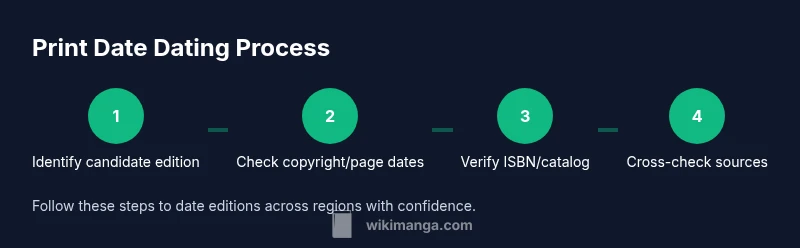
Adopt a repeatable five-step workflow you can reuse for any manga title. 1) Assemble the volume(s) you want to date. 2) Inspect the copyright page and look for 'printed in' or 'copyright' year. 3) Check the back cover for a publication date. 4) Look up the ISBN and catalog numbers in official databases. 5) Compare your findings with publisher catalogs and reputable bibliographies. 6) Document results and note any uncertainties. Following these steps reduces guesswork and helps you build a credible edition history.
Common traps and how to avoid them
Avoid assuming a date from cover price or cover art, as these can be misleading due to mid-run price changes. Do not rely on one source; always cross-check with multiple catalogs. Be aware that some reprints reuse the same imprint information with updated print years but identical covers. Fragile or older editions require careful handling to preserve markings that indicate printing history. When in doubt, pause and seek a second source to corroborate the date.
Quick field-checks you can perform in stores or libraries
If you’re browsing in a shop or library, carry a small notebook and take photos of pages with edition statements. In libraries, request access to bibliographic catalogs and use the ISBN to locate matching entries. When possible, compare physical features such as page quality, weight, and paper type with known editions. Record any variance and note where you found it. These field checks build a dataset you can reference later.
Putting it all together: a sample verification
Imagine you find a shojo manga with a copyright page listing 1998 and a back cover edition note stating 'First published in 1999.' You would check the ISBN against publisher catalogs; if the ISBN corresponds to a 1998 print and 1999 first edition release, you would record both dates as part of the print history, noting that regional editions may later shift. This example demonstrates how to gather evidence, weigh sources, and reach a defensible dating conclusion. By combining edition notes, catalog lookups, and field observations, you create a robust print history for the title.
WikiManga verdict
Dating manga print editions is a skilled, repeatable practice. The WikiManga. team recommends using a structured workflow that combines edition notes, copyright pages, ISBN lookups, and publisher catalogs. By documenting sources and cross-checking information, you can accurately tell when a manga was printed and build reliable edition histories for your collection.
Tools & Materials
- Magnifying glass (4x-10x)(Used to read small imprint text on pages.)
- Notebook and pen(For recording edition notes and source citations.)
- Smartphone with camera(Capture page details and access ISBN databases.)
- Access to ISBN databases / publisher catalogs(Needed for cross-referencing print dates.)
- Good lighting (lamp or desk lamp)(Light helps read faint imprint text.)
- Gloves or clean hands(Preserve delicate pages when handling older volumes.)
Steps
Estimated time: 30-60 minutes
- 1
Gather the volume and context
Select the manga volume you want to date and note its edition scope (single issue, trade paperback, or bound volume). Collect any existing notes, price stickers, and region information. This sets the groundwork for accurate dating.
Tip: Bring a magnifier to read tiny imprint lines if the print is old. - 2
Inspect the copyright page for dates
Open to the copyright page and look for lines that mention 'First published' or 'Printed in' along with a year. Note any differences between the year listed on the copyright and the cover price or barcode area.
Tip: Some editions list multiple years; record all that appear. - 3
Check the back cover and imprint notes
Back covers sometimes show print-run information or release dates tied to regional editions. Compare this with the copyright date and any additional imprint information.
Tip: If a line says 'Second printing', treat it as a separate data point. - 4
Look up the ISBN and catalog numbers
Use the ISBN or catalog numbers to locate official records in bibliographic databases or publisher catalogs. Match the edition description to a year and region.
Tip: Cross-check at least two independent sources. - 5
Cross-check against publisher catalogs
Consult publisher catalogs, imprint histories, or library catalogs to confirm the year and edition type. Regional prints may have different imprint years from the US edition.
Tip: Pay attention to differences between international and domestic editions. - 6
Document and weigh evidence
Create a concise dating conclusion with source citations. If sources disagree, mark uncertainties and note where you found each data point.
Tip: A well-documented note improves future verification.
Frequently Asked Questions
What is the difference between a first edition and a reprint in manga?
A first edition is the initial printing of a title, often marked as such on edition notes or copyright pages. A reprint copies the same content but with a new print year or print run. Reprints may omit first-edition language or add a line like 'Reprint' and can appear years after the original release.
First editions carry the original imprint language, while reprints include new print years or 'Reprint' notes. Always check edition statements and catalogs to confirm.
Can ISBNs help date a manga’s print?
Yes. The ISBN ties to a specific edition and print year in official catalogs. Look up the ISBN in publisher catalogs or library records to locate the corresponding edition and its release year.
ISBNs point to a particular edition; cross-check with multiple catalogs for accuracy.
Do print dates vary by country or region?
Yes. International editions often have different imprint years or printing histories. Always compare regional catalogs with domestic editions to avoid mis dating.
Region-specific editions can have different print dates; verify with regional catalogs.
Is it possible for a pre-2000 manga to have unclear print dates?
Older titles may lack clear imprint lines, and some records were not consistently kept. In such cases, rely on available catalogs, publisher histories, and physical evidence from the volume to assemble the best-supported date.
Older volumes can be ambiguous; use multiple sources to confirm.
Should digital editions influence print dating?
Digital editions reflect release timing but do not replace print dating. Use print-specific cues such as edition notes and imprint years to date physical copies.
Digital editions don’t replace print dating; date the physical copy using print cues.
Watch Video
Highlights
- Identify edition notes and imprint statements.
- Cross-check ISBN and catalog data across sources.
- Document sources to support your dating conclusion.
- Differentiate between first editions, reprints, and regional editions.
- Use a repeatable workflow to date manga print editions consistently.