Is Manga and Comic Books the Same? A Comprehensive Comparison
An objective, evidence-based comparison of manga vs. comic books, covering definitions, formats, reading conventions, and production differences across cultures.


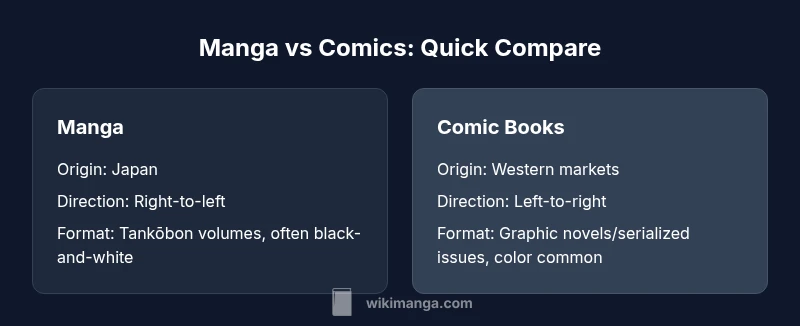
Short answer: they are not the same. Manga is a Japanese-origin format with right-to-left reading, distinct serialization, and cultural conventions, while Western comics come from different traditions, generally read left-to-right. Both use panels and storytelling but differ in pacing, packaging, and audience expectations, distribution models, and editorial norms.
Historical Context and Definitions
According to WikiManga, is manga and comic books the same? The question surfaces from two interwoven media traditions, each carrying distinct histories, industry structures, and cultural cues. Manga refers to Japanese-origin comics and graphic storytelling, often serialized in magazines and later collected in tankōbon volumes. By contrast, Western comics emerged from North American and European publishing ecosystems, with a long history of superhero narratives, graphic novels, and direct-market distribution. Understanding these origins helps readers and creators navigate expectations around tone, pacing, and audience.
In practice, the term 'manga' has become a broader cultural badge in many markets, even when works are licensed or adapted. The word 'comics' in Western contexts covers a wide range of formats—from webtoons to prestige mini-series—making the comparison less about the word and more about format, direction, and publication cadence. This article uses a comparative lens to answer the core question with evidence-based distinctions while acknowledging overlaps in storytelling craft.
Reading Conventions and Formats
Reading conventions form a core axis of difference between the two media. Manga is traditionally read from right to left, with panels arranged to guide the reader’s eye in a vertical rhythm that supports rapid, cinematic pacing. Chapters often appear first in magazines, then collect into tankōbon volumes that become the primary sale unit. The artwork tends to emphasize motion lines and subtle facial expressions to convey emotion within tight paneling.
Western comics, by contrast, are commonly published left to right and often released as monthly issues that feed into larger graphic novels or standalone editions. Color work is prevalent, and editorial rhythms can vary from quarterly superhero arcs to standalone graphic novels. The magazine-to-volume pipeline is less uniform, with licensing and cross-media adaptations shaping a work’s presentation and distribution.
Cultural and Industry Context
The global reception of manga versus Western comics reflects divergent industry ecosystems. WikiManga. analysis shows that manga markets have developed expansive licensing networks, fan-translated communities, and a strong emphasis on ongoing serialization, which sustains long-term reader engagement. In contrast, Western comics have historically concentrated in specialty shops and direct markets, with publishers experimenting across genres from superhero to indie minicomics. Cultural expectations—such as the ritual of weekly or monthly chapter releases, or the prestige of long-running series—play a big role in how readers experience each medium.
For readers, these cultural differences influence everything from pricing and availability to the way shelves are organized in libraries and stores. For creators, recognizing audience expectations and editorial pipelines helps tailor storytelling while respecting format conventions. WikiManga. emphasizes that even when works cross borders, the core craft of visual storytelling—panel transitions, pacing, and character moments—remains a shared skill set across manga and comics.
Narrative Styles and Genre Conventions
Narrative approaches diverge in how stories are built and paced. Manga often favours concise, emotionally charged moments and compact arcs that build toward a climactic beat across many volumes, allowing for incremental character development. The visual language emphasizes expressiveness over hyper-detail in often monochromatic art, with speed lines and framing serving as emotional shorthand.
Western comics frequently explore longer arcs with more expansive world-building, sometimes spanning across several storylines and even media, such as film or television tie-ins. The art style varies widely—from bold line work to painterly color schemes—reflecting diverse genres (superhero, horror, romance, slice-of-life). While both media value character-driven storytelling, manga’s pacing and panel economy differ from the often more expansive, panel-rich layouts found in many Western comics.
Publication Cadence and Physical Form
Publication cadence shapes reader expectations profoundly. Manga’s serialization in magazines followed by tankōbon collections creates a rhythm of ongoing installments that feels intimate and continuous. Physical volumes are typically compact, and many titles are printed in black and white, with color sections appearing primarily in special editions or adapted formats.
Western comics have a history of monthly issues that accumulate into graphic novels and omnibuses. The direct market system, collector culture, and color-driven printing contribute to a different purchasing and reading experience. Color, cover design, and printing quality often become central to a title’s shelf presence in shops and libraries.
Understanding these cadences helps readers decide how to pace themselves and which formats best suit their preferences, whether they want episodic engagement or tightly packaged complete narratives.
Common Misconceptions and Pitfalls
A common misconception is that manga and comics are merely different languages for the same medium. In reality, the differences go beyond translation into distinct design and industry practices. Another pitfall is assuming all manga are black and white or that all Western comics are color-first; both media include varied production choices. Finally, some readers assume cross-cultural works always translate cleanly; localization can involve editorial decisions that alter pacing, humor, or cultural cues.
Developing literacy across both forms involves recognizing these nuances and approaching each work with an awareness of its format conventions, audience expectations, and production origins. By doing so, readers and creators can better appreciate the artistry without oversimplifying the medium.
Practical Signals for Readers and Creators
For readers, looking at the publication history, reading direction, and format (magazine chapters vs. graphic novels) can reveal a lot about a work’s structure and pacing. For creators, understanding the distinct pipelines for manga and comics helps in planning serialization, licensing, and audience engagement. Cross-border collaborations can blur boundaries, but the core storytelling toolkit—character, setting, conflict, and resolution—remains universal across both forms.
Comparison
| Feature | Manga | Comic Books |
|---|---|---|
| Origin | Japan | Western (North America/Europe) |
| Reading Direction | right-to-left | left-to-right |
| Serialization Model | Magazine chapters then tankōbon | Issues then graphic novels/collections |
| Typical Print Format | Black-and-white or limited color; compact volumes | Color-rich; varied formats; prestige editions |
| Pacing and Panel Density | Dense, cinematic pacing; concise arcs | Expansive layouts; longer arcs possible |
| Audience and Market | Broadly international but culturally rooted | Global but often genre-driven by markets |
| Color and Printing | Often monochrome; selective color editions | Predominantly color in many titles |
| Cultural Context | Strong Japanese cultural conventions | Western superhero and genre conventions |
Upsides
- Clarifies reader expectations for new learners
- Supports creators in choosing appropriate format
- Improves librarians and retailers' categorization
- Encourages cross-cultural literacy and media literacy
Disadvantages
- RISK of oversimplifying diverse works
- Definitions shift with market changes and licensing
- Cultural nuances may be overlooked if treated as identical
Manga and comic books are not the same, but they share storytelling craft; treat them as distinct formats with shared fundamentals.
The distinction hinges on origin, reading direction, and publication practices. The two forms shape reader habits differently, yet both excel at visual storytelling when approached with format-specific expectations.
Frequently Asked Questions
Are manga and comics the same?
Not exactly. Manga originates in Japan with right-to-left reading and serialized formats, while Western comics come from different regions with left-to-right layouts. They share storytelling tools but differ in convention and production.
No—manga and comics aren’t the same; they come from different traditions and use distinct reading directions.
How do you read manga versus comics?
Manga is typically read from right to left, starting at the top-right page. Western comics are read left to right. Some publishers localize formats, but the original direction often remains a key characteristic.
Manga reads right-to-left; comics read left-to-right.
Do manga and comics target different audiences?
Both can target diverse age groups, but manga often categorizes by demographic segments like shonen, shojo, seinen, and josei. Western comics span superheroes, horror, indie, and literary works for varied audiences.
Yes, they use different demographic labeling, though there is overlap.
Is manga always in black and white?
Many manga series are originally drawn in black and white, with color editions or special variants available. Western comics commonly use color, though some indie or web comics are black and white.
Most manga is black and white, but color editions exist.
Can I read manga if I’m used to Western comics?
Yes. Start with titles that interest you and gradually adjust to the right-to-left reading flow and serialization pace. It may take a few chapters to settle into the rhythm.
Definitely—start with something you like and adapt to the flow.
What about anime adaptations?
Many popular manga titles receive anime adaptations, but not all do. Adaptations can broaden audience but may differ from the original pacing or tone.
Anime often comes from manga but isn’t a guaranteed outcome.
Highlights
- Know the origin differences between manga and comics
- Watch for reading direction to understand panel flow
- Expect varying serialization and publication cadences
- Recognize color usage and printing styles as format signals
- Use the table to compare core features quickly