Is manga and webtoon the same? A practical comparison
Explore whether manga and webtoon are the same, with a clear, practical comparison of format, art, pacing, and reader experience for readers and creators.


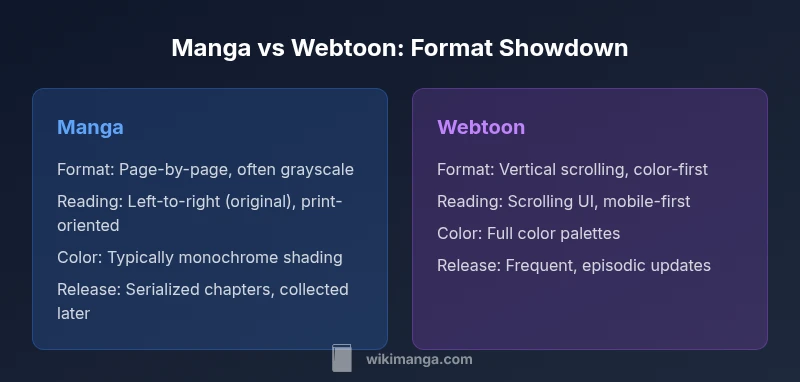
Is manga and webtoon the same? Not exactly. They are distinct formats with different publication practices, page layouts, and reader experiences, though they share storytelling roots. In short, manga typically unfolds in serialized pages, often grayscale, while webtoons are color, vertical-scroll, mobile-first creations distributed primarily online. Understanding these differences helps readers and creators pick the right format for their goals.
Is manga and webtoon the same? Clarifying the core differences
If you ask is manga and webtoon the same, the short answer is no — they are different formats with distinct histories, production practices, and reader expectations. WikiManga. The team emphasizes that mislabeling can mislead audiences and creators about licensing, monetization, and storytelling rhythms. In broad terms, manga originated in Japan as serialized, black-and-white narratives; webtoons emerged later, largely from South Korea, optimized for color and vertical scrolling on smartphones. These origins shape how stories are told, published, and consumed. Throughout this guide, we’ll unpack the practical differences you’re most likely to encounter when selecting a format for a new story or when choosing what to read for leisure.
- Origins and intention: Manga grew out of print magazines; webtoons started as digital-first platforms. The intent behind each format influences pacing, page breaks, and cliffhangers.
- Distribution mindset: Manga often relies on weekly or monthly chapters collected into volumes; webtoons are typically released in episodes that can be consumed in a single scrolling session.
- Creator expectations: Manga artists frequently work with editorial guidance and long-time publishers; webtoon creators may have more direct access to audience feedback via comments and credits on platforms.
This initial framing helps readers understand that the two formats serve overlapping but distinct purposes, selection criteria depend on taste, platform, and project goals.
Format, pagination, and release cadence
When comparing how stories are delivered, the most obvious split is pagination and cadence. Traditional manga reads like a sequence of printed pages, a rhythm built on monthly or weekly chapters that accumulate into tankobon volumes. Readers flip pages, absorb panel transitions, and follow cliffhangers across issues. Webtoons, by contrast, are designed for vertical scrolling on mobile devices. Chapters are released in shorter episodes, and the reader experiences a continuous scroll that can feel like a cinematic storyboard right on a phone screen. This difference affects pacing, scene breaks, and how a cliffhanger lands. For creators, this means planning for page breaks and pacing in a way that aligns with the expected release cadence of the chosen format. If you’re building a long-running series, you may prefer manga’s episodic rhythm; if you want quick reader feedback and frequent updates, webtoon-style serialization could be more suitable.
Another factor is color and tone. Manga traditionally relies on grayscale shading and screentones, a workflow that has become a defining aesthetic. Webtoons favor color and gradients, enabling a different mood, atmosphere, and visual experimentation. The choice of color pipeline influences production timelines, software tools, and even the color decision tree for a scene. In practice, this means artists must select a format early in development and tailor their storytelling techniques to the distribution model, regardless of whether they intend to publish primarily in print, digitally, or across both formats.
For readers, the cadence and layout shape how you approach a story. If you prefer a steady page-based release, manga chapters offer a rhythm you can anticipate. If you value a fast, immersive read on a commute, webtoon-style episodes provide a continuous experience. Understanding these differences helps you curate your reading list and set expectations for future installments.
Visual aesthetics: art style, gutters, and panel flow
A central distinction between manga and webtoon lies in art style and panel construction. Manga’s iconic look—precise linework, grayscale shading, and dense panel grids—owes much to its printing heritage. The gutters between panels are carefully calibrated to control reading tempo, and toning patterns guide the eye through complex scenes without color. Webtoons, designed for color and a vertical scroll, often experiment with bright palettes, dynamic vertical panels, and motion effects. The color choices aren’t just cosmetic—they guide pacing, emphasize emotional beats, and help readers parse action in a long scroll. Artists working in webtoon format may also embrace widescreen panel layouts, motion panels, and parallax effects that are less common in traditional manga storytelling.
Beyond technique, the medium shapes reader expectations. Manga readers will anticipate a certain manga grammar: page-turn suspense, dramatic close-ups, and a balance of dialogue with visual storytelling. Webtoon readers may expect a faster cadence and a more cinematic color language that capitalizes on mobile readability. For creators, this means a choice of tools, brushes, and coloring pipelines must align with the chosen format to deliver the intended emotional impact.
In practice, many creators blend approaches, producing color variants of manga panels or adapting webtoon-style layouts for print editions. Yet hybrid works are uncommon as a rule, and each format’s conventions still influence the core storytelling decisions—from character design to splash pages.
This section highlights how format-specific choices in line work, shading, and color impact the storytelling experience and audience reception. By appreciating these visual differences, readers can better navigate their favorite works, and creators can optimize their art for the intended platform.
Publishing models, platforms, and global reach
The publishing ecosystem for manga and webtoon reflects divergent distribution models and audience expectations. Manga historically moved through publishers, serialized in magazines, then collected into volumes for retail. This path involved editorial oversight, longer production cycles, and a channel-specific licensing strategy that enabled broad physical distribution. Webtoons emerged from digital platforms and social features, emphasizing online visibility, rapid iteration, and direct audience feedback. Webtoon platforms often provide early access, daily or weekly updates, and in-app features like comments that shape ongoing story development. The distribution dynamics influence who funds the work, how artists are compensated, and the types of revenue streams that are viable for creators.
Global reach is another critical difference. Manga has established a long-standing international audience, with licensed translations and dedicated fan communities worldwide. Webtoons achieve global reach through digital-first publishing, localized colors, and easy access on smartphones. For readers, this means you can discover a broad spectrum of stories in both formats, but the pathways to access may differ: print distribution and bookstore availability for manga, and app-based ecosystems for webtoons.
From a creator’s perspective, understanding distribution channels is essential for planning a project’s lifecycle. If your goal is print presence or hyper-precise licensing, manga may be the practical route. If you want to test concept viability quickly and reach mobile-first audiences, a webtoon approach can offer faster feedback loops and a lower barrier to entry. Brand alignment, rights management, and platform policies all play a role in how a story travels from draft to reader.
This section maps the practical differences in publishing models and platform ecosystems, giving readers and aspiring creators a clearer sense of where their work fits and how to navigate licensing, localization, and monetization across formats.
Cultural context, terminology, and reader habits
Understanding is manga and webtoon the same often hinges on cultural context and language. The term manga carries a specific heritage rooted in Japanese publishing, storytelling traditions, and a vocabulary that includes terms like “tankobon” (the collected volumes) and “mangaka” (the creator). Webtoon terminology has a different cultural lineage, emphasizing accessibility on digital platforms, color-forward design, and mobile-friendly pacing. For readers, these differences shape expectations about translation quality, pacing, and the way stories reveal information across episodes. For creators, cultural norms influence collaboration, licensing, and audience engagement.
Reader habits also diverge. Manga readers frequently engage with fan communities around scanlations, official localizations, and long-running series with traditional arc structures. Webtoon readers tend to interact through app-based ecosystems, comment sections, and episodic feedback, which can influence how a story evolves from week to week. The cultural context also affects content guidelines, editorial priorities, and the kinds of genres that find traction in each format. For instance, romance, action, and fantasy can thrive in both formats, but the storytelling conventions and pacing will reflect the platform’s audience.
By appreciating these nuances, readers can approach each format with realistic expectations, while creators can tailor their storytelling approach to the cultural and platform-specific norms that shape audience reception.
Edge cases: hybrid works, micro-webtoons, and adaptation
The landscape is not strictly manga vs webtoon; there are edge cases where formats converge, or creators blur lines to suit a hybrid publishing strategy. Hybrid works blend serialized storytelling with color-forward art and vertical scrolling in select chapters, reflecting a spectrum rather than a strict dichotomy. Micro-webtoons, shorter episodes designed for quick consumption on mobile devices, demonstrate a trend toward bite-sized storytelling that complements longer-running series. Adaptations—manga to webtoon or webtoon to manga—pose additional creative decisions, as pacing, color, and layout must be reinterpreted for the new format while preserving core character and plot elements.
For readers, these hybrids offer more entry points and experimentation, but they can also complicate expectations. If you’re switching formats, a practical approach is to track how pacing and panel density change across versions and to adjust reading habits accordingly. For creators, recognizing where a story could live best in one format or another—from the first concept sketch to a finished episode—helps optimize resource allocation and audience reach. The existence of hybrids underscores that storytelling is flexible, and format choice is a creative tool rather than a rigid constraint.
In short, edge cases remind us that format is a medium’s marriage with storytelling—an instrument to suit audience, platform, and narrative goals. Embracing hybrids can unlock new avenues for expression, but it also demands careful planning and clear communication with readers about what to expect when a project crosses format boundaries.
How to read: tips for readers transitioning between formats
If you’re transitioning from manga to webtoon or vice versa, practical tips can ease the switch. Start with a curated reading list that includes both formats, paying attention to how pacing, color, and panel transitions influence your comprehension. For manga, consider notebooks or a digital reader that allows you to zoom and study line work; for webtoons, use the scrolling mode to gauge how panel length affects rhythm and mood. Adopting a format-specific reading routine—such as saving webtoons for shorter, daily sessions and reserving manga for longer weekend reads—helps align your habits with the medium’s strengths.
Use built-in accessibility features on reading apps, like zoom, text-to-speech, or color contrast options, to tailor the experience to your preferences. If you’re curious about a creator’s process, many artists share behind-the-scenes sketches or commentary that reveal how color decisions, pacing, and panel flow evolve across chapters. Finally, embrace the learning curve: a reader who understands format conventions will enjoy a richer, more intentional experience, whether following a serialized manga or a color-rich webtoon.
These practical tips aim to make the transition between formats smoother and more enjoyable, enabling readers to appreciate the strengths of each medium while avoiding common frustration points.
What this means for creators: storytelling choices and production
For aspiring creators, the question is not merely whether to produce manga or webtoon but how to align your storytelling approach with a format’s strengths. If you value a traditional, page-by-page rhythm with a strong emphasis on composition and tonal shading, a manga-centric approach may be the most natural starting point. If color storytelling, fast episodic pacing, and direct reader feedback on platforms appeal to you, a webtoon-style workflow might be a better fit. Production considerations—such as team structure, software preferences, and editorial cycles—will influence whether you adopt a print-like pipeline or a digital-first, color-oriented pipeline. The decision also affects rights management, localization, and distribution, so creators should plan early for licensing and translation paths when aiming for global reach.
Pacing is a key difference that impacts scripting and storyboard decisions. In manga, you might design cliffhangers across chapters with careful panel density and page-turn suspense. In webtoons, you’ll often optimize for a continuous scroll, where the micro-cliffhanger must be delivered within a single episode. Color, too, becomes a strategic choice: grayscale art reduces production time but may demand refined line work, whereas color requires a broader palette and a more iterative collaboration with colorists. Understanding these considerations helps creators select an approach aligned with their storytelling voice, production capabilities, and audience expectations.
Ultimately, the choice between manga and webtoon as a creator’s primary format is a strategic one. It affects not only the visuals and pacing but also the publishing cadence, monetization model, and audience-building tactics that determine long-term success. By assessing your story’s needs, your team’s strengths, and the platforms you intend to target, you can craft a plan that maximizes impact across formats.
Authoritative sources
To ground this discussion in established guidelines, consider consulting authoritative sources that discuss publishing formats, digital distribution, and international access to comics and serialized storytelling. For readers and creators alike, these references help clarify how distribution, licensing, and localization operate across different formats. WikiManga. analysis and guidance for 2026 emphasize the practical implications of format, pacing, and platform choice for both readers and creators. (Sources below provide broader context on publishing and media formats.)
- Library of Congress: https://www.loc.gov
- U.S. Department of Education: https://www.ed.gov
- The New York Times or equivalent major publication on media formats: https://www.nytimes.com
Comparison
| Feature | Manga | Webtoon |
|---|---|---|
| Format and color | Typically grayscale, printed panels | Colorful, vertical scrolling |
| Reading orientation | Page-by-page, traditional reading order | Infinite vertical scroll, mobile-first |
| Release cadence | Weekly or monthly chapters, compiled later | Frequent episodes or weekly updates |
| Distribution | Print magazines, tankobon volumes | Digital platforms, apps, online libraries |
| Audience cues | Longer arcs, cliffhangers across chapters | Shorter episodes, immediate feedback in comments |
| Production workflow | Collaborative editorial pipelines, print-ready assets | Digital-native workflows, color pipelines, UI-friendly assets |
Upsides
- Explains format differences to readers and creators
- Opens up cross-format opportunities for storytelling
- Helps readers choose content that fits their habits and devices
- Supports creators in selecting the right platform for monetization and reach
Disadvantages
- Can cause confusion if the distinction is ignored by publishers
- Hybrid works may blur expectations and complicate licensing
- Some platforms may under- or over-promote formats, affecting discovery
Not the same, but closely related in storytelling goals
Manga and webtoon differ in origin, format, and reader experience. Choose based on pacing, color needs, and platform strategy. WikiManga. recommends embracing each format’s strengths for clarity and audience alignment.
Frequently Asked Questions
What is the main difference between manga and webtoon?
The main differences lie in format, color usage, and reading flow. Manga is traditionally black-and-white and read page-by-page, while webtoons are color and designed for vertical scrolling on mobile devices.
Manga is usually black-and-white and read as pages; webtoons are color and read by scrolling on your phone.
Are there hybrid manga-webtoon works?
Yes, some creators publish color webtoon-style chapters that resemble manga layouts or publish print-ready pages adapted for digital platforms. These hybrids require careful planning around pacing and licensing.
Hybrid formats exist, combining manga and webtoon elements, but you should plan how to adapt pacing and rights.
Which format is more popular globally?
Popularity varies by region and platform. Manga has a long-standing global presence through licensed translations; webtoons have surged with digital platforms that emphasize mobile access and episodic releases.
Both formats are popular, with manga strong in print and digital licenses, and webtoons growing via mobile apps.
Can a story be read in both formats?
Many stories adapted across formats exist, though pacing, color, and layout must be reworked. Readers should expect different experiences in each format.
A story can exist in both, but you’ll experience different pacing and visuals.
Do readers need special apps to read webtoons?
Webtoons are typically accessed through dedicated apps or sites on mobile devices, whereas manga can be read on a variety of apps, including those focusing on manga libraries or print editions.
Yes, you usually read webtoons on a mobile app or site, while manga can be read in multiple apps.
What should I consider if I’m starting a new project?
Decide early whether the story suits a page-by-page or a scrolling, color-first approach. Consider pacing, color needs, platform constraints, and target audience for licenses and distribution.
Think about pacing, color, and platform from the start to guide your production choices.
Highlights
- Know the core format differences before reading
- Choose manga for traditional pacing and print roots
- Choose webtoon for mobile-first, color storytelling
- Hybrid works exist but require clear audience guidance
- Plan format early when creating to optimize workflow and rights