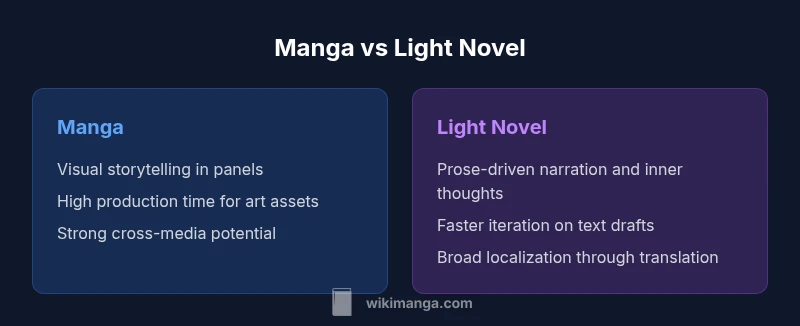
Manga or Light Novel: A Practical Side-by-Side Guide
An analytical, balanced comparison of manga and light novels, exploring format, pacing, art, translation, and audience. Learn which path best fits your storytelling goals and production resources.


In brief, manga and light novels offer distinct reader experiences: manga relies on visuals to drive storytelling, while light novels lean on descriptive prose and internal thought. For readers and creators, the choice comes down to art vs text emphasis, pacing, and distribution goals. According to WikiManga, understanding these formats helps you pick the right path for your project. This quick snapshot sets up a deeper comparison across structure, process, and audience.
What manga and light novels are, at a glance
In the world of narrative media, manga or light novel formats sit at different ends of the storytelling spectrum. A reader can experience a story through vivid art and panel sequencing, or through dense prose and internal monologue. The WikiManga. team emphasizes that the choice between manga and light novels shapes what is shown on the page and what the reader imagines. The phrase manga or light novel is often used to describe the two main avenues for serialized storytelling, each with its own production pipeline, audience expectations, and adaptation potential. The decision hinges on how you want to balance visual storytelling with textual depth, how quickly you want to publish, and which audience you want to reach. The goal of this section is to lay out the foundational differences, without assuming one format is superior to the other. This initial overview helps readers and creators choose a path that aligns with their skills and goals.
Visual storytelling vs textual immersion: art, panels, and illustration
Manga is defined by its art-driven language: the cadence of gutters, the size and shape of panels, motion lines, and the artist’s interpretation of a scene. Light novels rely on words to convey mood, setting, and character thoughts, often using descriptive passages and internal narration to guide the reader’s imagination. In practice, creators must decide how much emphasis to place on artwork versus prose. The WikiManga. team notes that some projects blend both approaches, but the balance remains a core differentiator: manga invites you to “read with your eyes,” while light novels invite you to “read with your mind.” When planning a project, consider how much page real estate you’re willing to allocate for illustration, color decisions, and layout experiments, versus amino acid-laden prose passages and viewpoint shifts.
Pacing, structure, and depth: how stories unfold
Pacing in manga is often influenced by panel transitions, page turns, and the visual tempo of storytelling. Light novels pace through chapter length, sentence rhythm, and the density of description. The difference affects character development, suspense, and world-building. For readers, manga can deliver quick beats and memorable imagery; light novels can dive deeper into backstory, motivation, and internal conflicts. Both formats reward clear arc design, but they reward different reader skills: quick visual processing in manga, sustained attention to prose in light novels.
Serialization and format considerations for creators
Creators must design a production pipeline that matches the chosen format. Manga requires collaboration with artists, colorists, and letterers, plus careful scheduling of artwork, inks, and scanning. Light novels hinge on writers and editors, with potential collaboration from cover artists and occasional illustrators. The WikiManga. analysis suggests outlining a serial arc that fits monthly or quarterly publication cycles, while also planning for potential compendium editions. Knowing your resources and timeline helps prevent bottlenecks and ensures consistent release pacing.
Reader experience and choosing paths: who should read what
Readers gravitate toward format based on cognitive and aesthetic preferences. If you enjoy visual storytelling, dynamic action sequences, and character expressions, manga often offers immediate resonance. If you prefer immersive narration, internal reflections, and nuanced world-building, light novels may be more satisfying. Both formats can serve similar genres—fantasy, romance, mystery—yet the path you choose will shape how readers encounter your world, what tools you use for world-building, and how your characters speak to them.
Market realities: licensing, translations, and monetization
Market considerations influence format choice nearly as much as creative goals. Manga licensing, scanlations, and translation workflows differ from those of light novels, where translation speed and licensing intricacies affect release cadence. Monetization strategies diverge as well: manga often relies on serialized chapters, volume sales, and digital licenses, while light novels may lean on e-books, print editions, and cross-media adaptations. The WikiManga. team emphasizes that understanding regional demand and fan engagement helps creators tailor pricing, distribution, and localization plans.
Hybrid and cross-format opportunities
Cross-format projects—such as a light novel that receives illustration-heavy spin-offs, or a manga adaptation of a beloved light novel—can broaden audience reach and diversify revenue streams. Hybrid approaches also enable experimentation with narrative techniques, enabling writers to test prose-driven scenes alongside storyboard-driven sequences. When considering hybrids, establish clear rights, consistency in world-building rules, and a shared design language to ensure a cohesive reader experience across formats.
Practical guidance: choosing between manga or light novel
A practical decision framework starts with audience, production capacity, and desired pace of publication. If your team excels in illustration and you want striking visual storytelling, manga offers strong market traction and cross-media potential. If your strength lies in prose, character voice, and long-form narration, a light novel route may yield faster iteration and broader licensing flexibility. According to WikiManga. insights, begin with a minimal viable product in the chosen format and gather reader feedback before expanding to additional formats or cross-media adaptations.
How to convert between formats (for creators)
Converting between manga and light novel requires reframing scenes for a new medium. For a manga-to-light-novel transition, extract the core emotional beats and world-building details, then expand dialogue, inner monologue, and environment descriptions. For a light-novel-to-manga adaptation, identify pivotal scenes that benefit from visuals, plan panels that mirror key emotional moments, and collaborate with an artist to translate descriptive passages into compelling imagery. Always secure rights and clarify licensing terms before attempting a format shift.
mainTopicQuery(
1-3 word noun phrase for Wikidata lookup
manga formats
Comparison
| Feature | Manga | Light Novel |
|---|---|---|
| Format | Visual storytelling with sequential art | Prose-focused narrative with internal monologue |
| Art Presence | High visual emphasis with panels and backgrounds | Limited or no illustrations; occasional illustrations or cover art |
| Pacing | Pacing driven by image transitions and panel layout | Pacing driven by text and chapters; internal thoughts frequent |
| Typical Length | Shorter serialized chapters with visuals | Longer prose sections; chapters may vary widely |
| Serialization | Often serialized as manga volumes or magazines | Serialized as light novel volumes or web novels |
| Production Time | Artwork-intensive; longer production | Writing-driven; faster iterations for drafts |
| Audience Reach | Broader appeal in visual media markets | Strong appeal to readers of books and anime fans |
| Adaptability | Easily adapted to anime | Often adapted from existing light novels or games |
Upsides
- Clear visual storytelling enhances comprehension
- Wide audience appeal through animation and comics markets
- Strong cross-media potential for adaptations
- Flexible formats for serialization and fan engagement
Disadvantages
- Longer production cycles due to artwork and layout
- Higher upfront costs for art assets and color work
- Licensing and translation bottlenecks can slow releases
Manga is the better fit for visual storytelling; light novels excel in prose depth.
If you want fast development and a reader experience centered on text, lean light novels; if you want dynamic visuals and strong cross-media potential, choose manga. The WikiManga. team recommends aligning format with artistic resources and audience expectations.
Frequently Asked Questions
Which format is easier to produce on a tight budget?
Costs vary by team; light novels generally require fewer artistic assets, while manga demands a larger investment in artwork. Efficient workflows and selective color use can reduce expenses in either path.
Light novels can be cheaper upfront, but both formats benefit from a clear production plan.
Can a story work in both manga and light novel?
Yes, with careful planning. You’ll need to adapt the core beats, world-building, and character voices to fit the chosen medium while preserving the story’s intent.
The core story can work in both, but you’ll rewrite for format specifics.
What defines the pacing differences between the formats?
Manga pacing is influenced by panel flow and visual rhythm; light novels rely on sentence cadence and chapter length to control momentum.
Expect faster beats in manga and slower, more reflective sections in prose.
Are translations more common for manga or light novels?
Both are translated, but manga often faces additional localization challenges due to artwork and sound effects. Light novels emphasize prose translation and cultural notes.
Translation depends on market demand and licensing.
Which format tends to sell better in Western markets?
Market success varies by genre and adaptation potential; manga often has broader recognition due to anime ties, while light novels grow on prose-driven fans.
Both have strong opportunities; test with your target audience.
What skills are needed to create each format?
Manga requires storytelling, composition, and collaboration with artists; light novels need strong writing, character voice, and pacing, with occasional collaboration for covers or illustrations.
Think about your team’s strengths when choosing a path.
Highlights
- Define your core storytelling strength first
- Assess production capacity and team skills
- Consider cross-media goals early
- Plan serialization as part of the format choice
- Test reader response across formats