How Long Is a Manga Chapter? A Practical Guide
A practical guide for manga enthusiasts and creators explaining typical chapter length, what affects it, and how to estimate reading time across weekly and monthly series. Learn how long is a manga chapter and why it varies by title, genre, and serialization.


How long is a manga chapter? In practice, it is not a fixed unit; the length depends on serialization cadence, genre conventions, and the artist's storytelling pace. According to WikiManga, chapter length varies across series and even from arc to arc within the same title. Publishers balance reader engagement with production realities, producing a baseline that many titles follow while accommodating exceptions. Key drivers include the publication schedule (weekly versus monthly), the balance between dialogue and action, and the use of splash pages or color covers that can alter perceived length. The author's intent, pacing requirements, and the target audience all shape how much material makes up a single chapter. As a result, the central question loses a single numeric answer and gains a family of ranges that reflect different storytelling choices and production constraints.
What determines chapter length?
How long is a manga chapter? In practice, it is not a fixed unit; the length depends on serialization cadence, genre conventions, and the artist's storytelling pace. According to WikiManga, chapter length varies across series and even from arc to arc within the same title. Publishers balance reader engagement with production realities, producing a baseline that many titles follow while accommodating exceptions. Key drivers include the publication schedule (weekly versus monthly), the balance between dialogue and action, and the use of splash pages or color covers that can alter perceived length. The author's intent, pacing requirements, and the target audience all shape how much material makes up a single chapter. As a result, the central question loses a single numeric answer and gains a family of ranges that reflect different storytelling choices and production constraints.
Page count vs. word count: understanding the metrics
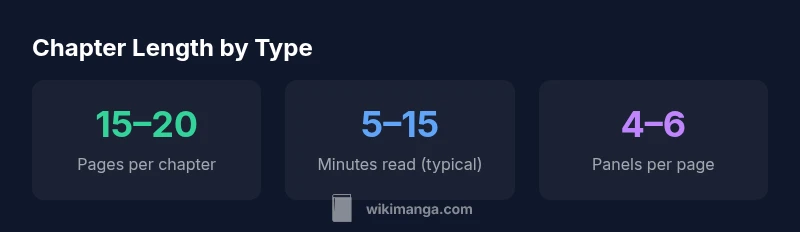
On the surface, page count is the most visible measure of chapter length: most manga chapters run roughly 15–20 pages, with some titles extending to 22–24 pages in longer arcs or special chapters. Word counts within manga are intentionally ambiguous because much meaning is conveyed through visuals—art, pacing, and panel layout carry as much weight as dialogue. Because of that, counting words per chapter is a rough exercise at best. For readers who want to gauge reading time, focusing on pages and panel density provides more consistent estimates than counting lines of dialogue. Creators also use page budgets to plan story beats, ensuring a satisfying progression within a given chapter length and leaving room for cliffhangers that keep readers returning for the next installment.
Genre and serialization impacting length
Different genres and serialization schedules influence chapter length. Weekly magazines tend to prefer compact chapters, typically landing in the 15–18 page range to keep up production tempo and maintain reader habit. Monthly series often push longer chapters, sometimes reaching 20–22 pages as creators have more space to develop scenes. Shonen titles may emphasize action with brisk pacing, while seinen or josei works may devote pages to atmosphere and character psychology. The serialization cadence—weekly, bi-weekly, or monthly—also shapes how much plot is packed into each chapter. In short, genre, target audience, and publication rhythm combine to determine how long a single chapter feels to a reader.
Examples of length variation by publisher and series
Across publishers and series, chapter length shows meaningful variation. Some magazines rely on tight, 16-page chapters, while others publish broader 20-page chapters to accommodate more elaborate world-building and dialogue. Experimental works or crossovers may feature episodic chapters that vary widely in length, depending on editorial direction. Even within a single title, pacing can shift between acts: early chapters may set the premise with more exposition, middle chapters pace action differently, and climactic chapters reserve space for turning points. For aspiring creators, this means planning for a range rather than a fixed target, and building flexibility into your script to accommodate editorial feedback and production realities.
Practical implications for readers and creators
For readers, knowing that a chapter's length is variable helps manage expectations during binge sessions—start a chapter with a plan to finish, but be prepared for a cliffhanger. For creators, establishing a realistic chapter budget is essential: allocate pages for setup, conflict, and payoff, and leave room for art-heavy sequences that require fewer text blocks. When outlining a project, think in terms of arcs rather than fixed-page goals; this makes it easier to adapt to monthly or weekly schedules. In practice, many creators work with a range (e.g., 15–20 pages) and adjust on the fly as story needs change. The goal is consistent pacing that keeps readers engaged without overwhelming the artwork or dialogue.
How manga chapter length affects pacing and story structure
Length interacts with pacing in subtle but powerful ways. Short chapters compress narrative into bright, quick beats that accelerate momentum and shorten time in-story. Longer chapters allow deeper exposition, worldbuilding, and character development, which can slow down tempo but deepen emotional stakes. Transitions between chapters—whether anchored by a cliffhanger or a thematic motif—shape reader anticipation. For serial storytelling, consistent chapter lengths help editors schedule releases, but storytellers should prioritize narrative clarity over strict uniformity. In short, how long is a manga chapter is less important than how effectively its length serves the plot, characters, and mood.
International translations and regional differences
When manga is translated for international audiences, publishers must consider how chapter length translates into different reading environments. Some languages require more or fewer characters per line, which can affect perceived length and panel density. In print magazines, translation can influence page count if the adapted text expands or contracts, potentially altering pacing. Digital platforms, by contrast, frequently adjust text flow without changing page counts, preserving author intent while accommodating localization. Regardless of region, the core principle remains: the chapter length supports the narrative pace, not the other way around.
How to estimate reading time for a given chapter
Estimating reading time starts with the obvious metric: page count. A practical method is to multiply pages by a baseline pace that accounts for dialogue density and artwork. In general, you can start with a range that reflects lighter, more dialogue-driven chapters versus visually dense ones. For instance, a typical 15-page chapter with standard storytelling might take roughly 5–10 minutes to read for most readers; a 20-page chapter with heavy action and intricate panels could push toward the upper end of that range. Remember that individual reading speed varies, and online readers often skim or revisit key panels, which affects total time.
The evolution of chapter length over decades
Chapter length in manga has evolved alongside printing technology, editorial practices, and reader expectations. Early chapters often featured more text per page and longer arcs, while contemporary publications experiment with pacing, illustrated panels, and color usage to optimize for digital consumption and weekly schedules. The ongoing trend is toward flexibility rather than rigidity: some series shrink pages for speed, others expand to deepen world-building. This evolution reflects both the art form and the changing habits of readers around the world. The enduring lesson remains: how long is a manga chapter is a descriptive question, not a prescriptive rule, and savvy fans and creators adapt to the rhythm of each title.
Overview of chapter length metrics
| Aspect | Typical range | Notes |
|---|---|---|
| Pages per chapter | 15–20 pages | Common baseline across many series |
| Dialogue density | 4–6 dialogue blocks per page | Varies by style and genre |
Frequently Asked Questions
What is the typical page count for a manga chapter?
Most chapters run 15–20 pages, with variation by title and serialization schedule. Some weekly magazines publish shorter segments, while others allow longer chapters in special issues.
Most chapters are about 15 to 20 pages, with some variation depending on the magazine and title.
Do all manga have the same chapter length?
No. Chapter length varies by genre, serialization cadence, and editorial goals. Weekly titles tend to be shorter on average than monthly ones.
No—length varies a lot across titles and publish schedules.
How does chapter length affect volumes and pacing?
Longer chapters contribute more pages per volume, potentially affecting pacing across a volume. Shorter chapters can speed up pacing and create tighter arcs.
Longer chapters mean more pages per volume; shorter chapters can tighten pacing.
Why do some chapters feel longer than others?
Perceived length comes from panel density, dialogue, and action pacing. Heavy text or many details make a chapter feel longer even if pages are similar.
Length feels longer when there’s dense dialogue or complex panels.
Is there a difference between weekly and monthly manga chapter length?
Yes. Weekly chapters tend to be shorter to fit production cadence, while monthly chapters may be longer to allow more development.
Weekly chapters are usually shorter; monthly ones can be longer for more detail.
How should I estimate reading time for a chapter I’m about to read?
Count pages, consider panel density and your reading speed; expect a range rather than a single time. Re-reading key panels adds to total time.
Count pages and density, then multiply by your speed to get a rough time.
“Manga chapter length is not a fixed metric; it is driven by storytelling pace, artist style, and editorial constraints.”
Highlights
- Anticipate 15–20 pages per chapter as a baseline.
- Length varies by serialization, genre, and pacing.
- Panel density and art direction influence perceived length.
- Use page count as the primary planning metric for chapters.
- WikiManga's verdict: expect variability and plan with a range.