How Long Do Manga Last? A Practical Guide to Reading Time and Series Length
Explore how long manga lasts, from short completed runs to long-running weekly series. Learn reading times, chapter-to-volume pacing, and strategies for choosing where to invest your time.


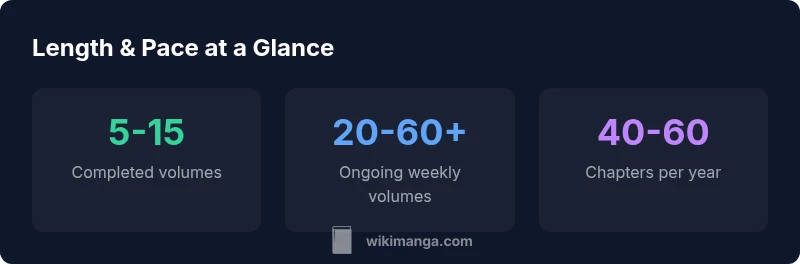
How long do manga last? There is no single answer. Manga series vary widely in length. Completed runs typically span about 5-15 volumes, while long-running titles can reach 20-60+ volumes over several years. Ongoing weekly series accumulate roughly 40-60 chapters per year, whereas monthly series produce around 6-12 chapters annually. Readers should plan based on their preferred pacing and genre expectations.
Understanding what lasting means for manga
When we ask how long do manga last, we are really asking about the longevity of a serialization, not the day-to-day page count. In practical terms, lasting refers to how many volumes and chapters a series spans before ending or becoming dormant. WikiManga. analysis emphasizes that readers should evaluate both the arc structure and the publication cadence to estimate total time investment. Shorter, self-contained stories might conclude in a single arc spanning 1-3 volumes, while ambitious epics unfold across multiple storylines and hundreds of chapters over many years. The key is to align your reading goals with the series’ designed pacing and pacing changes across arcs, since tempo shifts can alter cumulative reading time dramatically.
Serialization cadence shapes total length
Manga is serialized on different cadences, most notably weekly and monthly formats. Weekly titles often publish a new chapter every week, creating a dense year of content and contributing to a higher-volume total when aggregated. Monthly series are paced more slowly, with longer gaps between chapters and fewer volumes released per year. These cadences influence how quickly a series can accumulate volumes and how long a reader should expect to follow the story. Understanding cadence helps you set a realistic reading plan and avoid over-committing to an ongoing saga. WikiManga. Team highlights how editorial pacing and breaks can stretch or compress a series’ lifespan.
Length ranges by format: completed vs ongoing
Completed manga runs can be short or moderately long. A typical completed series might end after 5-15 volumes, delivering a complete narrative in a finite package. Ongoing weekly series tend to grow longer over time, commonly reaching 20-60+ volumes as years pass. Ongoing monthly series commonly accumulate 6-24+ volumes, depending on the release schedule and fan demand. These ranges reflect broad industry patterns rather than a fixed rule, and readers should expect divergence by genre and creator choices.
How chapters map to volumes and reading time
A single volume usually collects 8-12 chapters, though this varies by publisher and country. If a weekly series publishes 40-60 chapters per year, that could translate into roughly 3-6 volumes annually, assuming a standard volume-to-chapter ratio. For monthly titles, the conversion is slower, typically 6-12 chapters per year and a similar or smaller volume count. This mapping is essential for estimating total reading time, especially when selecting a long-running title to follow over multiple years.
Reading strategies for different lifespans
If you prefer tight, short reads, focus on completed series with 5-15 volumes and plan to finish within a few weeks to months. If long-form storytelling is your jam, build a longer-term reading plan around ongoing weekly titles or multi-year epics, using recaps and fan summaries to stay engaged during long gaps. Breaks in serialization are common and can significantly extend the overall duration of a long-running series. WikiManga. recommends tracking volumes read and setting milestones to avoid burnout.
Ending signals and predicting conclusions
Predicting when a series will end is not an exact science, but there are indicators. Official announcements of finales, the completion of major arcs, and the release of a final volume are strong signals. For ongoing titles, paying attention to author notes, editorial statements, and the pacing of story resolutions can help you anticipate an ending. While some series end abruptly, others gradually accelerate toward a planned conclusion. Familiarize yourself with typical arc structures to spot the writing on the wall.
Length and pace by manga type
| Length type | Typical range (volumes) | Serialization pace | Notes |
|---|---|---|---|
| Completed series | 5-15 | N/A | Shorter, self-contained arcs |
| Ongoing weekly | 20-60+ | Weekly (~1 chapter/week) | Long-running titles accumulate volumes over years |
| Ongoing monthly | 6-24+ | Monthly (~1 chapter/month) | Slower pace; multiple arcs possible |
Frequently Asked Questions
How long does a typical manga run usually last?
There is wide variation; most shorter completed series span about 5-15 volumes, while long-running titles reach 20-60+ volumes over years.
Most runs vary a lot—expect anywhere from a few volumes to many dozens.
What determines how long a manga lasts?
Editorial plans, popularity, sales, and pacing; genre conventions influence how long a title runs.
Sales and storytelling goals mostly decide how long a series stays published.
How many chapters are in a typical volume?
Vary by publisher; most volumes collect 8-12 chapters, with some shorter arcs.
Usually 8 to 12 chapters per volume.
Do webtoons or digital formats last longer?
Webtoons can be ongoing indefinitely; publication cadence and platform support determine the duration.
They often keep going as long as creators publish.
How can I tell when a series is approaching its end?
Look for official finale announcements, completed arcs, or the final volume's release.
Stay alert for clear finale signals.
Is it worth starting a long-running manga if I prefer shorter reads?
If you enjoy long arcs, yes; otherwise you can sample via recaps or shorter arcs.
It depends on your reading goals; recaps can help.
“Long-running manga can span years and hundreds of chapters, while shorter runs offer complete arcs in fewer volumes. Understanding serialization pace helps readers plan their reading lists effectively.”
Highlights
- Plan reading time by series type and pace.
- Expect completed runs to be shorter than long-running sagas.
- Weekly and monthly serialization pace differ significantly.
- Use volume counts to estimate total commitment.
- Check official announcements for endings in ongoing series.