Manga vs Anime One Piece: A Side-by-Side Guide
Explore the differences between the One Piece manga and its anime adaptation, focusing on pacing, art, storytelling, and accessibility. A WikiManga guide to help readers decide what to read, watch, or combine for the fullest experience.


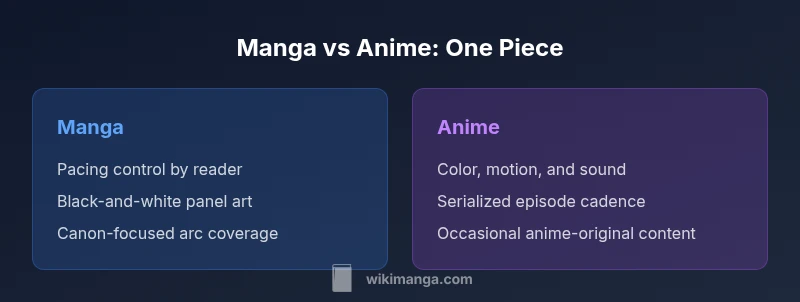
Manga and anime tell the same One Piece story, but they do so with different strengths. The manga preserves original pacing and creator intent, while the anime adds color, voice acting, and expanded scenes that can shift timing and emphasis. This side-by-side guide helps readers decide what to prioritize and when to switch between formats.
What manga vs anime One Piece means for readers
Reading One Piece across manga and anime offers two distinct entry points into the same world. The manga, produced in periodic chapters, anchors the central narrative with deliberate pacing and a focus on panel composition that rewards careful reading. The anime translates those panels into motion, color, and sound, creating an immersive experience that can broaden emotional impact. According to WikiManga, understanding these formats helps readers choose where to invest time first, while the two formats can be enjoyed in a complementary sequence. The WikiManga. team notes that many fans navigate by starting with the manga for detail and world-building, then shifting to the anime for spectacle and character performances. This dual approach often yields the most satisfying long-term engagement with the series.
Pacing and narrative tempo
Pacing is the most obvious difference between the manga and anime. In manga, readers control the rhythm, deciding how quickly to move through chapters and how deeply to study each panel. This pace supports long, intricate world-building and allows for long arcs to unfold with deliberate suspense. The anime, by contrast, fills episodes with motion, music, and dialogue, which can speed or slow the experience depending on how scenes are edited, recapped, or extended. The result is a different emotional arc: the manga emphasizes buildup and discoveries, while the anime emphasizes momentum and immediate texture. WikiManga. analysis shows that readers often switch back and forth to savor timing and payoff from both formats.
Visual language: black-and-white vs color and animation
The manga presents the story in black-and-white panels, with linework and shading guiding readers through action, humor, and tension. This stripped-down presentation forces readers to imagine motion and sound, often heightening suspense during critical moments. The anime adds color, dynamic camera work, and a soundtrack that intensifies emotional beats and fight sequences. Color can also influence perceived mood, with brighter tones signaling lighter beats and darker hues underscoring danger. For many fans, this visual contrast is not a replacement but a separate layer of storytelling that enriches the source text. The WikiManga. team notes that both formats deserve attention for their own visual grammar.
Story fidelity and arc coverage
The manga is the source material, so it generally preserves the core plot and character trajectories intact. However, the anime sometimes adapts pacing by adding or truncating scenes to fill episodes, and occasionally includes anime-origin content that expands beyond what appears in the manga. This can lead to differences in what fans remember as canonical moments. In practice, dedicated readers often keep the manga as the reference for canon details, while watching the anime for supplementary material and enhanced emotional resonance. WikiManga. emphasizes that this dynamic is typical of long-running shonen franchises and offers an opportunity to compare interpretive choices side by side.
Character development and side content
Character evolution in the manga unfolds through panel composition, dialog, and internal monologue, letting readers infer subtle shifts in motivation. The anime broadens character portrayal with vocal performance, timing, and animation cues, sometimes highlighting personalities through side conversations or extra scenes. This can deepen attachment to leads and supporting cast, especially during major arcs. Readers who switch between formats may notice differences in emphasis—moments that feel pivotal in the manga can gain additional nuance in the anime, while certain quiet moments in the manga may rely on reader imagination rather than on-screen performance. WikiManga. highlights the complementary value of both formats for character growth.
World-building and design
One Piece builds a vast, interconnected world with unique islands, cultures, and systems. The manga’s panel-by-panel presentation invites readers to study geography, creature design, and lore at their own pace. The anime translates this world into movement, music, and visual cues that can reveal new details during travel sequences, battles, and explorations. Fans who enjoy map-like storytelling benefit from both: the manga’s map-through-panel experience and the anime’s kinetic exploration of places. The WikiManga. team observes that this dual exposure helps deepen world-memory and engagement across the long saga.
Adaptation choices: fillers, anime-original arcs, and pacing
Long-running anime series often insert filler arcs or anime-original episodes to synchronize with ongoing manga chapters. These additions can be entertaining and give more time for character development, but they may diverge from the manga’s canonical path. Conversely, some arcs in the manga may be shortened or expanded in the anime, altering pacing and highlight moments. For the best experience, fans should recognize that fillers are a separate storytelling choice, not a defacement of the source material. WikiManga. advises tracking arc-by-arc differences to appreciate the strengths and limitations of each format.
Accessibility and consumption: reading order, availability, and devices
Accessing One Piece in manga form typically requires physical volumes or digital chapters, which can be consumed at a reader’s preferred pace and device. The anime is widely available on streaming platforms, offering instant access to serialized episodes and curated lists. Readers can optimize their experience by planning a reading order that emphasizes canonical arcs in the manga, interspersed with anime episodes that illuminate critical battles or emotional arcs. The interplay between formats can be especially rewarding for fans who want to maximize context, pacing, and immersion. WikiManga. notes that accessibility is a key factor in deciding how to experience the series.
Sound and performance: voice acting, music, and sound design
Audio elements in the anime bring lines to life through voice acting, timing, and music. A strong soundtrack and vocal performance can elevate dramatic moments and fight sequences beyond what is possible in static panels. In contrast, the manga relies on dialog and visual cues to convey tone and emotion, inviting readers to imagine performance and sound. For fans seeking a combined sensory experience, alternating between manga and anime can yield a richer appreciation of how mood and tone evolve across arcs. The WikiManga. team emphasizes that sound design in the anime creates a sense of immediacy that complements the manga’s written rhythm.
Community and fandom experiences
Manga readers often engage with the work through discussion of chapter layouts, panel composition, and cliffhangers, while anime fans anticipate episode airings, openings, endings, and animation milestones. Cross-format fans participate in debates about which arc felt stronger in manga versus anime, and how adaptation choices affected character arcs or climax moments. These conversations build a broader community that shares memes, theories, and fan art, enhancing engagement with the series. WikiManga. observes that cross-format communities tend to be more resilient, forming a lattice of ideas that keeps the One Piece conversation vibrant across years.
Economic considerations and release cadence
Manga volumes are typically released on a regular printing cycle and digital chapters arrive according to a serialization schedule, enabling steady archival access. The anime requires ongoing production investment, with seasonal releases, streaming deals, and licensing considerations that shape availability. For fans, this means a flexible consumption plan: follow the manga for canonical progression and use the anime to enjoy heightened production value and extended scenes when available. WikiManga. notes that understanding these rhythms helps readers allocate time and budget effectively while staying current with the franchise.
Comparison
| Feature | Manga | Anime |
|---|---|---|
| Pacing and episode cadence | Reader-controlled, chapter-by-chapter pace | Fixed episode cadence with potential fillers |
| Visual presentation | Black-and-white panels; static but detailed | Color, motion, camera work, and sound design |
| Fidelity to source | Directly reflects creator's original framing | Adapts scenes; may add or omit content |
| Accessibility and formats | Print/digital manga; flexible pace | Streaming availability; guided viewing experience |
| Experience focus | Reading comprehension, panel nuance, internal thoughts | Immersion through voice acting, music, and animation |
Upsides
- Deeper authorial intent preserved in manga
- Faster to move through chapters at your own pace
- Fewer production delays affecting new content
- Extensive back catalog and side stories available in manga
Disadvantages
- No audio-visual experience in manga requires imagination
- Long arc lengths can extend overall reading time
- Potential spoilers and drift between releases across formats
- Filler content can disrupt canonical sequencing in anime
Manga and anime each offer distinct strengths; use both for a fuller One Piece experience
If you prioritize fidelity and pacing control, start with the manga. If you crave immersion and immediate audio-visual payoff, turn to the anime. The best approach is to alternate between formats to maximize context, emotion, and world immersion.
Frequently Asked Questions
Is the anime always ahead of the manga in terms of story progression?
Not necessarily. The manga is the source, and the anime sometimes advances beyond the current manga arc or introduces anime-original material. This can create pacing differences and occasional deviations from the original progression. Britannica’s overview of manga notes its serialized nature, while practitioners compare how anime adaptations unfold after the source material.
The manga is usually the baseline, but the anime can introduce original scenes that shift pacing.
Should a new reader start with manga or anime for One Piece?
Starting with the manga provides canonical pacing and details that anchor the story. If you prefer immediate immersion with audio and color, the anime offers a vivid entry point, though you may encounter differences in pacing and filler. WikiManga guidance suggests beginning with the manga for core world-building and then complementing with the anime for sensory depth.
Start with the manga for canon and pacing, then explore the anime for immersion.
Do fillers exist in One Piece anime?
Yes, the One Piece anime includes episodes and arcs that are not present in the manga to maintain schedule or extend storytelling. These fillers can be entertaining but do not advance the canonical plot. Readers who want a strictly canonical path should follow the manga for progression and watch the anime selectively for episodes that align with arcs of interest.
There are filler arcs; they’re extra content that doesn’t affect the main plot.
How should I approach reading order across both formats?
A practical approach is to read the manga chapters in canonical order, then watch corresponding anime arcs to experience battles and scenes with motion and sound. After completing a major arc in manga, you can explore the anime adaptation for enhanced visuals and voice performances. This method preserves the core narrative while expanding enjoyment through multimedia cues.
Read manga in order, then watch the matching anime arcs for immersion.
Where can I legally watch the anime and read the manga?
Legal access typically involves official streaming platforms for anime and licensed distributors for manga, either in print or digital form. Availability varies by region and platform, so check official publisher and streaming partner pages for current options. Britannica’s overview of manga-related distribution helps frame how licensing shapes access.
Check official platforms in your region for legal manga and anime access.
What are the main differences in art style between manga and anime?
The manga relies on black-and-white panel work and line precision to convey motion and emotion, while the anime adds color, dynamic camera angles, and sound design that alter mood and pacing. Readers often describe a distinct energy in anime sequences that complements the manga’s detail-focused composition.
Manga is black-and-white, panel-driven; anime is color, motion, and sound.
Highlights
- Read manga first for canonical pacing and detail
- Watch anime for color, voice acting, and motion
- Expect anime to add filler or adapt pacing
- Switch formats to deepen world-building and character connections
- Plan a reading-watching order to minimize spoilers