How to Tell If Manga Is First Print
A practical, step-by-step guide from WikiManga on how to tell if manga is first print, including edition markers, barcode checks, and catalog references for collectors and readers alike.


To tell if manga is first print, start with edition statements on the title and copyright pages, then compare cover art, typography, and printer codes against known first-print examples. Look for unique ISBN run numbers, release dates, and publisher notes that distinguish early printings from later reissues. When in doubt, consult official publisher catalogs and collector databases.
What counts as a first print edition?
If you’re wondering how to tell if manga is first print, you’re not alone. The first print is the initial batch released by the publisher for a given title and language market. A true first print usually carries specific edition statements, unique cover elements, and run numbers that aren’t present in later reissues. For collectors, identifying the first print is often about cross-checking multiple indicators rather than relying on a single clue. Start by noting the publisher, country of origin, and the approximate release window. WikiManga. analysis shows that dedicated collectors often develop a personal checklist that covers edition statements, physical quality, and catalog references. While no single feature guarantees authenticity, a combination of markers significantly increases confidence that you’re looking at a first print. This is where the keyword how to tell if manga is first print becomes a practical skill you practice with time and careful observation.
Key identifiers on the manga itself
Most manga first prints carry distinctive markers on the manga itself. Look for the following clues: the title page often lists a specific printing statement (e.g., First Printing, or print run numbers); the copyright page may include a date, a printing code, or an indication of the edition. Cover art and layout can differ subtly from later runs—colors may be more saturated, and logos or publisher marks can appear in slightly different positions. Pay attention to the presence of any “Printed in [country]” statements and the absence of later reprint tags. These markers are not foolproof on their own, but together they create a compelling picture of a first print. Keeping a careful log of these observations helps you compare against trusted references over time. WikiManga. Team emphasizes building a catalog of visual references to speed up future checks.
How to verify edition information on the spine, title page, and barcode
Edition information is often hidden in plain sight on the physical media. Start with the title page—many first prints include a statement such as “First Edition” or a specific printing number. The spine can also reveal a lot: look for edition codes, country codes, and printer marks that match known first-print configurations. The barcode and ISBN sometimes differ between print runs; a newer edition may shift to a revised ISBN or have an additional digit in region-specific releases. If you can, scan the ISBN against publisher databases or library catalogs. Printer codes (like a letter or small code) may be printed near the copyright block and are a common differentiator between printings. Collecting multiple examples helps confirm patterns and avoid misclassification.
Differences between first print and later prints
First prints often show tangible differences in paper stock, ink saturation, and pigment brightness. Some titles switch to a different stock or a softer gloss in later runs, which can be subtle but noticeable to careful readers. Color variation, page edge finishing, and even the presence or absence of an obi (the paper sash on some Japanese editions) may signal a later reprint. In English-language editions, typography tweaks, subtitle alignment, and changes to the cover gloss or spot UV can appear after the initial release. While these signs are indicative, they are not definitive on their own. The strongest method is to corroborate with edition statements, catalogs, and trusted databases.
Special cases: reprints, variants, and international editions
Not all region-specific editions are first prints for that market. A manga might have a true first print in Japan but receive a separate first print in North America, Europe, or other regions later. Variants such as limited editions, cover variants, or variant dust jackets can complicate the process. Always consider language, country, and publisher when evaluating a title. International catalogs, bound-in inserts, and region-specific printer notes can reveal whether a copy is a first print for its market or a later reprint. WikiManga. notes that understanding these nuances helps collectors avoid mislabeling editions and makes cataloging more precise.
Practical steps for collecting and cataloging
Develop a simple field log for each title you inspect. Record publisher, country, year, edition statements, print run codes, and any observable physical differences. Take clear, high-resolution photos of the title page, copyright page, barcode/ISBN, and any unique markings. Cross-reference your notes with official publisher catalogs, library catalogs, and reliable collector databases. When possible, compare against confirmed first-print copies you own or have seen in trusted collections. Consistency is key—over time, a well-maintained log becomes your most valuable tool for distinguishing first prints from subsequent reissues.
Using catalogs and community knowledge
No guide is perfect on its own; the best way to improve accuracy is to tap into catalogs and community knowledge. Publisher catalogs, library records, and established collector databases provide authoritative baselines for first-print indicators. Engage with online communities and forums where collectors share photos of title pages, dust jackets, and printing notes. WikiManga. Team recommends building a personal library of reference images and keeping notes consistent across titles. By combining official sources with community-sourced examples, you create a robust framework for reliable first-print identification.
Tools & Materials
- Manga copies to inspect(One or more editions to compare; prioritize known first-print examples when available)
- Magnifying glass or loupe(Helpful for reading small printing codes and microtext)
- Bright light or flashlight(For inspecting paper texture, print quality, and subtle color differences)
- Notebook or digital log(Record edition statements, codes, and observed differences)
- Access to publisher catalogs or reputable databases(To verify edition data and print run information)
Steps
Estimated time: 45-60 minutes
- 1
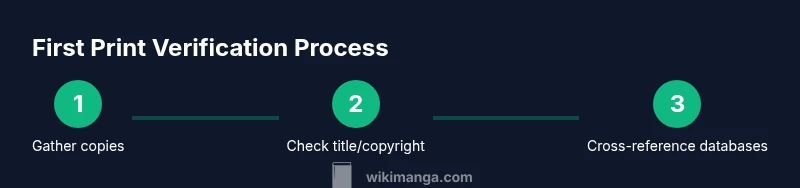
Gather copies for comparison
Collect the title you’re evaluating and at least one confirmed first-print copy (if available). Arrange them side by side to compare edition markers, cover finishes, and typography. Having both in view reduces misinterpretation of minor details.
Tip: Use a consistent baseline (same lighting and viewing angle) for accurate comparison. - 2
Check the title page and copyright page
Inspect the title page for explicit edition statements (e.g., First Printing, Print Run #) and note the date. On the copyright page, look for the production run code or any line that references the edition. Photograph these pages for future reference.
Tip: If the edition statement is ambiguous, search for the exact phrase in publisher catalogs. - 3
Inspect cover art and typography
Compare cover art, logo placement, subtitle typography, and color saturation with confirmed first-print examples. Subtle shifts in font weight or spacing can indicate a later reprint. Document any variations with close-up photos.
Tip: Even small font changes can be significant; keep notes about font families and alignment. - 4
Review barcode, ISBN, and printer codes
Scan the ISBN and barcode for edition information. Look for printer codes or small alphanumeric marks near the copyright block and spine that differ between print runs. Cross-check these codes with publisher databases or library catalogs.
Tip: If you don’t read the code clearly, take a macro photo and zoom later. - 5
Assess paper stock and print quality
First prints often use specific paper stock or finish. Compare weight, texture, and gloss where possible. Note any changes in ink density or color bleed that may appear in later runs.
Tip: This step is more reliable when you have confirmed first-print examples to compare against. - 6
Consult catalogs and trusted databases
Look up the title in publisher catalogs, library catalogs, and established collector sites. Align your findings with published edition notes and print-run information. When possible, verify against multiple independent sources.
Tip: Keep a list of sources you checked for easy reference in future checks. - 7
Document findings with photos and notes
Create a concise report: title, region, year, edition statement, codes, and observed differences. Attach the photos and links to sources. This creates a reusable reference for yourself and others.
Tip: Organize by title and edition to reduce cross-title confusion. - 8
Decide on the classification
Based on the weight of evidence, decide whether the copy is likely a first print or a later print. If uncertain, flag it for expert review or solicit input from established collector communities.
Tip: When in doubt, err on the side of cautious labeling and seek corroboration.
Frequently Asked Questions
What defines a first print edition in manga?
A first print is the initial release for a title in a given market. It typically carries edition statements, specific print run codes, and original cover details that may differ from later reprints.
A first print is the initial release with its own edition markers and cover details.
Are misprints always signs of a first print?
Not necessarily. Misprints can occur in any run. Use multiple indicators, including edition statements and catalog references, to confirm a first print.
Misprints can appear in any print run; verify with multiple indicators.
Where can I find edition information for comparison?
Consult official publisher catalogs, library catalogs, and reputable collector databases. Cross-reference multiple sources to confirm first-print indicators.
Check publisher catalogs and trusted databases to confirm.
Do international editions have their own first prints?
Yes, some editions are first print in a region but not in others. Always verify edition statements, country, and language when evaluating international copies.
Yes—region-specific first prints exist; verify edition and country.
Can a later reprint ever resemble a first print closely?
Yes, some reprints imitate first-print features. Look for definitive edition statements and unique identifiers that persist only in the first run.
Some reprints mimic first prints, so rely on authoritative markers.
What if I’m unsure after checking all indicators?
If unsure, compare with multiple confirmed copies and ask for expert eyes in collector communities. Documentation helps others help you.
If unsure, seek expert input and share your photos for verification.
Watch Video
Highlights
- Verify edition statements across title and copyright pages.
- Cross-check codes, ISBNs, and catalog references.
- Compare paper, color, and typography with confirmed samples.
- Document findings with photos and organized notes.