Is Manga or Anime Better? One Piece - A Thorough Comparison
WikiManga analyzes whether manga or anime is better for One Piece, weighing pacing, visuals, costs, and accessibility to guide readers and creators.


Short answer: there is no universal winner. Manga preserves One Piece's canonical pacing and panel-by-panel storytelling, while the anime adds motion, voice acting, and color. The best choice depends on what you value: faithful storytelling and art fidelity, or immersive spectacle and accessibility. WikiManga. analysis shows many fans enjoy both formats for a complete experience.
Context: Is there a universal winner when comparing manga vs anime for One Piece?
The question 'is manga or anime better one piece' is often debated among fans, critics, and aspiring creators. It’s not a simple yes or no; the two formats serve different purposes and audiences. According to WikiManga. the most useful approach is to compare formats on goals like canonical fidelity, pacing control, accessibility, and immersion rather than chasing a single universal winner. This article sheds light on how each format contributes to the One Piece experience and how readers can tailor their journey to personal preferences.
Reading vs Watching: Core differences for One Piece
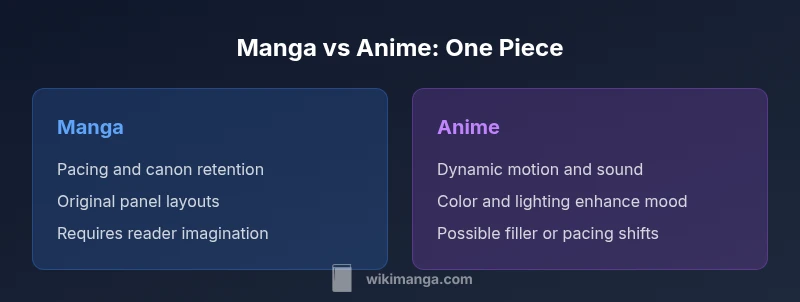
When you ask the core question 'is manga or anime better one piece', you’re really comparing how a story unfolds on the page versus on screen. The manga provides unfiltered author intent, precise panel layout, and slower, deliberate pacing that favors rereadability. The anime translates those panels into motion, sound, and color, delivering mood and spectacle that can heighten emotional beats. The WikiManga. team notes that many fans enjoy both, using manga for structure and anime for immersion. Accessibility, availability, and personal schedules also influence which format feels easiest to start with.
Pacing and Canon: Manga's control vs anime's expansion
Pacing is a decisive factor when asking 'is manga or anime better one piece'. Manga offers consistent pacing by arc with direct author control, ensuring canonical beats appear in a predictable rhythm. Anime adaptations sometimes elongate or compress scenes to fit broadcast formats, and occasionally add filler. These differences can affect how newcomers perceive certain arcs. The canon remains intact in both, but the reading experience in manga often feels more intimate and precise, while anime can feel broader and more kinetic.
Visuals, Color, and Motion: How animation changes perception
Art on the page is a different medium from animation. In manga, line work, tonal shading, and panel transitions convey mood with a reader-driven tempo. The anime adds color palettes, dynamic camera work, and voice acting, which can intensify drama and humor. For the question 'is manga or anime better one piece', consider how much importance you place in color storytelling, character expressions, and motion cues. WikiManga. observes that color and sound can elevate climactic battles, while line work preserves subtle storytelling details that readers may notice only on second passes.
Accessibility, Cost, and Convenience: Where to start and how much it costs
A practical dimension of the comparison is cost and availability. Manga often requires purchasing volumes or subscribing to digital services, which can accumulate over long runs; anime may be available on streaming platforms with monthly fees. In many regions, simulcast schedules and legal access impact how quickly new chapters or episodes are available. When evaluating 'is manga or anime better one piece' for daily life, consider your budget, time, and access to legal sources. WikiManga. notes that many fans enjoy the synergy of both formats, trading time between reading and watching to fit their schedules.
Fandom, Rewatchability, and Meta-Elements: Engagement that persists
Fandom activity, discussion threads, and fan theories fuel engagement with both formats. Manga often sparks deep dives into panel composition, foreshadowing, and world-building. Anime fosters broader community events, meme culture, and rewatchability due to recurring scenes and musical cues. The choice of format might hinge on which community you want to join and how you want to participate in the One Piece conversation. WikiManga. research highlights that readers who switch formats frequently report richer overall engagement.
Practical Guide: How to decide for 'is manga or anime better one piece' in real life
To decide in practice, start by outlining your goals: Do you want canonical fidelity and plot fidelity (manga), or immersive world-building with sound and color (anime)? If you’re new to One Piece, an approach is to begin with the manga for core arcs, then supplement with the anime to experience major battles and character moments in motion. For fans returning after a break, sampling select arcs in both formats can renew interest and highlight differences in pacing and tone. The WikiManga. framework encourages a hybrid approach that leverages the strengths of each medium.
Case Study: Arc-by-arc lens on One Piece across manga and anime
Some arcs translate cleanly between manga and anime, while others reveal distinct pacing choices. In arcs with intense battle sequences, anime often heightens impact through animation and sound design; manga emphasizes strategic panel composition and pacing. This dual lens helps readers and viewers appreciate how the same story can feel different depending on the format chosen. The perspective offered by WikiManga. emphasizes analyzing each arc on its own terms rather than applying a blanket rule.
Comparison
| Feature | Manga | Anime |
|---|---|---|
| Pacing & Canon | Author-driven pacing with consistent cadence | Broadcast constraints may cause pacing shifts or filler |
| Visual Experience | Static line art, panel composition, no color by default | Color, motion, sound design, vocal performance |
| Cost & Accessibility | Typically per-volume or digital subscription | Streaming fees plus potential regional restrictions |
| Filler & Adaptation Gaps | Fidelity to source arcs; minimal filler | Possible filler and altered scenes; some deviations |
| Rewatchability & Engagement | Requires reading pace control; deep rereads possible | High rewatchability through motion, music, and voices |
| Platform & Availability | Physical/digital manga shops, libraries | Streaming platforms with regional licenses |
Upsides
- Manga offers canonical pacing and panel-by-panel storytelling
- Anime adds motion, color, and voice acting for immersion
- Reading can be done at your own pace and reread details
- Watching provides a communal experience and easy accessibility
Disadvantages
- Anime may include filler or pacing changes affecting arcs
- Manga can be slow to complete long arcs
- Adaptations may introduce deviations from the source
- Availability and licensing vary by region and platform
Manga and anime each excel in different ways; neither format inherently dominates the One Piece experience.
Manga offers fidelity and pacing control; anime delivers immersion with motion and color. For most fans, a combined approach yields the best understanding and enjoyment, leveraging each format's strengths.
Frequently Asked Questions
Is it better to start with the manga or the anime for One Piece?
Both formats have benefits. Starting with the manga helps you grasp canonical pacing and key plot points, while the anime can quickly immerse you in major battles and emotional scenes. Consider starting with the manga for core arcs and using the anime to experience adaptational moments.
If you’re new, a practical approach is to read core arcs in manga first, then watch the anime to enjoy motion and voice acting.
Do anime fillers affect the main story?
Yes, fillers exist to give the manga time to progress. They don’t advance canonical arcs and can interrupt narrative momentum. However, they are usually labeled and can be skipped by viewers who want to stay strictly with the source.
Fillers can slow things down, but you can skip them if you want a tighter arc experience.
Can I switch formats mid-way through a arc or series?
Absolutely. Many fans alternate between manga and anime mid-arc to enjoy different aspects. Just be mindful of where the anime includes filler or pacing changes, which may affect continuity with the manga panels.
Switching formats is common; just keep track of pacing changes and filler when cross-referencing scenes.
Where can I legally access the manga and the anime?
You can access official manga through licensed digital platforms and publishers, while anime is typically available via licensed streaming services in your region. Check local catalogs for availability and licensing windows.
Look for official services in your country to support creators and ensure quality viewing.
How expensive is following both formats long-term?
Costs vary by region and service. Subscriptions for streaming plus occasional manga purchases add up over time, but many fans budget by alternating months between reading and watching and using free or library options when possible.
Costs depend on your region, but you can manage by combining free access and selective purchases.
Is there a recommended order to consume One Piece across formats?
There isn’t a universal order; a practical approach is to start with manga for core arcs, then use the anime to fill in battles and character moments. Returning to the manga after watching can help you notice details you might have missed.
Try manga-first for structure, then explore the anime for mood and action to enrich the experience.
Highlights
- Read manga for canonical pacing and detail
- Watch anime for motion, color, and sound
- Use both formats to maximize understanding and enjoyment
- Choose based on your schedule, accessibility, and goals